
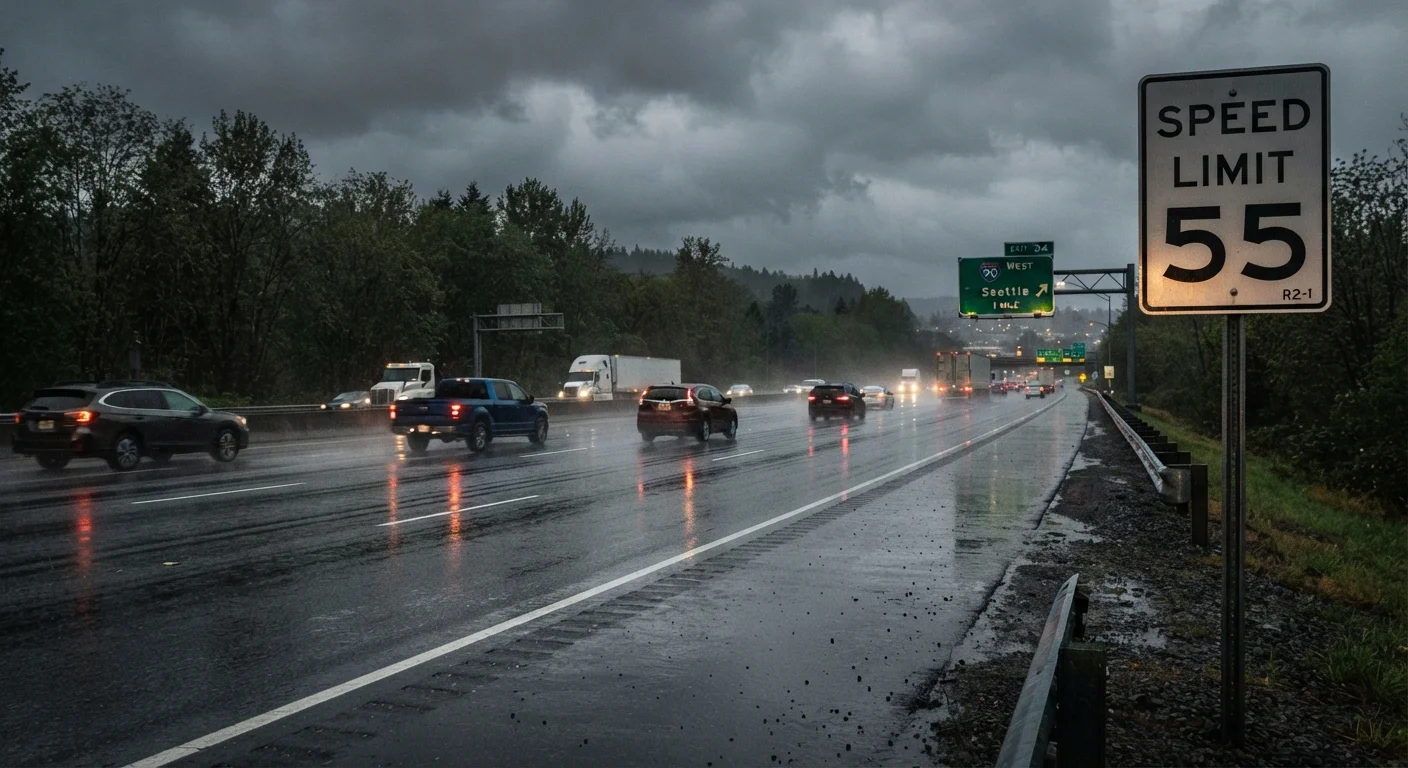
What Posted Speed Limits Actually Mean
Speed limit signs are among the most familiar fixtures on American roads, but many drivers misread what they legally communicate. A posted speed limit is an absolute maximum - the highest speed permitted by law under ideal conditions. It is not a suggested cruising speed, and it is not a guarantee that traveling at that speed is safe at any given moment.
Speed limits are established through a process that considers road geometry, sight distance, traffic volume, and typical weather patterns for a given area. Engineers generally use what is known as the 85th-percentile speed - the speed at or below which 85 percent of free-flowing traffic travels - as a guiding benchmark. But that methodology assumes clear, dry pavement and normal visibility. When conditions change, the posted number on the sign does not.
For a broader look at what different road signs are communicating, see our driver's reference on road sign meanings.
The Basic Speed Law: What It Is and Why It Matters
Every U.S. state has some form of the Basic Speed Law written into its traffic statutes. The principle is straightforward: a driver must travel at a speed that is reasonable and prudent given actual conditions at the time of travel. Those conditions include weather, visibility, traffic density, road surface condition, and any hazards present.
This matters for two important reasons. First, it means you can be cited for speeding even if you are driving under the posted limit - if a reasonable officer concludes the conditions demanded a slower speed. Second, it shifts responsibility back to the driver. You are not protected from legal consequences simply because you chose a number equal to or below what the sign says.
~70%
Of fatal crashes involving speeding occur below the posted limit
According to NHTSA research, a significant portion of speed-related fatal crashes occur at speeds at or below posted limits, illustrating that posted numbers alone do not define safe travel speed.
4x
Increase in stopping distance on wet vs. dry pavement
Traffic safety research consistently shows that wet road surfaces can increase braking distances by up to four times compared to dry conditions, depending on tire condition and vehicle speed.
The Basic Speed Law is a recognition that no posted sign can account for every real-world scenario. A 65 mph interstate limit was set with dry pavement and adequate daylight in mind. Those assumptions evaporate in dense fog or black ice. When they do, you - not the sign - are responsible for choosing an appropriate speed.
Understanding stopping distance is essential here. The physics of stopping distance show that speed has a compounding effect on how far a vehicle travels before coming to a full stop - a detail that makes the Basic Speed Law especially consequential at highway speeds.
Conditions That Require Slowing Down
Knowing when to reduce speed is as important as knowing the posted limit. Drivers should actively consider slowing below the maximum in any of the following situations:
- Precipitation: Rain reduces tire traction and increases stopping distances significantly. Snow and ice compound the effect dramatically.
- Reduced visibility: Fog, heavy rain, smoke, or nighttime driving on unlit roads all shrink the margin of time you have to react.
- Road construction zones: Narrowed lanes, uneven pavement, and unexpected worker presence demand greater caution even at posted work-zone speeds.
- Heavy traffic: Dense stop-and-go conditions require a following distance and speed that allow adequate reaction time.
- Sharp curves or hills: Posted advisory speeds on curves (yellow warning signs) are separate from speed limit signs and indicate a safe speed for that specific geometry.
- Vehicle load: Towing a trailer or carrying significant cargo changes your vehicle's stopping and handling behavior.
For a detailed breakdown of how to adapt your driving in low-visibility conditions, see our guide to driving in rain, fog, and snow.
Speed, Following Distance, and the Full Picture of Safe Travel
Speed does not operate in isolation. It interacts directly with following distance, reaction time, and your vehicle's mechanical capabilities. Drivers who understand the Basic Speed Law should also be thinking about the gap between their vehicle and the one ahead - because both speed and spacing determine whether you can stop in time when something unexpected happens.
Most drivers maintain a following distance that is too short for the speed they are traveling, particularly on highways. The combination of traveling near the posted maximum and maintaining an inadequate gap leaves no margin for error.
Similarly, the risk profile changes significantly depending on the type of road. Highway and city driving present distinctly different hazards, and a speed that feels manageable in one environment may be genuinely dangerous in the other. Treating the posted limit as the floor - rather than the ceiling - is one of the most common and consequential misunderstandings among everyday drivers.
The takeaway is simple: posted speed limits define the legal boundary, but safe driving requires continuously reading the road and adjusting accordingly. That judgment call is yours to make every time you get behind the wheel.