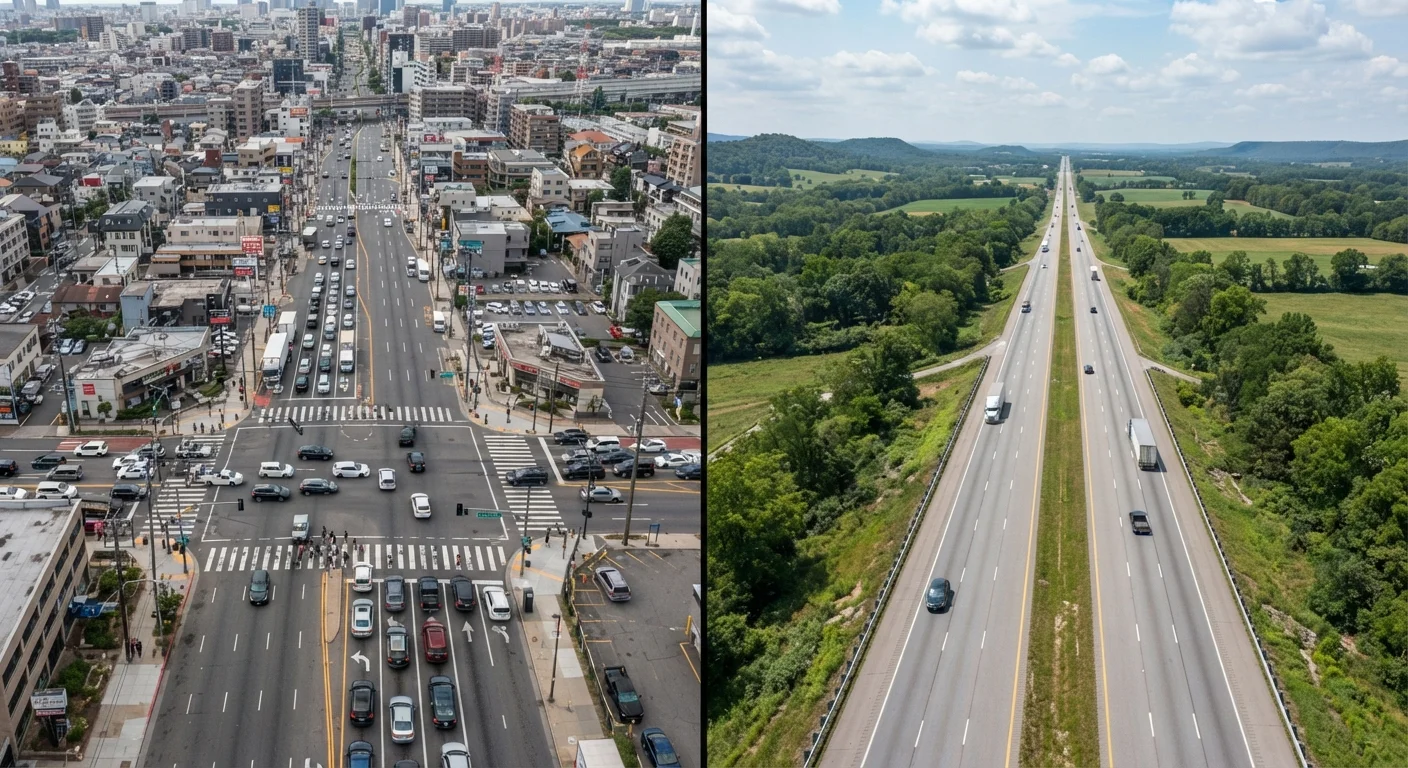
Two Very Different Risk Landscapes
Most drivers treat highway and city driving as opposite ends of a speed spectrum. In reality, they represent fundamentally different risk environments - each demanding a distinct mental model. Understanding how the dangers diverge is the first step toward managing them effectively.
Highway crashes account for a disproportionate share of traffic fatalities in the U.S. The National Highway Traffic Safety Administration (NHTSA) consistently finds that rural and interstate roads - where speeds are highest - produce far more fatal outcomes per crash than urban streets. But urban roads generate far more crashes overall. The distinction matters: city driving is more collision-prone; highway driving is more lethal when things go wrong.
For a broader foundation on staying safe across all road types, see our complete safe driving overview.
| Criterion | Highway Driving | City Driving |
|---|---|---|
| Typical speed range | 55-80 mph | 15-45 mph |
| Crash frequency | Lower overall | Higher overall |
| Fatal crash likelihood | Higher per crash | Lower per crash |
| Primary hazard type | Speed, fatigue, tailgating | Intersections, pedestrians, cyclists |
| Decision frequency | Low - sustained attention | Very high - constant scanning |
| Fatigue risk | High on long stretches | Lower, but stress fatigue possible |
| Impact of distraction | Severe - high closing speeds | Severe - fast-changing hazards |
What Makes Highways Dangerous
Speed is the defining variable on highways. At 70 mph, a vehicle travels roughly 103 feet per second. A one-second distraction - enough to glance at a notification - covers the length of a ten-story building before your eyes return to the road.
The primary highway hazards include:
- Tailgating: Following too closely eliminates stopping distance at speeds where physics offers little forgiveness.
- Improper lane changes: Merging without adequate mirror checks or signaling is a leading cause of sideswipe and run-off-road crashes.
- Fatigue: Long stretches of monotonous road suppress alertness. Highway hypnosis - a real phenomenon where drivers operate on autopilot - is more likely at sustained high speeds.
- High-speed blowouts: Tire failures at highway speeds can cause rapid loss of vehicle control with very little recovery time.
Distraction plays a role here too. Research on hands-free vs. handheld devices shows that cognitive distraction persists even when your hands are on the wheel - a concern at any speed, but especially consequential at 65 mph or above.
What Makes City Driving Dangerous
Urban environments compress decision-making. Within a single city block, a driver may encounter a pedestrian stepping off the curb, a cyclist on the right, a delivery truck double-parked ahead, and a traffic light cycling to yellow - simultaneously.
Key urban risk factors include:
- Intersections: The majority of urban crashes occur at or near intersections. Red-light running and failure to yield are consistent culprits.
- Pedestrians and cyclists: Cities concentrate vulnerable road users. Their unpredictability requires constant 360-degree scanning.
- Stop-and-go traffic: Rear-end collisions spike in dense stop-and-go conditions, often linked to distraction or following too closely at low speed.
- Limited sight lines: Parked vehicles, narrow lanes, and visual clutter reduce how far ahead a driver can see and plan.
New drivers often find city driving the steeper challenge. Our article on situations new drivers find hardest breaks down the specific scenarios - like navigating busy intersections and parallel parking - that require deliberate practice.
Speed Doesn't Always Equal Danger
It may seem counterintuitive, but low-speed urban crashes cause the majority of insurance claims and non-fatal injuries in the U.S. The assumption that slower traffic is inherently safer can lead drivers to lower their guard precisely where sustained vigilance matters most. Both environments deserve full attention - just for different reasons.
Adapting Your Driving Mindset for Each Environment
The skills that keep you safe on a highway are not identical to those that protect you in a city - though they share a common foundation: proactive hazard awareness rather than reactive response.
On highways, prioritize:
- Maintaining a following distance of at least three to four seconds (more in poor conditions).
- Checking mirrors before any lane change and using signals early.
- Taking breaks every two hours on long trips to counter fatigue.
- Adjusting speed proactively in rain, fog, or reduced visibility - see our guide on driving in adverse weather conditions.
In cities, prioritize:
- Scanning intersections before entering, even on a green light.
- Anticipating door openings from parked vehicles when passing.
- Keeping speed low enough to stop within your visible range.
- Reducing phone interaction entirely - urban hazards emerge too quickly for any divided attention.
Both environments reward the same underlying habit: looking further ahead than feels immediately necessary. The principles of defensive driving - reading road conditions, identifying escape routes, and anticipating other drivers' behavior - apply in equal measure to a freeway merge and a downtown intersection.