Why Reduced Visibility Changes Everything
Visibility is the foundation of safe driving. It determines how early you spot a hazard, how much time you have to react, and how confidently you can navigate the road ahead. When rain, fog, or snow shrinks your sight lines, the entire safety equation shifts - and the adjustments you need to make go well beyond simply slowing down.
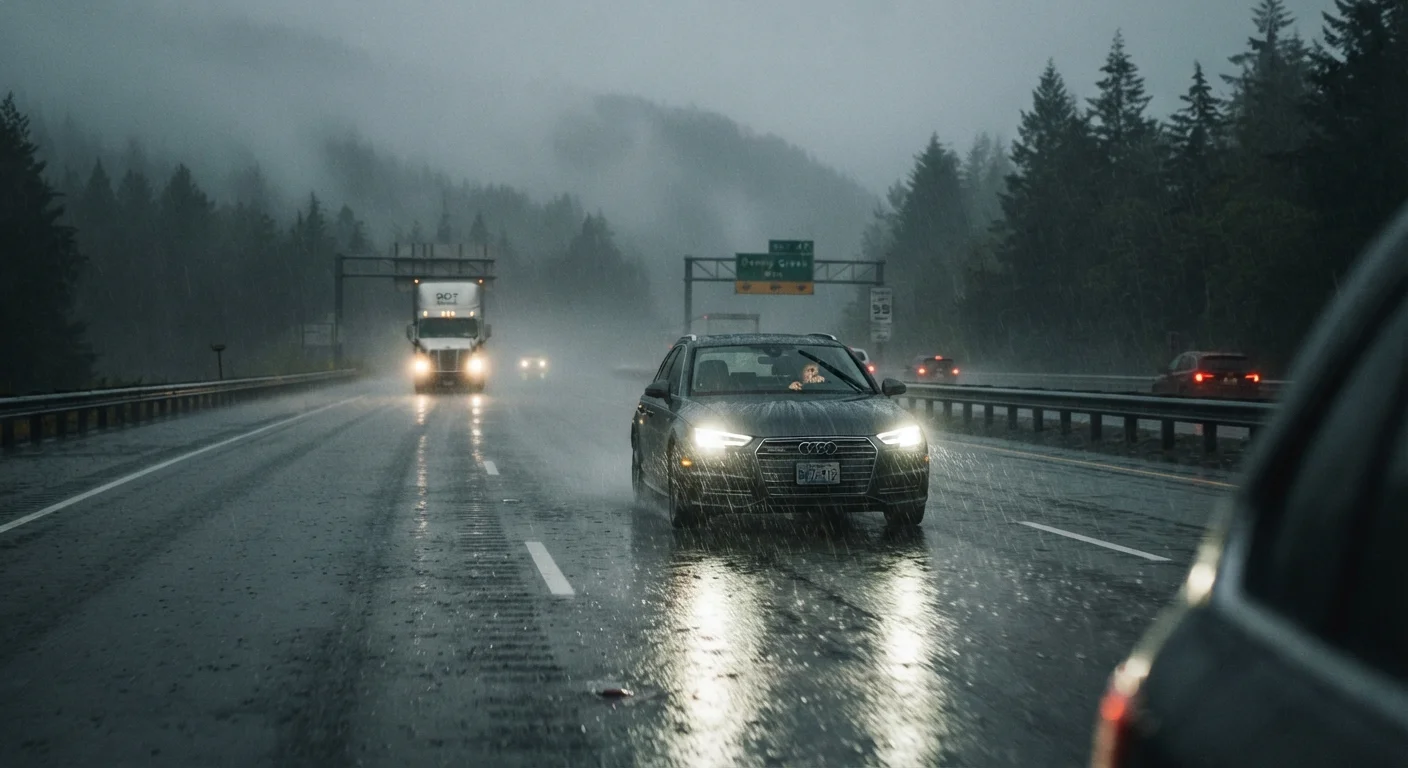
Rain doesn't just obscure vision. It reduces tire grip, causes road spray from other vehicles, and can lead to hydroplaning - where tires ride on a film of water rather than the road surface. Fog creates a deceptive calm while cutting visibility to just a few car lengths. Snow combines slippery surfaces with the visual noise of falling flakes, making depth perception and road edge detection genuinely difficult.
Understanding these conditions as distinct challenges - not just variations of the same problem - helps you apply the right techniques. This is a core element of defensive driving, which trains drivers to anticipate hazards rather than simply react to them.
Never Use High Beams in Fog
In foggy conditions, high beams reflect off water droplets and scatter light back toward you, making visibility worse - not better. Always use low beams or dedicated fog lights when driving in fog. This is one of the most common and consequential mistakes drivers make in reduced-visibility conditions.
Step-by-Step: Adjusting Your Driving for the Conditions
The steps below apply broadly across rain, fog, and snow - with condition-specific notes where technique differs. Before you begin, confirm your vehicle's wipers, lights, and tires are in serviceable condition.
What you will need
Reduce your speed deliberately
Speed limits are set for ideal, dry conditions. In rain, fog, or snow, your stopping distance increases dramatically while your ability to see hazards shrinks. Reduce your speed well below the posted limit - the worse the conditions, the greater the reduction. In heavy snow or dense fog, driving 20-30 mph below the limit may still be too fast.
Slow down smoothly rather than braking abruptly; sudden braking increases skid risk on slippery surfaces.
Select the right lights for the condition
Each weather type calls for a different lighting strategy:
- Rain: Turn on your headlights (low beams). Many states legally require it whenever wipers are running. Headlights help other drivers see you, not just help you see ahead.
- Fog: Use low beams or front fog lights. High beams bounce off fog particles and reduce your own visibility.
- Snow: Low beams again. In heavy snowfall, fog lights can help cut through precipitation closer to the road surface.
Hazard lights are not a substitute for headlights in moving traffic and are illegal to use while driving in some states - check your local law.
Increase your following distance significantly
The standard three-second following distance is calibrated for dry roads. In wet conditions, double it to six seconds minimum. In snow or ice, many safety experts recommend eight to ten seconds or more. Greater distance gives you the reaction time and stopping room that slippery roads demand.
Count from when the vehicle ahead passes a fixed point to when your front bumper reaches the same point. If you close that gap too quickly, you're following too closely.
Steer and brake with smooth, deliberate inputs
Harsh steering, sudden braking, and aggressive acceleration all destabilize a vehicle on low-traction surfaces. Instead, apply inputs gradually. Brake early and gently, then ease off to avoid wheel lock. If your vehicle has ABS (anti-lock braking system), apply firm, steady pressure and let the system modulate - don't pump the pedal.
In a skid, ease off the gas, steer in the direction you want the front of the car to go, and avoid overcorrecting.
Know when to pull over and wait it out
There is a threshold beyond which even careful driving carries unacceptable risk. If visibility drops to near zero in blizzard whiteout conditions, if rain is so heavy your wipers can't keep pace, or if you feel your vehicle is not responding predictably, pull off the road completely.
Choose a parking lot, rest area, or a safe shoulder well away from travel lanes. Turn on your hazard lights and remain in the vehicle with your seatbelt fastened. Resuming the trip when conditions improve is always the safer choice.
Prepare Your Vehicle Before the Season
Worn wiper blades, underinflated tires, and foggy interior windows compound every visibility hazard. Check your tires, replace worn blades, and confirm your defroster works before cold or wet weather arrives. Visit our car maintenance hub for a full seasonal readiness checklist.
Low-visibility driving shares some characteristics with nighttime driving, where limited sight lines require the same careful management of speed, distance, and lighting. And if you regularly drive both city streets and highways, it's worth understanding how highway and city risk profiles differ under these conditions - highway speeds amplify the consequences of every visibility-related error.