
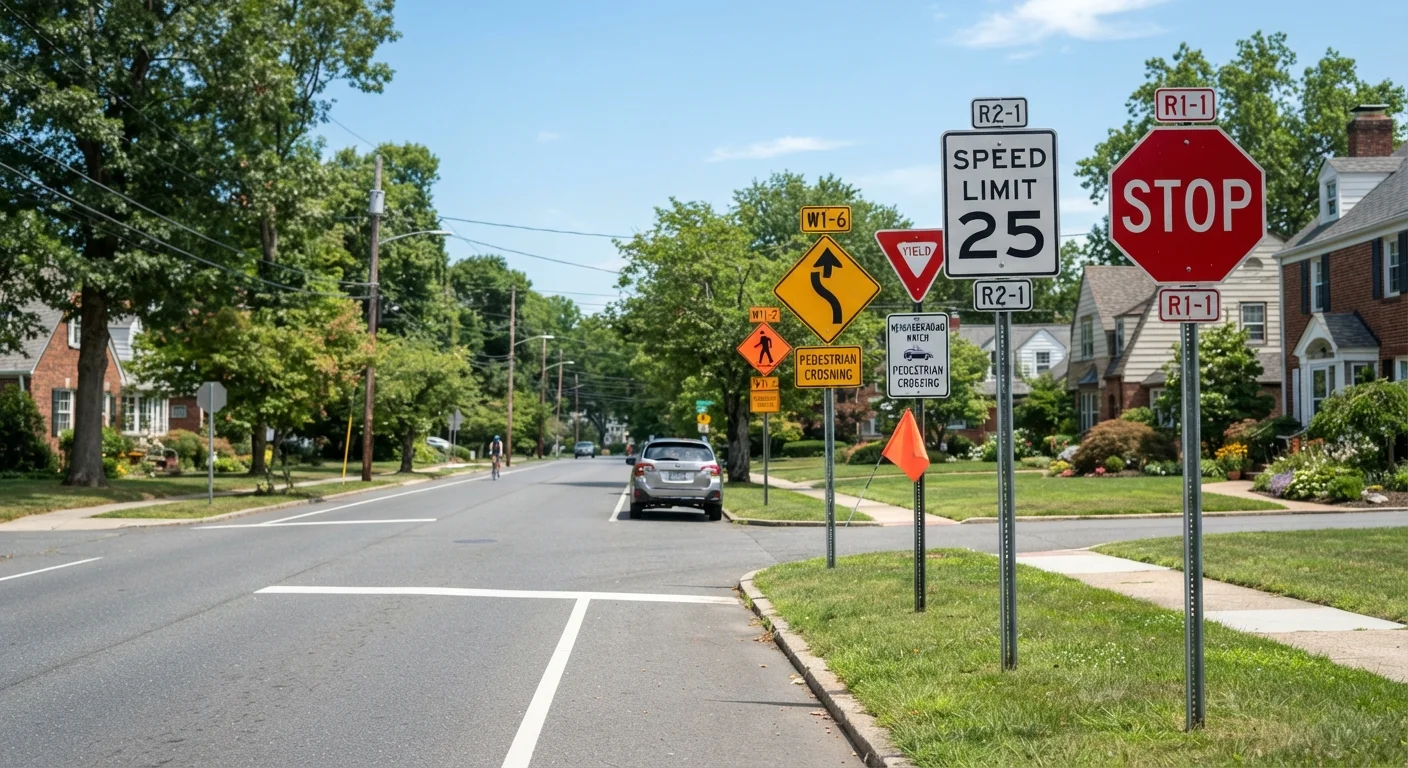
The Three Categories Every Driver Should Know
U.S. road signs are organized into three functional categories by the MUTCD, the federal standard that governs traffic control devices across all 50 states. Knowing which category a sign belongs to tells you immediately what kind of response it requires.
Regulatory signs communicate laws you must follow. Running a stop sign or ignoring a one-way marker isn't a judgment call - it's a traffic violation. Warning signs alert you to changing road conditions, hazards, or geometry ahead, giving you time to adjust speed and attention before reaching the situation. Guide signs provide directional and informational support: route numbers, distances, services, and destinations.
Color and shape do a lot of the communication work. Red is reserved for regulatory signs requiring a stop or prohibition. Yellow and fluorescent yellow-green signal warnings. Green indicates permitted movements or directional guidance. Orange marks work zones. Blue identifies motorist services. Brown designates recreational or cultural areas. These color conventions are consistent nationwide, which is why a driver unfamiliar with a specific sign can still interpret its urgency at a glance.
Regulatory Signs: What You're Required to Do
Regulatory signs carry the force of law. The most familiar - the red octagonal Stop sign - requires a full stop before the stop line, crosswalk, or intersection edge, every time, regardless of traffic conditions. The Yield sign (a downward-pointing triangle) requires you to slow and give right-of-way to crossing or merging traffic, but does not mandate a full stop unless traffic requires it. For a deeper look at how yield and right-of-way rules interact, see how drivers commonly misread right-of-way rules.
Speed limit signs are also regulatory. The number posted is the maximum lawful speed under ideal conditions - not necessarily the safe speed for current conditions. The Basic Speed Law requires drivers to travel at a speed that is reasonable and prudent regardless of what is posted.
Other common regulatory signs include Do Not Enter, Wrong Way, No U-Turn, Keep Right, and lane-use control signs that specify which lanes may turn or go straight. White rectangular signs with black text are the standard format for most regulatory markers.
Warning Signs: Read Them, Don't Ignore Them
Warning signs are diamond-shaped and typically yellow with black symbols or text. They don't tell you what to do by law - they tell you what's coming. Common examples include curve and turn warnings, merge and lane-ending alerts, pedestrian crossings, bicycle crossings, signal ahead, and hill grade markers.
Fluorescent yellow-green warning signs are used specifically in pedestrian, bicycle, and school zones where heightened visibility is warranted. If you see a School Speed Limit sign with a flashing beacon, the reduced speed applies only when the beacon is active or when children are present - not at all hours. For guidance on how these zones relate to your responsibilities around vulnerable road users, see sharing the road with cyclists and pedestrians.
Orange diamond signs serve a parallel purpose in construction and work zones, where speed reductions and lane shifts are common. Fines are frequently doubled in active work zones, and traffic patterns can change quickly.
MUTCD
The Manual on Uniform Traffic Control Devices is the federal document published by the Federal Highway Administration that sets standards for all traffic signs, signals, and pavement markings in the United States.
Regulatory sign
A sign that communicates a traffic law or rule that drivers are legally required to follow. Violating a regulatory sign can result in a traffic citation.
Warning sign
A sign - typically yellow and diamond-shaped - that alerts drivers to a hazard, road condition, or geometry change ahead. These signs inform rather than mandate.
Guide sign
A sign that provides directional, route, distance, or service information to help drivers navigate. Green, blue, and brown signs are the most common guide sign colors.
Work zone sign
An orange sign used to warn drivers of construction or maintenance activity ahead, often accompanied by temporary speed reductions and altered lane configurations.
Basic Speed Law
A legal principle, present in most U.S. states, requiring drivers to operate at a speed that is safe and reasonable for current conditions - regardless of the posted speed limit.
Guide Signs: Navigating with Confidence
Guide signs keep traffic moving by providing advance notice of routes, exits, distances, and services. Green signs on highways and expressways show exit numbers, route designations, and city distances. Blue signs indicate rest areas, fuel, food, lodging, and hospital services accessible from an upcoming exit. Brown signs point toward parks, historic sites, and recreational areas.
On interstates, exit numbers typically correspond to milepost locations, so Exit 47 is roughly 47 miles from the state border or southern/western edge of the highway. Advance guide signs appear at one mile and one-third mile before most highway exits, giving drivers time to change lanes safely rather than making last-second maneuvers.
Route marker signs - shields for interstates, circles for U.S. routes, squares for state routes - tell you which road you're on. Odd-numbered interstates generally run north-south; even-numbered ones run east-west. Three-digit interstates beginning with an even number typically loop around a city; those beginning with an odd number are spurs leading into a city center.
Road sign literacy is a foundational part of driving safely. For a broader look at safe driving skills in the U.S., the complete safe driving overview covers traffic laws, hazard awareness, and vehicle readiness in one place.