The Gap Most Drivers Leave Isn't Enough
Ask most drivers how much space they leave behind the car ahead, and they'll mention the two-second rule - that staple of driver's education. Count two seconds between when the vehicle in front passes a fixed point and when you do. It's a reasonable starting point, but the evidence suggests it's widely misapplied and often dangerously short in real-world conditions.
Rear-end collisions are among the most common crash types on American roads. A significant share involve drivers who simply didn't have enough room to stop. Understanding why that gap closes so fast - and where the two-second rule breaks down - is essential to safer driving.
Speed and spacing are closely linked: the faster you travel, the more distance your vehicle covers every second, and the more space a safe stop actually requires.
Treating the two-second rule as sufficient in all conditions.
Why it happens: Driver's education presents it as a universal standard, and most drivers never revisit or reassess it once licensed.
Underestimating reaction time before braking even begins.
Why it happens: Drivers assume they'll respond instantly to a hazard. In reality, perception, recognition, and physical response together consume roughly 1.5 seconds on average - sometimes more.
Closing the gap after being cut off rather than re-establishing space.
Why it happens: It feels natural - and briefly satisfying - to maintain your position or reassert closeness after someone merges in front of you. Some drivers do it automatically without conscious thought.
Following heavy vehicles - trucks, buses, RVs - at the same distance as passenger cars.
Why it happens: Drivers apply a uniform habit regardless of the vehicle type ahead, not accounting for the different stopping behavior of heavier or less agile vehicles.
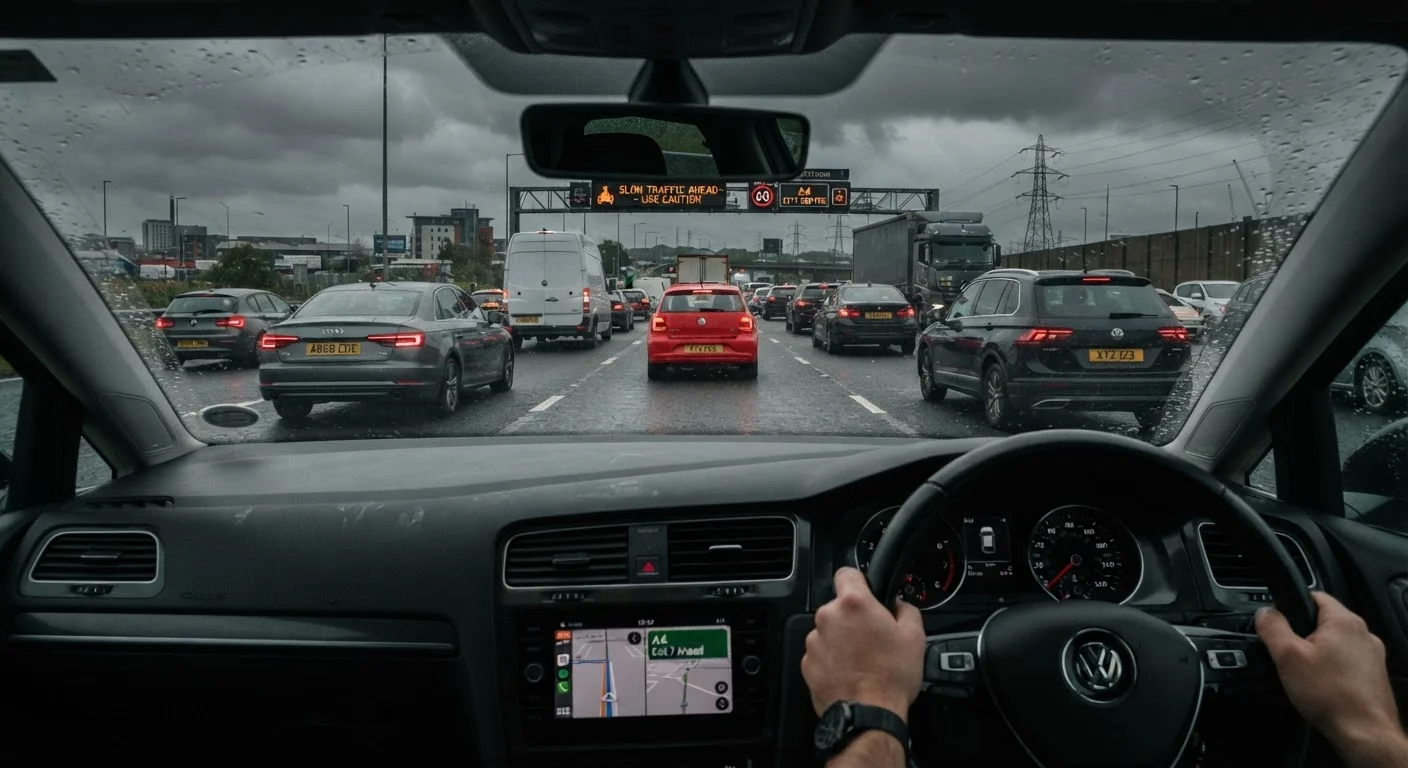
Not adjusting following distance for reduced-visibility conditions like fog, rain, or night driving.
Why it happens: Habit and traffic pressure lead drivers to maintain familiar spacing even when visibility drops and stopping distances extend.
Conditions That Demand Significantly More Space
The two-second rule was designed for ideal conditions: dry pavement, good visibility, an alert driver in a well-maintained vehicle. Deviate from any of those assumptions and the math changes quickly.
Wet or icy roads can double or triple stopping distances compared to dry asphalt. At highway speeds, a vehicle that stops in 300 feet on dry pavement may need 600 feet or more on wet roads - a gap that two seconds simply doesn't provide. For detailed guidance on adjusting your driving in deteriorating conditions, see how to drive safely in rain, fog, and snow.
Large or heavily loaded vehicles require considerably more stopping distance than standard passenger cars. If you're following a truck or van, your stopping ability may be fine - but theirs may not be, and a sudden stop ahead can compress the gap before you've had time to respond.
Fatigue and distraction add to reaction time in ways drivers consistently underestimate. Even a moment of inattention can consume the buffer that two seconds provides. Research on driver inattention consistently shows that cognitive distraction slows reaction times measurably - for more on this, see common distracted driving myths.
~1.5 sec
Average driver reaction time before braking
At 60 mph, that reaction time alone translates to roughly 132 feet of travel before the brakes engage - before stopping distance is even factored in.
2×-3×
Stopping distance increase on wet roads
Wet pavement can double or triple stopping distances compared to dry conditions, according to general road safety guidance from transportation safety agencies.
A reasonable adjustment: use three to four seconds as your baseline on highways, and double that in rain, fog, or darkness. At night, reaction time and visibility both worsen - night driving requires more than just turning on your headlights.
Tailgating Is a Crash Risk, Not Just Rude
Following closer than two seconds at highway speeds gives you virtually no margin if the car ahead brakes suddenly. Rear-end collisions frequently result in serious injury and are among the most preventable crash types. No destination is worth eliminating your ability to stop in time - and in most states, following too closely is a traffic violation in its own right.