Two Distances, One Outcome
Most drivers think of stopping as a single action - press the brakes, car stops. In reality, stopping distance is the sum of two distinct phases that happen in sequence, and only one of them involves the brakes at all.
Reaction distance is the ground your car covers from the moment you perceive a hazard to the moment your foot actually depresses the brake pedal. Braking distance is everything that follows - the distance the vehicle travels while the brakes are actively working to bring it to rest.
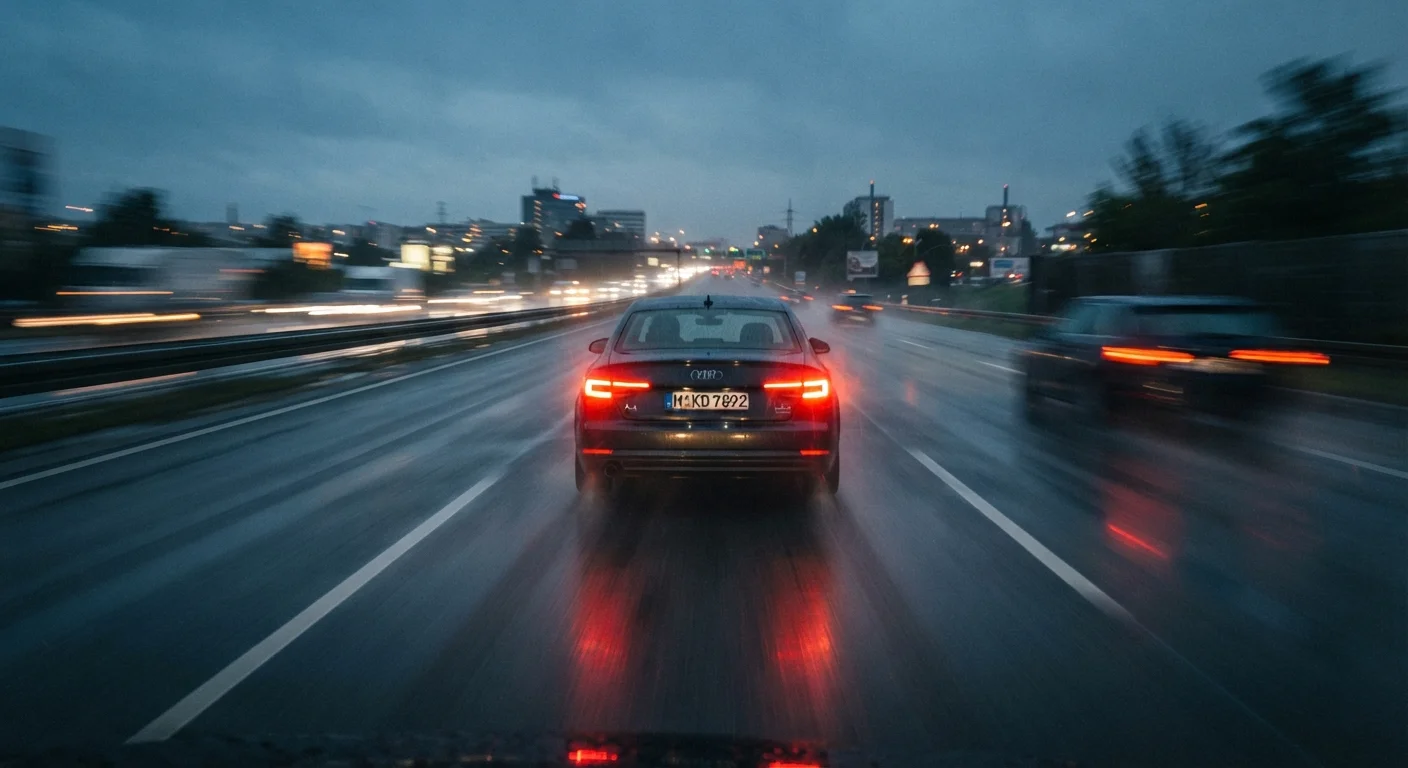
At 60 mph on a dry road, an alert driver with a 1.5-second reaction time will travel roughly 132 feet before braking even begins. Add braking distance on top of that, and total stopping distance can approach 300 feet - the length of a football field. Understanding this gap between perception and stop is foundational to defensive driving.
~132 ft
Reaction distance at 60 mph
Based on a typical 1.5-second driver reaction time - before any braking force is applied.
4×
Braking distance increase when speed doubles
Doubling speed from 30 to 60 mph roughly quadruples braking distance due to the kinetic energy equation.
Up to 10×
Stopping distance increase on ice vs. dry asphalt
Ice dramatically reduces tire-road friction coefficients, as documented by road safety researchers and transportation agencies.
Why Speed Changes Everything
The relationship between speed and stopping distance isn't linear - it's exponential, and that distinction matters enormously in everyday driving decisions.
A moving vehicle carries kinetic energy proportional to the square of its velocity. That energy must be fully dissipated - converted to heat through friction between the brake pads and rotors, and between the tires and road - before the vehicle stops. When you double your speed from 30 mph to 60 mph, your kinetic energy quadruples. Your brakes must do four times the work, and braking distance roughly quadruples to match.
This is why even modest speed reductions make a meaningful difference. Slowing from 60 mph to 50 mph doesn't trim just 10 mph off your speed - it substantially reduces the energy your braking system must overcome. The basic speed law exists precisely because posted limits alone don't account for conditions that compound stopping distance.
Road Surface, Tires, and the Friction Factor
Brakes generate stopping force, but it's friction between tires and road that actually brings the vehicle to a halt. When that friction is reduced - by water, ice, loose gravel, or worn tread - stopping distance stretches, sometimes dramatically.
On dry asphalt, a good set of tires in proper condition can achieve a friction coefficient high enough to stop a vehicle efficiently. On wet pavement, that figure drops noticeably. On ice, it can fall to a fraction of the dry-road value, meaning stopping distances ten times longer or more are physically possible. For a deeper look at why frozen roads behave so differently, see our article on the science behind icy road dangers.
Tire condition is equally important. Tread depth determines how well a tire evacuates water from the contact patch. Worn tires on wet roads are a compounding hazard: reduced tread plus reduced friction equals sharply extended stopping distances. Vehicle load matters too - a heavier car carries more kinetic energy at the same speed, requiring greater braking force to stop in the same distance.
What This Means for How You Drive
The physics of stopping distance translate directly into practical decisions every time you get behind the wheel. Following distance is the most immediate lever available. The conventional two-second rule was developed as a rough minimum, but as our guide on why your following distance is probably too short explains, that gap is frequently inadequate in heavier traffic, rain, or higher-speed conditions.
Fatigue and distraction extend reaction time, inflating the reaction-distance component before brakes are ever touched. A driver who takes 2.5 seconds rather than 1.5 to respond adds another 60-plus feet at highway speeds - distance that may not exist between vehicles in dense traffic.
Understanding stopping distance isn't about memorizing numbers. It's about internalizing why slowing down slightly, increasing following distance, and staying alert aren't overcautious habits - they're direct, physics-backed responses to how vehicles actually behave on real roads.