The Liquid Layer That Makes Ice So Treacherous
Most people assume ice is slippery simply because it's frozen and smooth. The real explanation is more interesting - and more counterintuitive. Ice maintains a thin quasi-liquid layer on its surface even at temperatures well below the standard freezing point of 32°F (0°C). This layer was once attributed solely to pressure from a vehicle's weight melting the ice beneath it, but modern physics research has shown that molecular disorder at the ice surface creates this liquid-like film independently of pressure.
The result is a built-in lubricant between your tire and the road. On dry asphalt, microscopic irregularities in both the tire rubber and road surface interlock, generating the friction that gives you control. Ice's surface liquid layer prevents that interlocking almost entirely, which is why friction coefficients on glare ice can fall below 0.1 - compared to 0.7-0.8 on dry pavement. That's not a marginal difference; it's a fundamental change in how physics governs your vehicle.
For more on how friction actually works - and where common assumptions go wrong - see our breakdown of friction myths.
How Stopping Distance Physics Changes on Ice
Braking force is directly proportional to friction. When friction collapses on ice, the distance required to bring a vehicle to a complete stop increases dramatically. The physics here follows from Newton's second law: deceleration equals the friction force divided by the vehicle's mass. Cut the friction coefficient to one-seventh of its dry-road value, and deceleration drops by the same factor - meaning stopping distance extends by roughly that multiple.
At 30 mph on dry pavement, a typical passenger car stops in about 75 feet after the driver reacts. On ice, that same vehicle may need 300 feet or more. At 60 mph - a common highway speed - stopping distances on ice can exceed 900 feet. These are not worst-case estimates; they reflect the physics of reduced friction applied to real vehicle weights and speeds.
~0.1
Friction coefficient on glare ice
Compared to 0.7-0.8 on dry asphalt, glare ice reduces available tire friction by as much as seven times.
300+ ft
Stopping distance at 30 mph on ice
Dry pavement stopping distance at the same speed is roughly 75 feet - a fourfold difference driven entirely by reduced friction.
17%
Of U.S. crash fatalities tied to icy or snowy roads
According to the U.S. Federal Highway Administration, weather-related road conditions - including ice and snow - account for a significant share of annual traffic fatalities.
Anti-lock braking systems (ABS) help prevent wheel lockup on ice, keeping the tires rotating so steering remains possible. But ABS cannot create friction that isn't there. It manages the friction available - it cannot manufacture more. Understanding stopping distance physics is essential context for appreciating just how much ice changes the equation.
Black Ice, Bridges, and Where Risk Concentrates
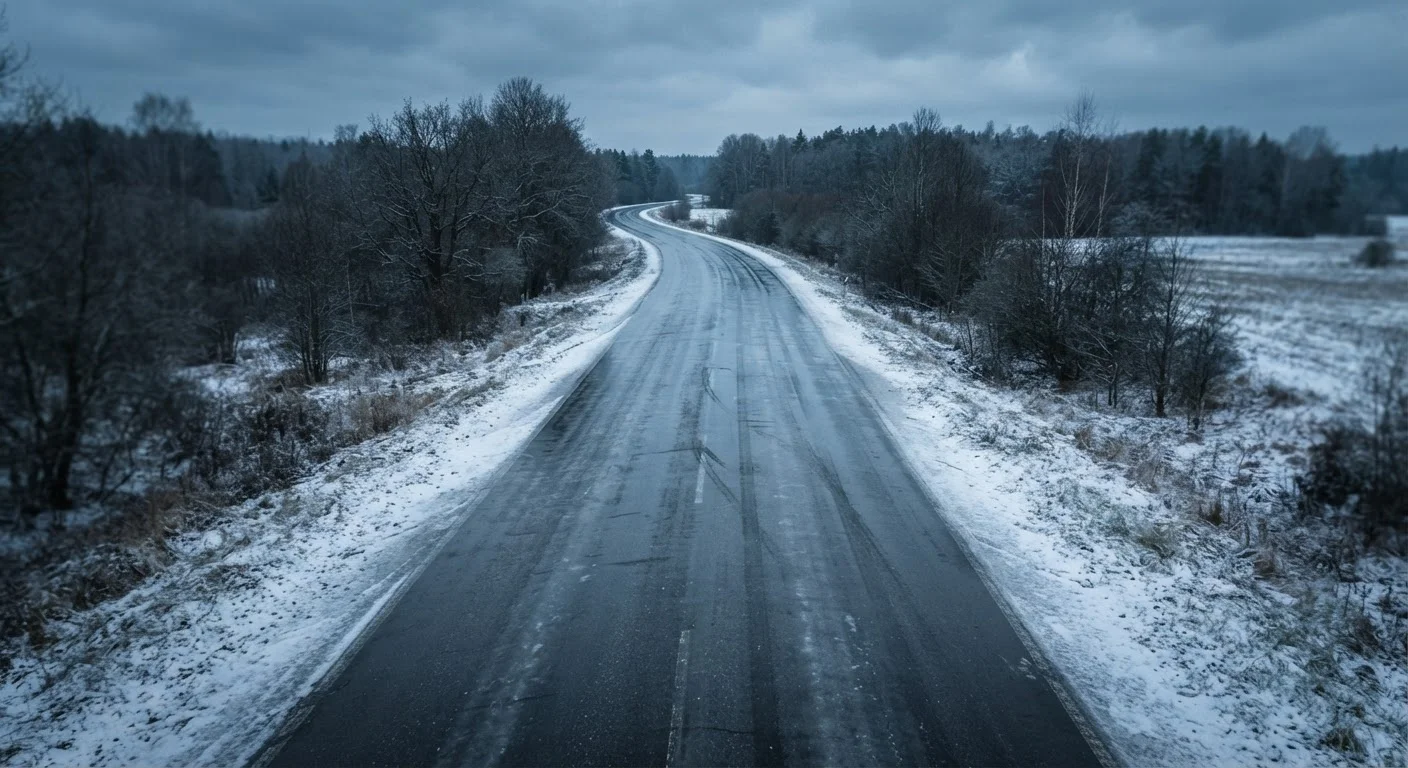
Not all road ice presents the same hazard in the same way. Black ice - a thin, transparent glaze that forms on pavement - is particularly dangerous because it's visually indistinguishable from a wet road surface. Drivers who recognize wet pavement but not ice maintain speeds appropriate for wet conditions, which are far too fast for ice. The friction coefficient doesn't advertise itself visually.
Bridges and overpasses ice first because they lose heat from both their top and bottom surfaces simultaneously. Standard road sections sit on earth, which acts as a thermal reservoir and slows cooling. A bridge deck can be covered in ice while the approach road just a few hundred feet away remains clear - a transition that can catch even experienced drivers off guard.
Shaded sections of road, intersections where vehicles slow and idle, and areas near water bodies are also common ice formation zones. Risk on ice is also strongly shaped by speed - the same dynamics that make icy roads hazardous at 30 mph become far more severe at highway speeds. Highway and city driving carry distinct risk profiles, and ice compounds the dangers of both.
Driving Physics: What Actually Works on Ice
Because friction is limited, every control input on ice - steering, braking, accelerating - must be gradual and smooth. Abrupt inputs demand more friction than the surface can provide, causing tires to slide rather than grip. This is why hard braking on ice often causes skids even on vehicles with ABS, and why sharp steering corrections can send a car spinning.
Increasing following distance is the single most effective behavioral adjustment on icy roads. Since stopping distance may be four to eight times longer than on dry pavement, the safe gap between vehicles must expand proportionally. Driving at reduced speeds also matters: kinetic energy scales with the square of velocity, so halving your speed reduces the energy that friction must dissipate to stop you by 75%.
Winter tires (as distinct from all-season tires) are engineered with rubber compounds that stay flexible at low temperatures and tread patterns optimized for biting into snow and ice - increasing the actual contact friction available. They don't override physics, but they shift the friction coefficient meaningfully in the driver's favor. For visibility challenges that accompany icy conditions, see adjusting your driving for reduced winter visibility.
This article is for general informational and educational purposes. Always follow official road safety guidance from your state or local transportation authority when driving in winter conditions.