
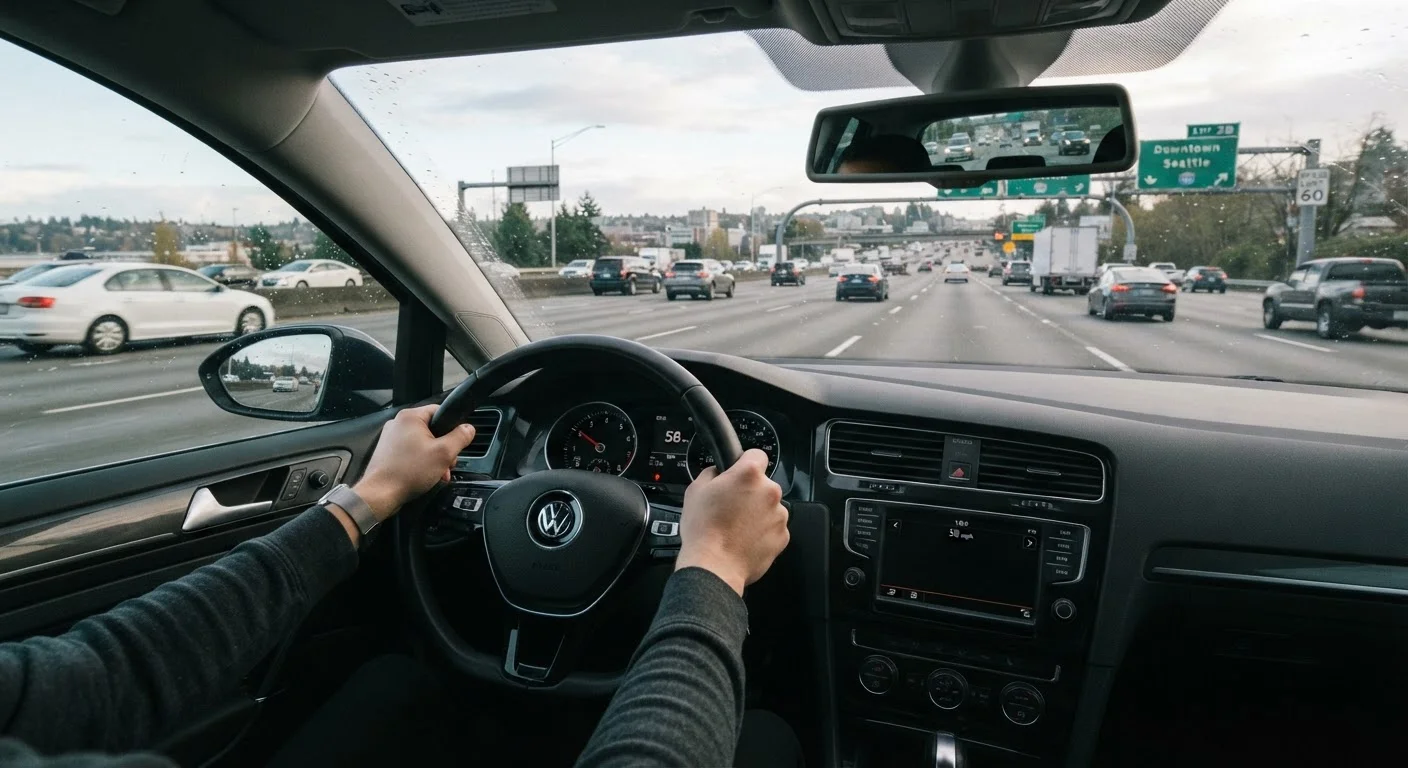
What Defensive Driving Actually Means
Defensive driving is often described as "being careful," but that framing undersells what it actually involves. At its core, defensive driving is a systematic approach to anticipating hazards, maintaining control, and making decisions that account for what other drivers might do - not just what you intend to do yourself.
It assumes that conditions will not always be ideal, that other road users will sometimes make mistakes, and that the driver's job is to create enough time and space to respond before a situation becomes critical. This is fundamentally different from simply obeying traffic laws, which is a baseline - not a strategy.
This approach is covered in broader detail in the complete safe driving overview for U.S. drivers, which puts hazard awareness in context alongside road rules and vehicle readiness.
Following distance
The gap between your vehicle and the one ahead, measured in time rather than car lengths. A larger gap gives you more time to react if that vehicle brakes suddenly.
Hazard anticipation
The practice of identifying potential dangers before they fully develop, so you can respond calmly rather than react in emergency.
Scanning
The habit of moving your eyes across a wide field of view ahead of and around your vehicle, rather than staring at a fixed point.
Escape route
A clear path you deliberately maintain in case you need to steer away from a developing hazard quickly.
Reaction time
The interval between perceiving a hazard and physically responding to it - during which your vehicle continues moving at its current speed.
The Core Principles That Make It Work
Defensive driving rests on a small set of durable principles that apply regardless of road type, speed, or vehicle:
- Assume others will make errors. Expect that drivers around you may fail to signal, brake suddenly, or drift into your lane. This isn't pessimism - it's realistic planning.
- Maintain control of your vehicle. Speed, steering, and braking inputs should always be smooth and deliberate. Abrupt maneuvers reduce your margin for error.
- Keep an escape route. Always position yourself so that you have somewhere to go if the situation ahead changes suddenly.
- Stay focused. Distraction and defensive driving are directly opposed. Common distracted driving myths show just how sharply attention lapses affect collision risk.
Scanning, Space, and Speed Management
Three practical skills translate defensive driving principles into everyday behavior.
Scanning Ahead
Drivers who look only at the vehicle immediately in front of them have far less time to react than those who scan well ahead. Aim to read the road 10-15 seconds ahead of your position. At 60 mph, that's roughly a quarter mile of advance awareness - enough time to ease off the throttle, cover the brake, or shift lanes before a hazard develops.
Managing Space
The three-second following distance rule - choosing a fixed point ahead and ensuring at least three seconds pass between when the vehicle in front passes it and when you do - is a widely recognized minimum under dry conditions. In rain, fog, or heavy traffic, that gap should increase. Understanding stopping distance is closely tied to this: the physics of stopping distance explains why your speed has an outsized effect on how far your vehicle travels before it halts.
Matching Speed to Conditions
Posted speed limits reflect ideal conditions. Rain, darkness, construction zones, or heavy traffic all call for lower speeds, regardless of the legal limit. Slowing down increases your reaction window and reduces the severity of any collision that does occur.
When and Where Defensive Driving Matters Most
Every driving environment carries its own hazard profile. Highway and city driving present different risks: high-speed lane changes and merge conflicts dominate on freeways, while intersections, pedestrians, and cyclists create the primary hazards in urban settings.
Nighttime driving adds another layer of complexity. Reduced visibility shortens your effective scanning range, and driver fatigue becomes a genuine factor. Nighttime driving habits that work in daylight often need to be recalibrated after dark.
New drivers tend to find certain environments especially challenging. Situations that challenge new drivers - like highway merging or navigating busy intersections - are precisely the contexts where defensive habits pay off most quickly.
Use Your Mirrors More Than You Think You Need To
Most experienced drivers check their mirrors every five to eight seconds, not just when changing lanes. Regular mirror checks keep you continuously updated on the traffic pattern around your vehicle, which is essential for knowing whether you have a viable escape route at any given moment.
Building the Habit Over Time
Defensive driving becomes natural with deliberate, consistent practice. Early on, it requires conscious effort - actively choosing to scan ahead, check mirrors every five to eight seconds, and adjust following distance. Over time, these behaviors become reflexive.
One useful approach: after each drive, briefly consider whether there were moments where you had less space or time than you would have liked. That kind of low-pressure self-review helps identify specific habits to strengthen without requiring formal instruction.
Defensive driving won't eliminate all risk - no approach can. But it reliably reduces the frequency and severity of close calls, and it gives you the best possible chance of emerging from an unexpected situation without a collision.