Why Certain Situations Feel So Much Harder
Every new driver knows the feeling: a situation arises on the road that wasn't covered thoroughly in driver's ed, and suddenly the stakes feel very real. What separates experienced drivers from beginners isn't a different set of instincts - it's accumulated pattern recognition. They've encountered these situations dozens or hundreds of times and developed reliable responses.
The scenarios below consistently challenge new drivers across the board. For each one, understanding why it's difficult - and how experienced drivers approach it differently - makes a meaningful difference. This article is part of a broader look at safe driving; see the complete overview for new and returning drivers for broader context.
Merging onto a Highway
The on-ramp is one of the most anxiety-inducing moments for new drivers. The task requires accelerating to highway speed while simultaneously scanning for a gap in fast-moving traffic - two cognitively demanding jobs at once. New drivers often brake at the top of the ramp or enter too slowly, creating a genuine hazard.
Experienced drivers use the full length of the acceleration lane and match highway speed before merging - not after. They identify a target gap early and adjust speed to fit into it, signaling early so nearby drivers know their intent. For a deeper look at the rules involved, right-of-way and merging errors are worth reviewing.
Use the entire acceleration lane to match highway speed - never brake at the top of the ramp.
Parallel Parking
Parallel parking demands precise spatial judgment, reversing skill, and the ability to stay calm under pressure - especially when other drivers are waiting. New drivers often misjudge the required gap size or start their turn too early or too late.
Experienced drivers use reference points: specific moments when part of the car aligns with a landmark (such as when the rear bumper clears the front car) as cues to turn. They also choose spaces generously larger than their vehicle when possible. Practicing the sequence slowly in an empty lot, using cones or empty parking spaces, builds the muscle memory needed before tackling real street parking.
Reference points - not guesswork - are what make parallel parking reliable and repeatable.
Driving at Night
Reduced visibility, glare from oncoming headlights, and fatigue make nighttime driving genuinely more demanding. New drivers often don't adjust their following distance or speed to account for the shorter stopping window that reduced visibility creates.
Experienced drivers increase following distance after dark, dim dashboard lights to reduce interior glare, and avoid staring directly at oncoming headlights - instead watching the right edge of their lane. They're also honest about fatigue. Night driving requires deliberate habit changes, not just turning on the headlights.
After dark, increase your following distance and watch the right lane edge - not oncoming lights.
Navigating Busy Intersections
Multi-lane intersections with turning traffic, cyclists, and pedestrians create sensory overload for new drivers. Uncertainty about right-of-way - especially at four-way stops or uncontrolled intersections - leads to hesitation that can itself cause problems.
Experienced drivers slow their approach even when they have the right of way, scan left-right-left before proceeding, and never assume another driver will comply with traffic signals. They treat eye contact with pedestrians as confirmation - not just the signal light. Sharing space with vulnerable road users is a skill that intersects directly with intersection safety.
Always scan left-right-left at intersections, even when you have the green light.
Driving in Rain or Low-Visibility Conditions
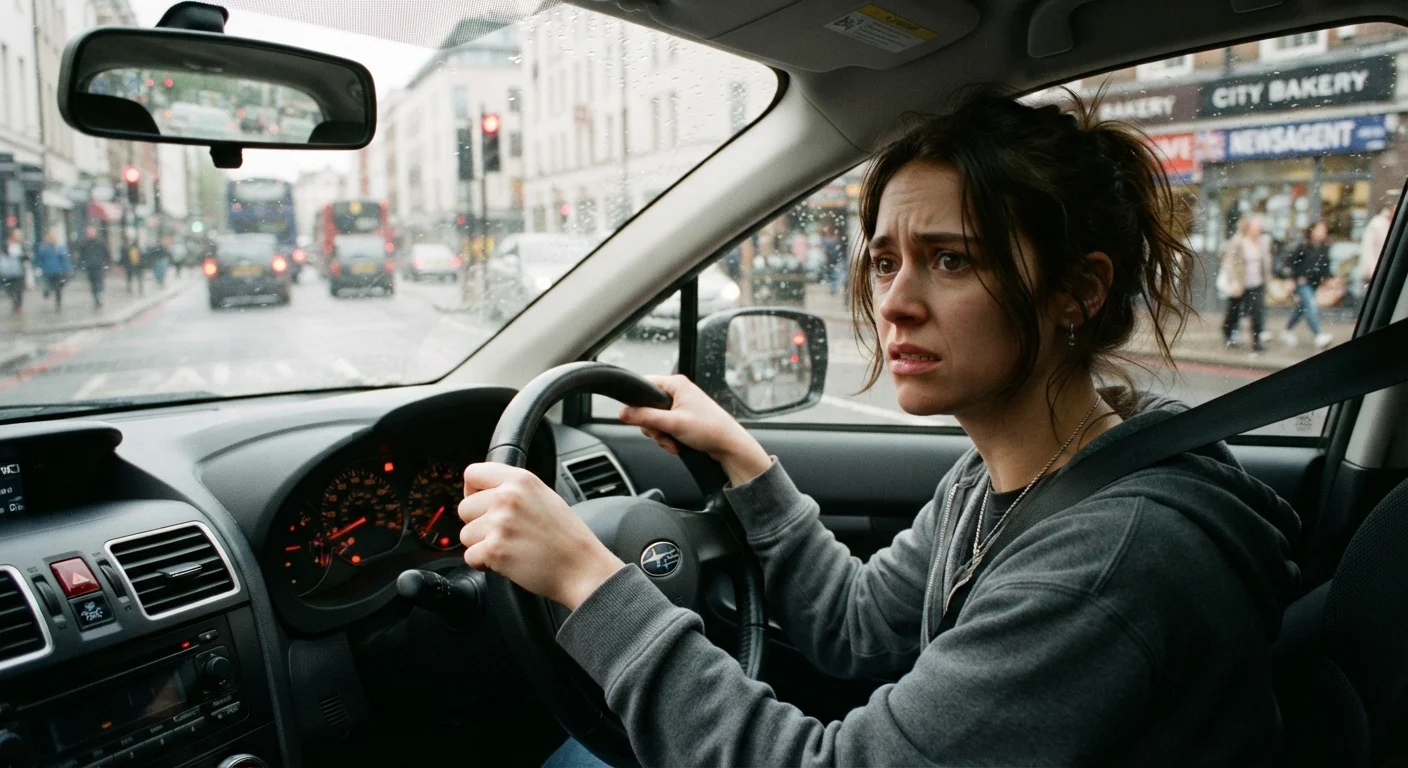
Rain reduces tire traction, extends stopping distances, and creates glare on road surfaces. New drivers often don't reduce speed sufficiently or maintain adequate following distance in wet conditions, partly because the road feels the same until it suddenly doesn't.
Experienced drivers understand that stopping distance roughly doubles on wet pavement compared to dry. They turn headlights on in rain regardless of visibility level (required by law in most states), avoid sudden braking or sharp steering inputs, and slow down before curves rather than during them. The key adjustment is recognizing that familiar roads behave differently when wet.
Stopping distances roughly double on wet pavement - adjust your following distance accordingly.
Changing Lanes in Dense Traffic
Lane changes in heavy traffic require checking mirrors, checking blind spots, signaling, finding a gap, and executing the move - all without disrupting flow. New drivers frequently either rush the process or delay it so long that they create their own problem.
Experienced drivers plan lane changes several seconds ahead, signal early to communicate intent, and check their blind spot with a brief shoulder glance - not just mirrors. They also avoid forcing a change when no clear gap exists, trusting that another opportunity will come. Understanding the distinct risks in high-speed versus dense traffic helps frame why lane-change discipline matters differently in each environment.
Plan lane changes several seconds ahead and signal early - don't force a gap that isn't there.
Building Confidence Through Deliberate Practice
The common thread running through every difficult scenario above is that confidence comes from controlled exposure - not avoidance. Seek out low-traffic practice environments before facing challenging situations at rush hour. A quiet parking lot, an uncrowded side street, or an early-morning highway run gives you the repetitions needed to build real competence.
It also helps to understand the distinct risk profiles involved in different environments. Highway and city driving carry different dangers, and recognizing those differences lets you apply the right mental framework before you even start the car. Similarly, defensive driving techniques give you a proactive structure for anticipating hazards rather than simply reacting to them.
Practice the Hard Stuff Deliberately
Rather than waiting for difficult situations to arise organically, seek them out in controlled conditions. Practice parallel parking in an empty lot, take an early-morning highway drive before traffic builds, and find a quiet neighborhood to practice smooth lane changes. Repeated low-stakes exposure is far more effective than occasional high-pressure encounters.