Why Night Driving Carries a Disproportionate Risk
Traffic thins out after dark, but crash fatality rates do not. In fact, data from the National Safety Council indicates that roughly half of all traffic deaths occur at night - even though far fewer miles are driven in those hours. The math tells a clear story: nighttime is inherently more dangerous mile for mile.
Several factors converge after sunset. Human vision degrades significantly in low light - much like it does in fog or heavy rain - reducing your ability to judge speed and distance. Fatigue accumulates through the day and peaks in the late-night hours. And the proportion of impaired drivers on the road rises sharply. Understanding these overlapping risks is the first step toward managing them intelligently.
Night Driving and Vision Changes
Human eyes adapt to darkness gradually - a process called dark adaptation - but they never see as sharply at night as in daylight. Depth perception and peripheral vision are both reduced after dark, and older drivers typically experience more pronounced night vision decline. These physiological realities are fixed; the practices in this article work around them, not against them.
Practices That Make a Measurable Difference
Safer night driving isn't about a single technique - it's the combination of adjusted habits that compounds your margin of safety. Each practice below targets a specific nighttime vulnerability.
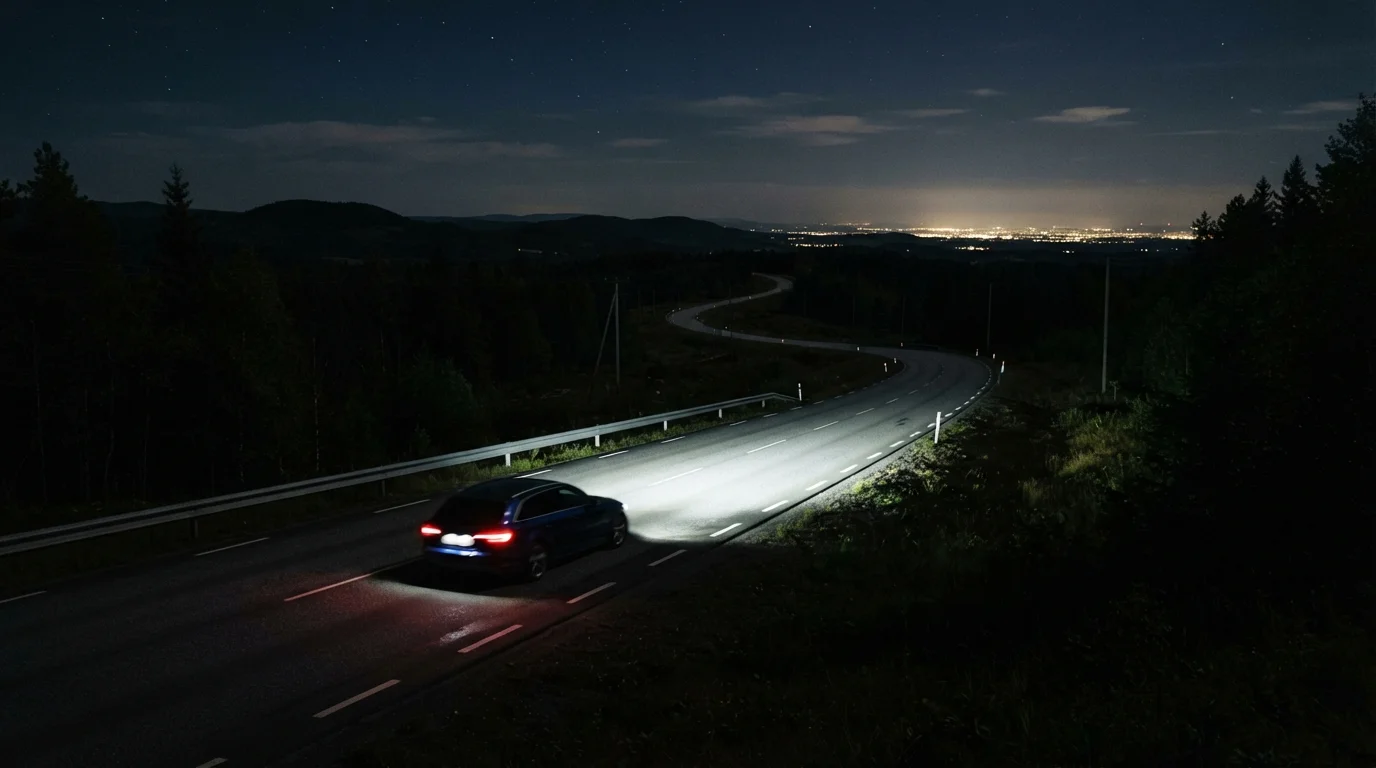
Keep your headlights clean, aimed correctly, and always on - even at dusk.
Dirty or misaligned headlights can cut your effective visibility range dramatically. Dusk is statistically one of the most dangerous periods because many drivers delay turning on their lights while ambient light fades faster than they realize.
Increase your following distance to at least three to four seconds at night.
Your stopping distance doesn't change after dark, but your reaction time can suffer from fatigue and reduced visual input. More space gives you more time to identify and respond to hazards that appear suddenly at the edge of your headlight range. Following distance is frequently underestimated even during the day.
Avoid looking directly into oncoming headlights; shift your gaze to the right edge of the road.
Direct glare from oncoming high-beams temporarily impairs your night vision and can leave visual spots lasting several seconds. Focusing on the road's right edge line helps you maintain lane position while reducing the glare impact.
Recognize and act on early signs of fatigue - pull over if needed.
Fatigue and night driving are a dangerous combination. Research has consistently shown that drowsy driving impairs reaction time and judgment in ways that parallel alcohol intoxication. Drowsy driving affects your reactions far more than most drivers acknowledge.
Use high beams strategically and switch them off promptly for oncoming or leading traffic.
High beams roughly double your forward visibility range on unlit roads, making them genuinely valuable on empty highways. However, leaving them on when other vehicles are present blinds other drivers and is illegal in most states.
Stay especially alert for impaired and distracted drivers during late-night hours.
Alcohol-involved crashes are disproportionately concentrated at night, particularly on weekends. You cannot control other drivers' behavior, but you can maintain extra margin - wider spacing, slower speeds, and heightened scanning - to give yourself more time to react.
Quick Actions You Can Take Tonight
You don't need a complete overhaul of your driving routine to improve your nighttime safety. A few targeted adjustments, made consistently, reduce your exposure to the most common after-dark hazards. These are the highest-return starting points.
For a broader look at how challenging conditions affect driving strategy, the guidance on adjusting for reduced visibility in rain, fog, and snow pairs well with what you've read here. And if you're newer to the road, common challenges for new drivers covers many of the same situational awareness principles in a broader context.
Dim Your Dashboard for Better Night Vision
A bright instrument cluster or infotainment screen reduces your eyes' ability to adapt to the darkness outside the windshield. Turn down interior screen brightness after dark - most vehicles allow this through display settings. It's a small adjustment that makes a real difference in how well you see the road ahead.