What Makes Romance a Genre
Before tracing how romance fiction has changed, it helps to nail down what has stayed constant. According to the Romance Writers of America, the genre has two core requirements: a central love story and an emotionally satisfying ending - commonly called the HEA (happily ever after) or HFN (happy for now). Everything else - setting, tone, heat level, protagonist demographics - is fair game for reinvention.
That stability at the center is part of what makes romance so enduring. Readers enter each book with a contract: however turbulent the journey, emotional payoff is guaranteed. That promise is both the genre's greatest commercial strength and, historically, the source of some critical dismissal. As we'll see, that dismissal has had less to do with craft than with who was doing the reading. For a broader map of where romance sits among other genres, see our breakdown of the major literary genres.
The Gothic and Victorian Roots
Modern romance fiction didn't appear out of nowhere. Its roots run deep into 18th- and 19th-century Gothic novels - books like Ann Radcliffe's brooding tales of imperiled heroines in crumbling castles - and through the sharp social comedies of Jane Austen, whose novels structured courtship as intellectual contest as much as emotional longing. Charlotte Brontë's Jane Eyre (1847) arguably established the template that would echo through the genre for over a century: a spirited, morally upright heroine, a powerful and emotionally damaged hero, and a resolution that hinges on mutual recognition of worth.
These works weren't sold as "romance novels" - the genre category didn't exist yet - but they seeded the conventions that later writers would pick up, amplify, and argue with. The dark, atmospheric hero with a secret; the heroine who refuses to be diminished; the estate as both setting and symbol. Victorian fiction and its Gothic precursors gave romance a vocabulary it still uses today, even when contemporary authors are deliberately subverting it.
Genre Labels Are a Modern Invention
Austen, Brontë, and Radcliffe never thought of themselves as writing "romance novels" - that category emerged as a publishing and marketing construct in the 20th century. Placing their work within the romance tradition is a retrospective act of literary history, useful for tracing influences but worth holding loosely. Genre boundaries are tools for readers and booksellers, not absolute literary categories.
The Mid-20th Century and Mass Market Boom
The modern romance genre as a distinct, commercially packaged category took shape in the mid-20th century. British publisher Mills & Boon, founded in 1908 and later acquired by Harlequin, industrialized the form - producing short, formulaic novels in large print runs aimed at female readers. By the 1970s, Harlequin had become a publishing phenomenon in North America, selling millions of paperbacks through supermarkets and drugstores as well as bookshops.
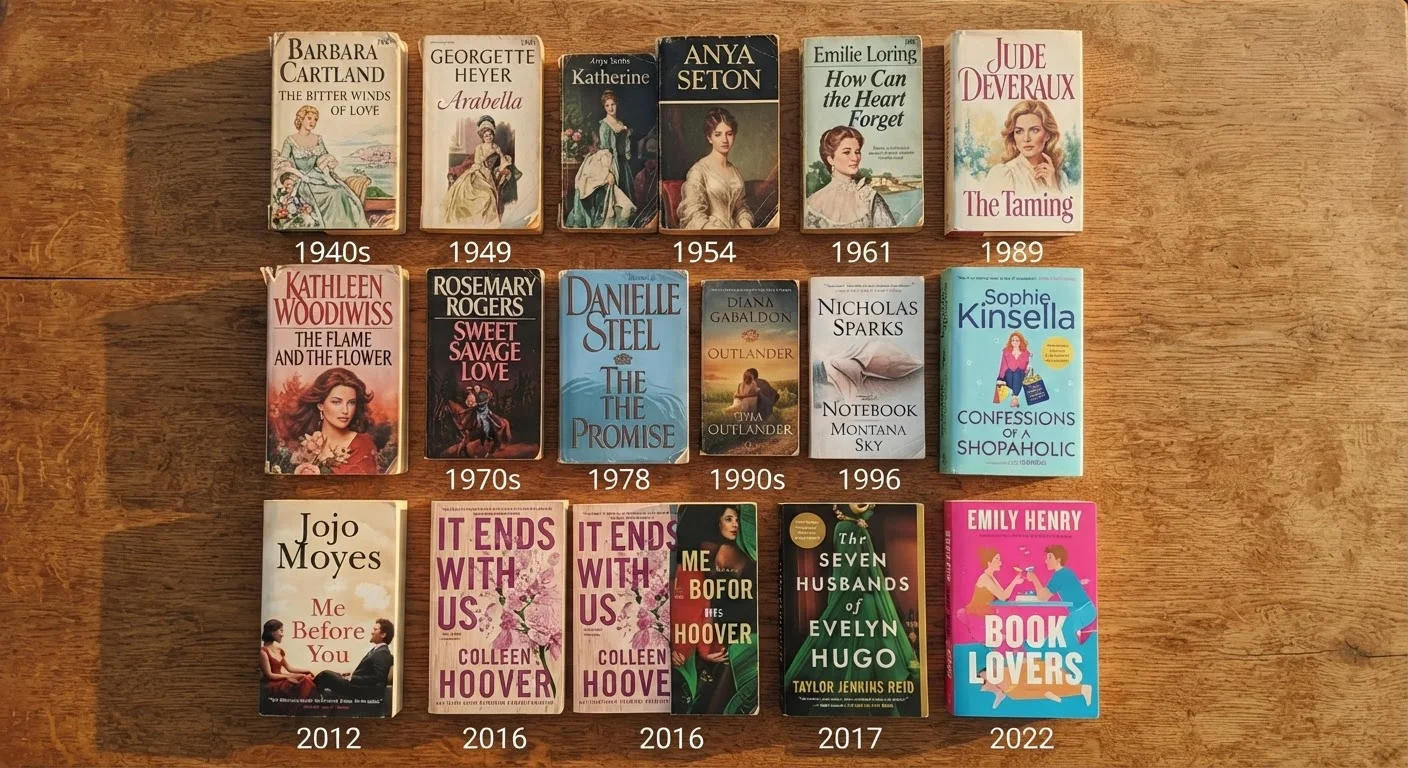
That same decade brought a different wave: longer, more explicitly sexual historical romances sometimes called "bodice rippers." Kathleen Woodiwiss's The Flame and the Flower (1972) is widely credited as a turning point - a sweeping historical novel with frank sexual content, published as original fiction rather than a reprint. It demonstrated enormous commercial appetite for romance that went beyond the restrained Mills & Boon format. The 1980s consolidated these gains, with authors building massive readerships and romance becoming the top-selling fiction category in the United States by unit sales - a position it has held for decades.
#1
Romance's rank in U.S. fiction sales by units
Romance has consistently ranked as the top-selling fiction category in the United States by unit sales, according to publishing industry data tracked by organizations such as the Association of American Publishers.
1972
Year long-form romantic fiction changed
Kathleen Woodiwiss's The Flame and the Flower, published in 1972, is widely cited by literary historians as a pivotal shift in how romance novels were written and marketed.
100M+
Harlequin paperbacks sold annually at peak
At its commercial peak in the early 1980s, Harlequin Enterprises was reportedly selling over 100 million romance novels per year across global markets.
The 1990s to 2000s: Subgenres Multiply
If the 1970s and 80s established romance as a commercial titan, the 1990s fragmented it into a rich ecosystem of subgenres. Paranormal romance - featuring vampires, shapeshifters, and other supernatural elements - surged in popularity. Romantic suspense merged the genre's emotional core with thriller pacing. Inspirational romance (faith-centered stories, often marketed to Christian readers) grew into a substantial sub-market. Historical romance became increasingly varied in its settings, moving well beyond Regency England to include medieval, Viking, Scottish Highland, and American Western backdrops.
This fragmentation was a feature, not a bug. Readers who wanted the guaranteed emotional payoff of romance could now find it wrapped in virtually any setting or tone they preferred. The genre was demonstrating what literary critics often underestimate about genre fiction: that conventions don't limit storytelling - they focus it, freeing writers to innovate within a shared framework readers already trust.
When exploring romance subgenres for the first time, start by identifying your preferred emotional register - light and comedic, dark and angsty, or tender and slow-burn - before worrying about setting or time period.
Readers often abandon subgenres because the tone doesn't match their expectations, not the subject matter. Emotional tone is the most consistent variable across a subgenre, making it the most reliable guide for new readers.
If a historical romance's accuracy matters to you, check the author's note - many writers explicitly describe which details are invented and which are documented.
Historical romance sits on a spectrum from lightly period-flavored to meticulously researched. Authors who care about accuracy almost always signal it in their back matter, giving readers a clear quality indicator.
Contemporary Romance and the Diversity Shift
The most significant transformation in romance over the past two decades has been demographic and thematic. For much of the genre's modern history, the default protagonist was white, heterosexual, and cisgender. That assumption has eroded substantially. Authors of color, LGBTQ+ writers, and readers from previously underrepresented groups have pushed - through reader demand, online communities, and self-publishing platforms - for stories that reflect a wider range of lives and loves.
Self-publishing and digital distribution have accelerated this shift by lowering the gatekeeping barriers of traditional publishing. A writer with a niche audience - say, readers seeking Black historical romance or queer small-town contemporary - can now reach that audience directly. The result is a genre that feels more genuinely pluralistic than at any earlier point in its history. This mirrors a broader pattern in literary culture: how reader communities can redirect what stories get told and who tells them.
Finding Your Place in the Genre
Understanding this arc - from Gothic courtship fiction to the fragmented, diverse landscape of contemporary romance - gives readers a practical tool. If you're drawn to brooding atmosphere and class tension, Regency and Victorian-set historicals may be your entry point. If you want emotional intensity with supernatural stakes, paranormal romance has a deep catalog. If you prefer contemporary settings with real-world relationship dynamics, today's market offers more variety than ever before in terms of who the protagonists are and what kinds of relationships are centered.
The genre also rewards readers willing to cross adjacent lines. Romance shares techniques and reader pleasures with historical fiction, and some of the most interesting recent work sits right at that boundary. If you've been a committed romance reader for years, venturing into neighboring genres can deepen your appreciation for what romance does so distinctively well: its insistence that emotional life is serious subject matter, and that a guaranteed happy ending is not a cheat - it's a choice.