
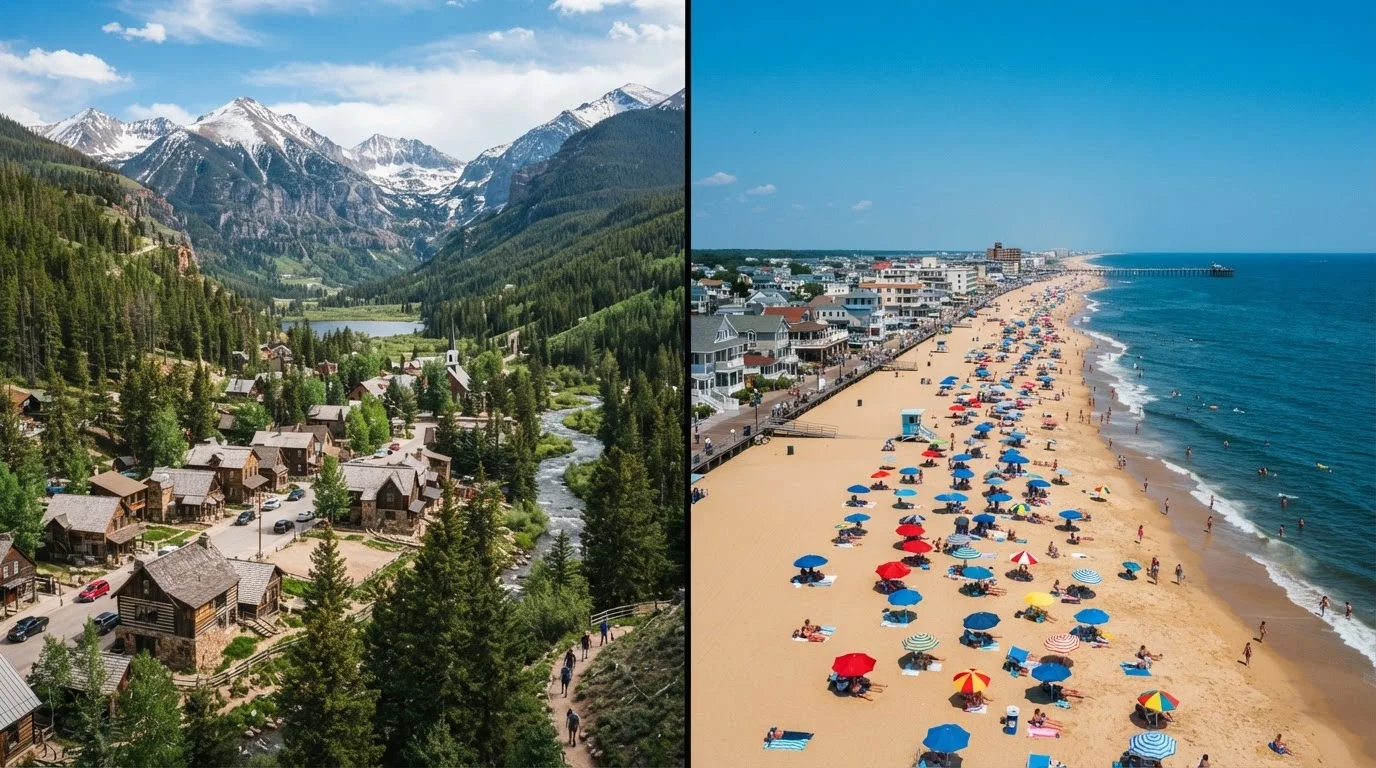
Setting the Stage: What an Anchor Town Actually Does for Your Trip
A vacation anchor is your home base - the town you return to each evening, build your itinerary around, and use to judge whether the trip felt right. Choosing between a mountain town and a beach town isn't just about scenery. It shapes your daily pace, the activities available, how much the weather controls your plans, and how crowded your experience will be. Before you book anything, it's worth thinking through what each type of destination actually delivers day-to-day. For broader planning strategy, the Trip Planning hub is a solid starting point.
The US has remarkable examples of both: think Asheville, NC or Ouray, CO for mountains; think Seaside, OR or Outer Banks, NC for the coast. Each style of destination has a genuine rhythm, and the wrong fit can make even a beautiful place feel off.
Pace, Activities, and What You'll Actually Do All Day
Mountain towns tend to encourage a more varied pace. Mornings are often cool enough for hiking or biking, afternoons lend themselves to exploring downtown galleries, breweries, or farmers' markets, and evenings cool off quickly - ideal for those who don't want a vacation that demands constant action. Winter ski seasons aside, mountain destinations feel quieter and more self-directed.
Beach towns, by contrast, organize themselves around the water and the sun. Days tend to be more linear - beach in the morning, lunch somewhere shaded, back to the water, then sunset somewhere with a view. That rhythm is genuinely wonderful if it's what you want, but it offers less variety if the weather turns or you're not a swimmer. Families with kids often thrive in beach settings because the entertainment writes itself.
If your group includes people who disagree on activity intensity, mountains often give you more options simultaneously. Group dynamics matter here - a hiking-obsessed couple and a pool-day family may find mountain towns offer more middle ground.
| Mountain Town | Beach Town | |
|---|---|---|
| Summer temperature comfort | Cooler at elevation, generally comfortable | Hot and humid in most regions |
| Weather risk | Afternoon storms, early-season snow | Hurricane risk June-November (Atlantic/Gulf) |
| Peak crowd season | Ski season + July-September | June through August |
| Activity variety | Hiking, biking, arts, skiing, local culture | Swimming, surfing, fishing, beach leisure |
| Pace | Flexible, self-directed | Sun and water-centered, more linear |
| Family appeal | High, especially for active families | Very high for young children |
| Shoulder-season value | Excellent - spring and fall are ideal | Good - late May or September reduce crowds |
Weather Risk and What It Means for Your Plans
Weather is where beach towns take on real uncertainty. Atlantic and Gulf Coast destinations face hurricane season (roughly June through November), which can disrupt trips with little notice. Heat and humidity are also significant - a July afternoon on a Florida beach can feel punishing for anyone not heat-adapted. Pacific Coast beaches offer milder summers but come with marine fog and cooler water temperatures that surprise some visitors.
Mountain towns face their own weather quirks: afternoon thunderstorms are common in summer at elevation, and some high passes or trailheads may be inaccessible early in the season. But temperature regulation is a genuine advantage - a hot August day at 7,000 feet is a different experience than one at sea level. If you're visiting in shoulder season, mountain destinations are especially forgiving, with stable weather and thinner crowds.
Crowd Levels, Cost Patterns, and Realistic Expectations
Beach towns hit peak crowds - and peak prices - in June, July, and August. A popular coastal destination in mid-July can feel overwhelming: traffic, packed shorelines, and accommodation rates that reflect full demand. Families with school-age kids often have no choice but to travel during this window, which is a real constraint worth acknowledging.
Mountain towns have two distinct peaks: ski season (December through March in most ranges) and summer hiking season (July through September). Outside those windows, mountain towns are often genuinely uncrowded and more affordable. The hidden Appalachian towns of Western North Carolina and West Virginia, for instance, offer substantial charm at a fraction of the cost of peak-season coastal destinations.
When considering how you'll get to either type of destination, it's worth thinking through your transit options early. Road tripping versus flying plays out differently depending on whether your anchor is accessible by a major airport or better reached by car.
Do Your Destination Research Before You Commit
Both mountain and beach towns vary enormously within their categories. A well-researched choice beats a well-marketed one every time. Before booking, check local event calendars (festivals can spike crowds unexpectedly), read recent traveler reports on road or trail conditions, and verify any entry or permit requirements for popular natural areas. A structured pre-trip research approach can save you from avoidable surprises.