Entry, Visas, and Arrival
Great news for Americans: neither Japan nor South Korea requires a tourist visa for stays up to 90 days (Japan) or 90 days (South Korea under the K-ETA program, though you should verify current requirements with official government sources before booking). That removes one major hurdle immediately.
Arrival experience differs more than you might expect. Tokyo's Narita and Haneda airports are large, well-signposted in English, and connected to central Tokyo by express train. Seoul's Incheon International Airport is consistently rated among the world's best and features an exceptionally smooth immigration process, English-language wayfinding, and direct rail links to the city center. Both are genuinely first-timer-friendly, but Incheon's compactness gives it a slight edge for travelers who feel anxious about big airports.
Always verify entry rules directly with the U.S. Department of State and each country's official immigration authority before travel - policies can change. See our ground-up international trip planning guide for a full checklist on passports and documentation.
Getting Around: Transit Complexity Compared
Both countries have public transit systems that make American cities look underprepared. But they feel different on the ground.
Japan's rail network is extraordinary in scale - the shinkansen bullet train connects major cities at speeds up to 200 mph, and local metro systems in Tokyo and Osaka are dense and frequent. The trade-off: the system's complexity can overwhelm newcomers. Route planning apps like Google Maps handle Japan well, but understanding IC cards (rechargeable transit cards), ticket gates, and platform numbering requires a small learning curve. First-timers should budget a couple of hours to get comfortable.
Seoul's metro, by contrast, is extensive but more intuitive. The city is geographically compact, and most major attractions cluster within a manageable area. A T-money card covers buses, metro, and even some taxis. Day trips to destinations like Suwon or the DMZ (Demilitarized Zone, the heavily fortified border area between North and South Korea) are straightforward to arrange independently.
| Criterion | Japan | South Korea |
|---|---|---|
| Visa for Americans | Visa-free up to 90 days | Visa-free (verify K-ETA status) |
| English signage | Good in tourist areas | Strong in major cities |
| Transit complexity | High - rewarding but demanding | Moderate - intuitive metro system |
| Daily budget (mid-range) | Higher overall cost | More affordable day-to-day |
| Geographic spread | Multi-city planning needed | Seoul-centric trips work well |
| Food scene accessibility | Excellent, slightly pricier | Excellent, very affordable |
| Cultural learning curve | Moderate - etiquette-forward | Moderate - relaxed urban norms |
| Trip planning effort | Higher - benefits from research | Lower - easier to improvise |
For a broader perspective on transit navigation across the region, our overview of first-time Southeast Asia travel shows how these two countries compare to a wider range of Asian destinations.
Cost, Culture, and What to Realistically Expect
Japan is not a cheap destination. Mid-range accommodation in Tokyo averages noticeably higher than Seoul equivalents, and restaurant meals - while extraordinary - can add up quickly outside of convenience stores and ramen shops. A two-week Japan trip covering Tokyo, Kyoto, and Osaka typically costs more than a similar-length South Korea trip, particularly when factoring in the Japan Rail Pass (a prepaid multi-day train ticket for tourists).
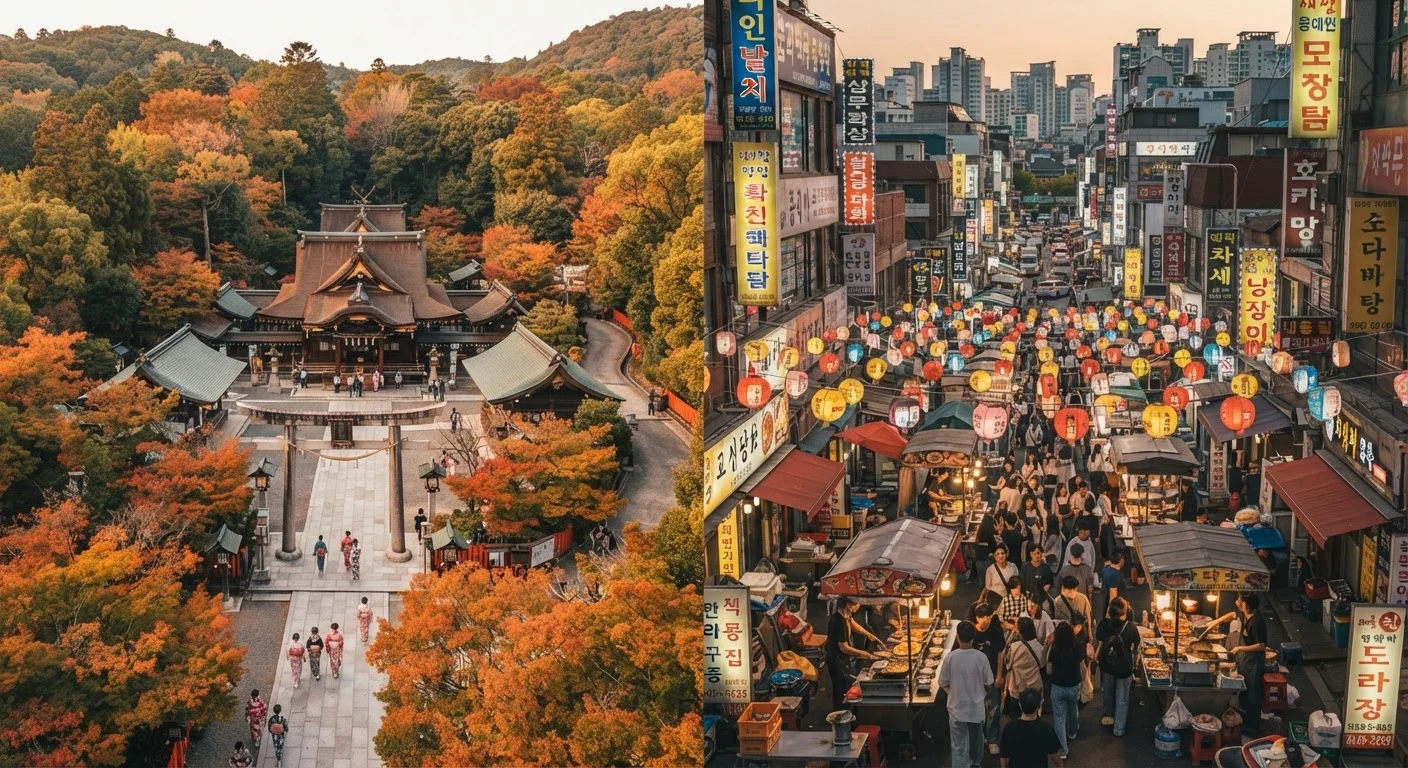
South Korea's food economy is one of its most compelling draws. Street food stalls, pojangmacha (street tent bars), and casual restaurants deliver exceptional quality at very reasonable prices. Seoul's Myeongdong and Insadong neighborhoods give first-timers immediate immersion without requiring much navigation confidence.
Culturally, both countries reward respectful, curious travelers. In Japan, quietness in public spaces, removing shoes when indicated, and not eating while walking are widely observed norms. In South Korea, the vibe is somewhat more informal in urban areas, though respect for elders and basic table etiquette still matter. Neither destination is hostile to Americans - both are accustomed to international visitors - but a few hours of cultural research before you go will meaningfully improve your experience.
3.5M+
American visitors to Japan annually (pre-pandemic baseline)
Japan Tourism Agency figures indicate the U.S. has consistently ranked among the top source countries for inbound tourists to Japan.
Top 5
Incheon Airport global rankings
Incheon International Airport has regularly appeared in top global airport rankings by organizations such as Skytrax, making it one of the most traveler-friendly entry points in Asia.
~2 hrs
Time to learn to read Hangul basics
Linguists and travel educators widely note that Hangul's phonetic alphabet system can be learned in a short sitting, giving newcomers a functional reading ability for menus and signs.
New to international travel altogether? Our first-time international traveler's orientation covers everything from customs declarations to currency exchange fundamentals.