The Three Numbers That Drive Every Auto Loan
Every auto loan is defined by three core variables: the principal (the amount borrowed), the APR (the annualized cost of borrowing), and the term (how many months you have to repay). Change any one of them and your monthly payment - and your total cost - shifts accordingly.
Principal is straightforward: it's the vehicle price minus any down payment or trade-in value. If a car costs $30,000 and you put $5,000 down, your principal is $25,000.
APR (Annual Percentage Rate) is the all-in yearly cost of the loan. It incorporates the base interest rate plus lender fees, giving you a single number to compare across different financing offers. A difference of even one or two percentage points compounds significantly over a multi-year loan. Your credit history is one of the primary drivers of the APR you'll be offered - learn more in our article on the role of credit score in auto financing.
Term is typically 24, 36, 48, 60, 72, or 84 months. Shorter terms carry higher monthly payments but lower total interest. Longer terms do the reverse.
68 months
Average new car loan term in the U.S.
According to data from Experian's State of the Automotive Finance Market reports, the average new vehicle loan term has trended above 67 months in recent years.
~$730
Average monthly new car payment
Experian's automotive finance data has consistently shown average new vehicle monthly payments in the $700-$740 range in recent reporting periods.
3-5×
Interest cost difference: short vs. long term
On a typical mid-range auto loan, stretching from a 48-month to a 72-month term can multiply total interest paid by a factor of two to three or more, depending on the APR.
How Amortization Actually Works
Auto loans are amortized, which means each fixed monthly payment is divided between interest and principal repayment using a predetermined schedule. The split is not equal across payments - it shifts over time.
In the early months, a disproportionately large share of each payment goes toward interest because interest is calculated on the remaining balance, which is highest at the start. As you pay down the principal, the interest portion of each payment shrinks and the principal portion grows.
Here's a simplified example: on a $25,000 loan at 7% APR for 60 months, your fixed monthly payment works out to roughly $495. In month one, about $146 of that covers interest; roughly $349 reduces the principal. By month 48, the interest portion has dropped to around $38, with the balance going straight to principal.
This front-loading of interest has a practical consequence: if you sell or trade in the car in the first two or three years, you may have paid more in interest than you've reduced the principal - sometimes leaving you owing close to what the car is worth or even more. That's called being underwater, or having negative equity.
The Real Cost of Stretching Your Term
Dealers and lenders often frame longer loan terms as a benefit because the monthly payment looks more manageable. But focusing on the monthly figure instead of the total cost is one of the most common and costly mistakes car buyers make.
Consider a $28,000 loan at 6.5% APR. At 48 months, the monthly payment is roughly $665 and total interest paid is about $3,900. Stretch that same loan to 72 months and the payment drops to about $476 - but total interest climbs to around $6,300. That's over $2,400 more paid purely for the convenience of a lower monthly number.
Longer terms also amplify the risk of going underwater, since vehicles depreciate fastest in their first few years and a slow-amortizing loan means your balance shrinks more slowly than the car's value.
Before signing, always ask for the total amount financed, the total interest paid, and the total of all payments. Our guide on what to check before you sign at a dealership walks through every line item worth reviewing in the contract.
Auto loan interest is only part of the long-term ownership picture. For a complete view, see the full cost of car ownership most buyers never see coming.
Reading a Financing Offer Clearly
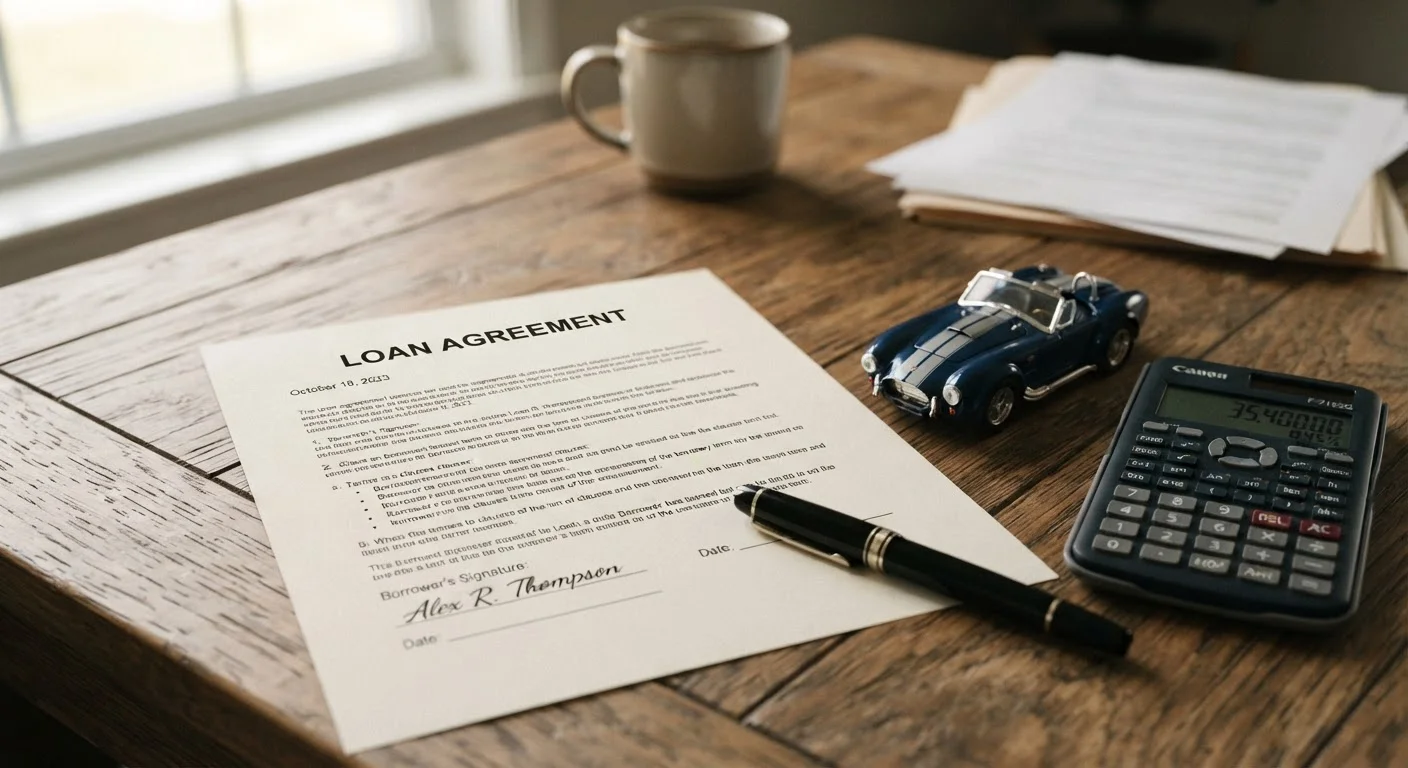
When a lender or dealership presents a financing offer, the document will typically show: the loan amount, the APR, the term in months, the monthly payment, and the total of payments. Each of these figures deserves scrutiny.
- Check the APR, not just the rate. A quoted interest rate may not include all fees. The APR does.
- Verify the loan amount matches your expectation. Add-ons, extended warranties, and GAP insurance are sometimes rolled into the principal without clear disclosure.
- Calculate total interest yourself. Multiply the monthly payment by the number of months, then subtract the principal. That's your total interest cost.
- Ask about prepayment penalties. If you plan to pay off the loan early, confirm there are no fees for doing so.
If you're weighing dealer financing against an outside lender, our article on financing through a dealer vs. a bank or credit union explains how the two channels differ and what to watch for in each. And if you're deciding between buying and leasing entirely, leasing has its own financial structure worth understanding before you commit.