
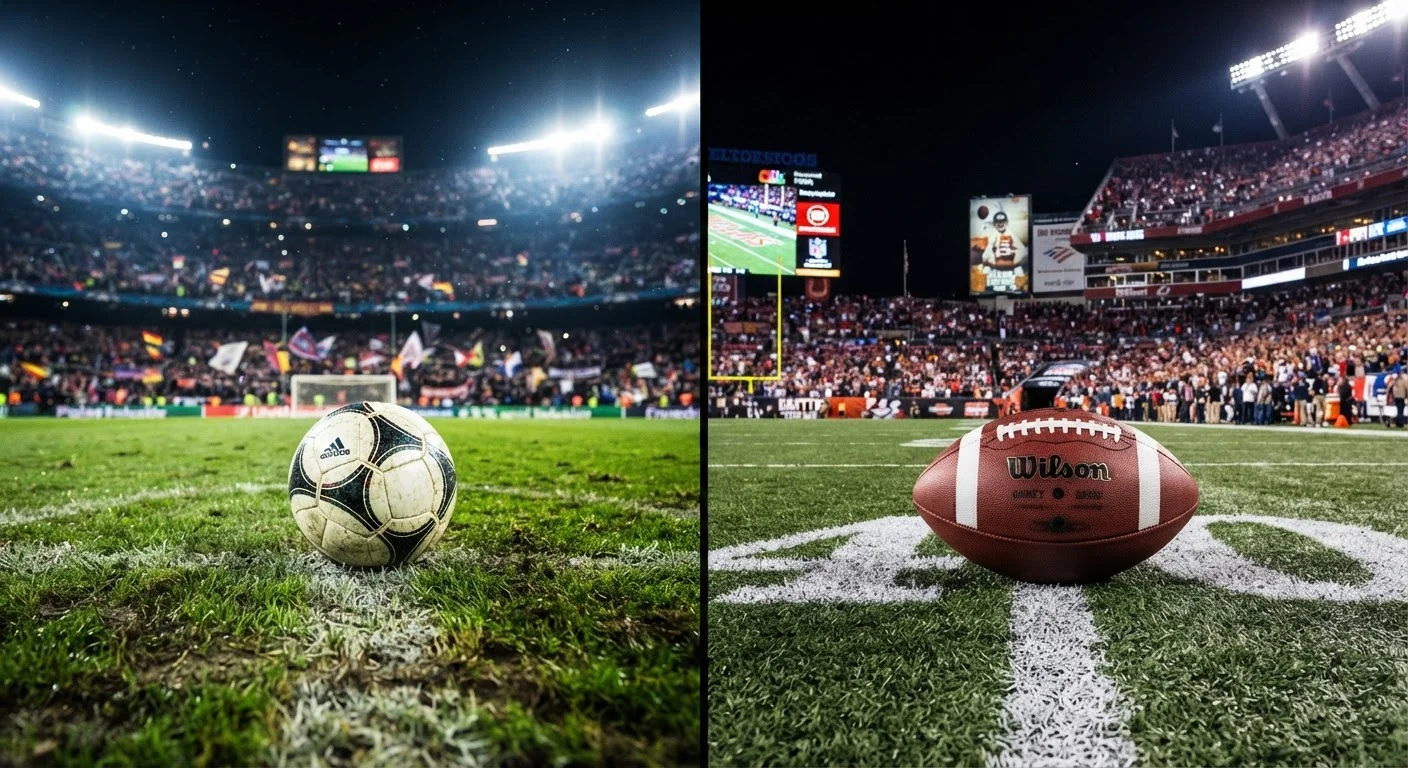
How Each Game Actually Works
At their core, soccer and American football are structured around fundamentally different philosophies of play. Soccer - known globally as association football - is a continuous, free-flowing game. Two teams of 11 players compete across two 45-minute halves with minimal stoppages, aiming to advance a round ball into the opposing goal using any body part except the arms and hands (for outfield players). The simplicity of the rules is a major part of the sport's global appeal. For a deeper look at rules that still trip up longtime observers, see our breakdown of the most misunderstood rules in American sports.
American football is built on a series of discrete plays. An offense has four attempts - called downs - to advance the ball 10 yards; failing to do so surrenders possession. Scoring involves touchdowns, field goals, and safeties. The game clock runs but stops frequently for incomplete passes, penalties, and out-of-bounds plays, meaning a 60-minute game clock can stretch across three or more real-world hours. New fans should consult our plain-language NFL guide for a full breakdown.
| Criterion | Soccer | American Football |
|---|---|---|
| Game Duration | 90 min + stoppage time | 60-min clock (~3+ hrs real time) |
| Live Action Per Game | ~60 minutes continuous | ~11 minutes of live play |
| Players Per Side | 11 | 11 (offense/defense rotate) |
| Primary Fitness Demand | Aerobic endurance | Explosive power and strength |
| Global Fanbase | ~3.5 billion worldwide | Primarily U.S.-based |
| Scoring Frequency | Low (avg. ~2-3 goals/match) | High (avg. ~45-50 pts/game) |
| Position Specialization | Moderate - versatile roles | Very high - highly specialized |
| Primary Injury Risk | Lower-body musculoskeletal | Concussions, full-body contact |
Athletic Demands and Fitness Profiles
The fitness requirements of each sport are distinct enough that athletes who excel in one may struggle significantly in the other. Soccer demands elite aerobic endurance. Outfield players typically cover between 7 and 9 miles per match, combining sustained jogging with explosive sprints and rapid directional changes. This puts a high premium on cardiovascular capacity, lean muscle efficiency, and mental stamina over 90-plus minutes of near-constant movement.
American football, by contrast, is a sport of intermittent explosiveness. Most plays last between 4 and 7 seconds, followed by a reset. Different position groups have vastly different physical profiles: offensive linemen are among the largest athletes in professional sports, prioritizing mass and leverage, while wide receivers and defensive backs require sprinter-level speed. The specialization is extreme - a team's kicker may go entire quarters without touching the ball. For a look at how athletes navigate these contrasting physical worlds across sports, see our article on playing different sports back-to-back.
Culture, Fanbase, and Global Reach
Soccer holds an unmatched position in global sport. With an estimated 3.5 billion followers worldwide - roughly half the global population - it is the common language of sport across Europe, Latin America, Africa, and Asia. The FIFA World Cup, held every four years, is widely considered the most-watched single sporting event on the planet.
American football's dominance is largely concentrated within the United States, where the NFL regularly claims the top spots in American television ratings. The Super Bowl is a genuine cultural event domestically, drawing over 100 million U.S. viewers annually. International expansion efforts have grown, with NFL games now played in London and Frankfurt, but the sport's global footprint remains a fraction of soccer's. Within the U.S., however, the cultural grip of football - from high school Friday nights to college Saturdays to NFL Sundays - is difficult to overstate.
3.5B
Estimated global soccer fans
Soccer's worldwide following makes it by far the most-watched sport globally, according to estimates from sports research organizations.
~11 min
Actual live play per NFL game
A Wall Street Journal analysis found that the average NFL broadcast contains approximately 11 minutes of live ball-in-play action.
7-9 miles
Distance covered per soccer match
GPS tracking studies of professional soccer players consistently show outfield athletes covering this range per 90-minute match.
Injury Risk and Safety Considerations
Both sports carry meaningful injury risks, though the types and mechanisms differ considerably. American football's contact nature - particularly full-speed collisions between large, fast athletes - has brought significant attention to concussions and long-term brain health. The sport has implemented rule changes and improved equipment standards in recent decades, but head injury risk remains an active area of medical research and public concern. Parents evaluating youth football should consider the differences between flag and tackle football as a starting point.
Soccer's injury profile is dominated by lower-body musculoskeletal issues - hamstring strains, anterior cruciate ligament (ACL) tears, and ankle sprains - driven by the sport's constant running and rapid cutting. Heading the ball has also come under increased scrutiny in youth soccer, prompting many governing bodies to restrict heading at younger age groups as a precautionary measure. Neither sport is without risk, and players at every level benefit from proper conditioning, technique coaching, and appropriate rest periods.
This article is for general informational and educational purposes only. It does not constitute medical or professional sports training advice. Consult a qualified healthcare or sports medicine professional regarding any health or injury concerns.