What Sets These Two Categories Apart
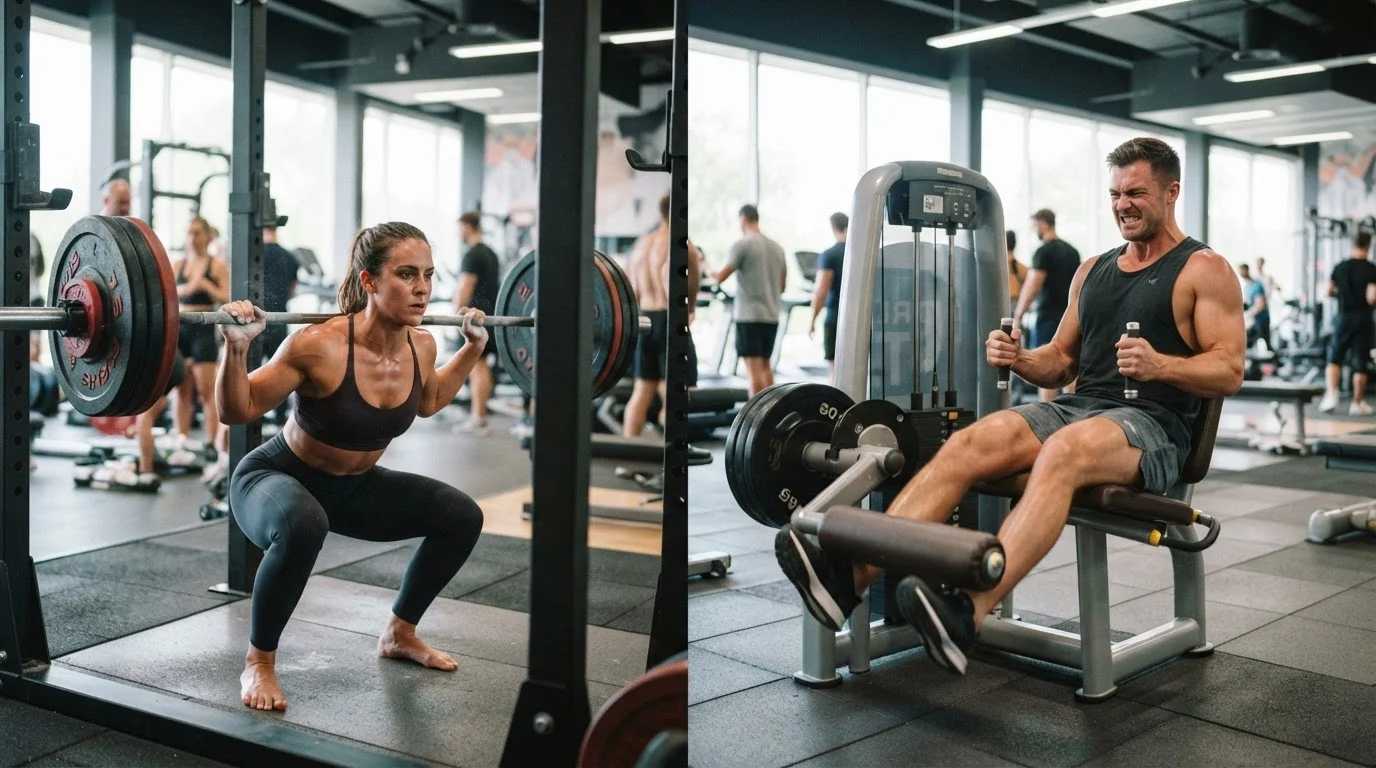
Every resistance exercise you perform falls into one of two broad categories. Compound movements recruit multiple joints and muscle groups simultaneously - think squats, deadlifts, bench press, rows, and overhead press. Isolation exercises focus the work on a single joint and the primary muscle crossing it - bicep curls, leg extensions, tricep pushdowns, and lateral raises are classic examples.
The distinction matters because it shapes how much total stimulus each exercise delivers, how long it takes to recover from, and what training goal it serves best. Neither category is inherently superior; they answer different questions.
If you're already building structure into your week, see our weekly movement planning guide for a practical framework that can accommodate both approaches.
The Case for Compound Movements
Compound lifts are the backbone of most evidence-based strength and hypertrophy programs - and for good reason. By loading multiple muscle groups in a single movement, they generate a large hormonal and neuromuscular training stimulus relative to the time invested. A properly executed deadlift, for instance, challenges the hamstrings, glutes, spinal erectors, lats, and grip simultaneously.
| Compound Movements | Isolation Exercises | |
|---|---|---|
| Muscles targeted | Multiple joints and muscle groups | Single joint, one primary muscle |
| Time efficiency | High - more stimulus per set | Lower - requires more sets for same volume |
| Skill requirement | Higher - complex coordination | Lower - simpler movement pattern |
| Best for strength gains | Yes - primary driver of strength | Supplementary role only |
| Best for muscle imbalances | Limited - hard to isolate weak links | Excellent - precise targeting |
| Rehab applicability | Limited in early rehab phases | Frequently prescribed in rehab |
| Functional carry-over | High - mirrors real-world movement | Lower - highly specific |
Research in sports science consistently shows that multi-joint exercises produce significant gains in both strength and lean mass, particularly for beginners and intermediates. They also tend to translate more directly to everyday functional movement patterns - pushing, pulling, hinging, and squatting are actions the body performs outside the gym as well.
For those working within tight schedules, compound movements offer the highest training density per session. If you only have three hours a week to lift, prioritizing compounds gives you the most physiological return on that investment.
Where Isolation Exercises Earn Their Place
Isolation exercises are often dismissed as vanity work, but that reputation undervalues their practical role. When a specific muscle lags behind or fails to activate adequately during compound lifts, targeted isolation work can address that gap directly. A lifter whose upper back fatigues before their legs on a squat may benefit from adding face pulls or band pull-aparts to bring the rear deltoids and mid-traps up to par.
In rehabilitation contexts, isolation work is frequently essential. Physical therapists commonly prescribe single-joint exercises to rebuild strength around an injured joint without loading the surrounding structures prematurely. This controlled, lower-demand approach allows tissue to adapt progressively.
For intermediate and advanced trainees focused on hypertrophy (muscle growth), isolation exercises add targeted volume to specific muscles that may not receive sufficient stimulus from compound work alone. The long head of the bicep, for example, is difficult to fully develop without some form of elbow-flexion isolation exercise.
Use Isolation to Fix, Not Replace
If a compound lift is breaking down at a specific point - for instance, your knees cave during a squat - use targeted isolation work to strengthen the responsible muscles (in this case, hip abductors and glutes). Then re-integrate that strength into the compound pattern. Isolation exercises work best as a support system for your compound movements, not a replacement for them.
That said, isolation exercises demand more total sets to match the training volume achievable through compounds, making them less efficient when time is the primary constraint. See how this trade-off compares to other training decisions in our intensity comparison guide.
Programming Both Intelligently
The most practical approach for most people is a compound-first, isolation-finish structure. Begin each session with the compound movements that require the greatest neuromuscular coordination and overall load - when you're freshest. Use isolation exercises at the end of the session to address specific targets or add volume to lagging areas.
A sample lower-body session might look like: barbell squat → Romanian deadlift → leg press, followed by leg curls and calf raises. The compound lifts do the heavy lifting (literally), and the isolation work fills in the gaps.
How you split the proportion depends on your goal. A powerlifter or someone training primarily for functional strength may dedicate 80-90% of their volume to compounds. A bodybuilder may use a closer to 60/40 split. A general fitness-oriented individual just looking to stay healthy, build some muscle, and feel good typically does well somewhere in between.
For those whose daily life doesn't accommodate structured gym sessions, our guide on building movement into a busy day offers strategies to keep activity consistent even outside a formal training environment. And if you're weighing the environments where you'll perform these exercises, our gym vs. home workout comparison covers the practical trade-offs.
This article is for general informational and educational purposes only and does not constitute medical or professional fitness advice. Consult a qualified healthcare provider or certified fitness professional before beginning or modifying any exercise program, particularly if you have a pre-existing health condition or injury.