
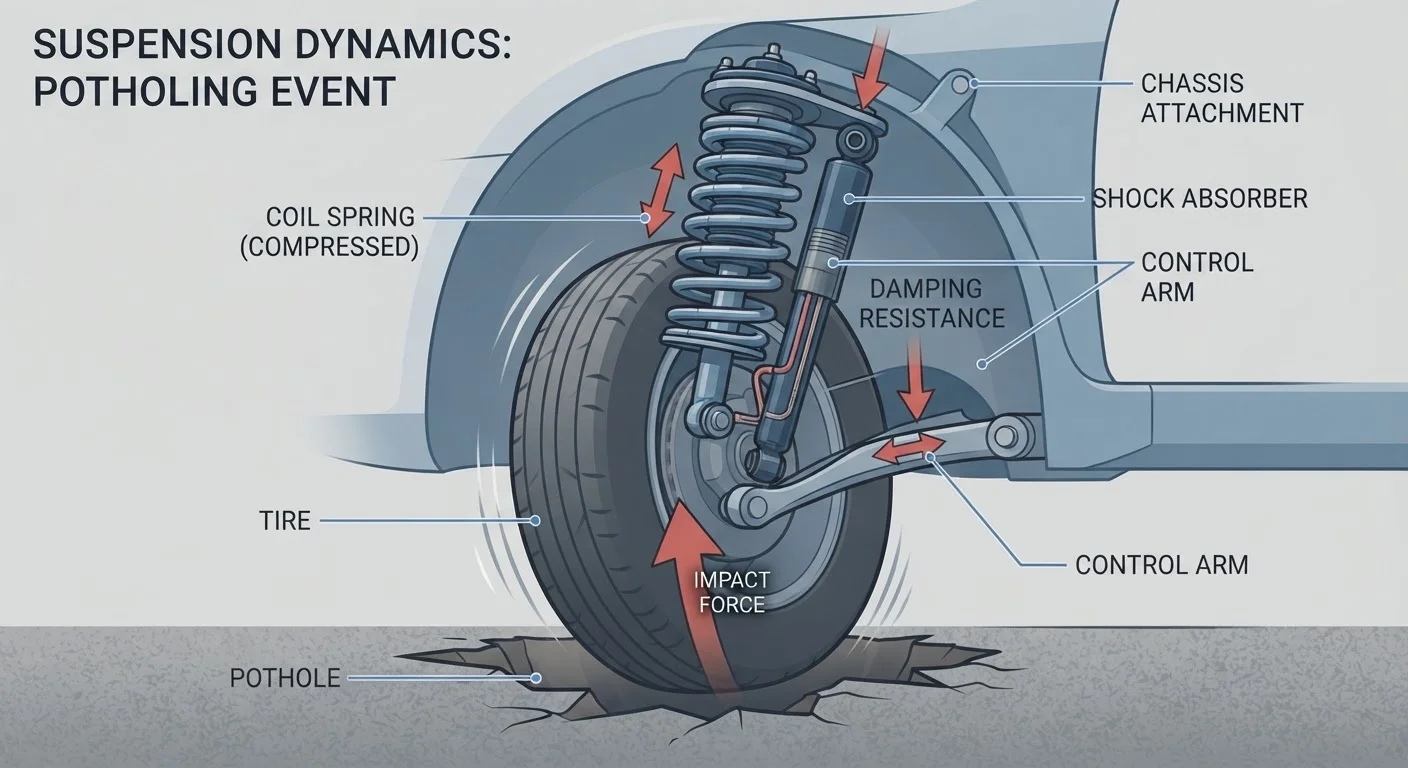
The Moment of Impact: Impulse in Action
You're driving along a familiar street when the front wheel drops into a pothole. What feels like a jarring thud is actually a precise physics event. The rim of the pothole applies a sudden upward force to your tire over a very brief time interval - physicists call this combination of force and time an impulse.
Impulse equals force multiplied by the duration of contact (J = F·Δt). It also equals the change in momentum of the object being struck. Because the time window is extremely short - often just milliseconds - the force required to produce that change in momentum becomes very large. That's why even a modest-sized pothole can feel violent at speed.
This same principle is why boxing gloves are padded: spreading the stopping force over more time reduces the peak force at any given moment. Your car's suspension is engineered around exactly this idea. See how everyday impulse physics shows up in other familiar contexts.
Springs, Dampers, and the Art of Absorbing Energy
After the initial impulse, your suspension system takes over. The coil springs - governed by Hooke's Law (F = kx, where k is the spring constant and x is the displacement) - compress in response to the upward force. A stiffer spring (higher k) resists compression more aggressively, transmitting more force to the cabin. A softer spring allows more travel, spreading the energy dissipation over time.
But springs alone would make your car bounce like a pogo stick. Shock absorbers (dampers) convert that kinetic energy into heat through fluid resistance, preventing oscillation. Together, the spring and damper form a classic mass-spring-damper system - a fundamental model in mechanical engineering that describes how structures respond to sudden forces.
Slow Down Before You Hit the Pothole
If you spot a pothole ahead and have room to slow down safely, do it. Even a modest speed reduction dramatically cuts the kinetic energy your suspension must absorb. Avoid sudden hard braking directly over the pothole, though - compressing the suspension mid-impact can actually increase the force transferred to the wheel.
For a deeper look at how force and friction interact in vehicle dynamics, our article on stopping distance physics covers the same principles applied to braking.
Speed, Kinetic Energy, and Why It Multiplies Fast
Kinetic energy is expressed as KE = ½mv², where m is mass and v is velocity. The squared term means speed has an outsized effect: a car traveling at 40 mph carries four times the kinetic energy of the same car at 20 mph. When that energy is suddenly redirected by a pothole's edge, the suspension and tires must handle all of it.
4×
Energy increase when doubling speed
Because kinetic energy scales with velocity squared, doubling your speed quadruples the energy your suspension must manage at impact.
~61%
Energy reduction: 40 mph vs. 25 mph
Calculated from KE = ½mv²; reducing speed from 40 to 25 mph cuts the kinetic energy involved in a pothole impact by roughly 61%.
Milliseconds
Typical pothole impact contact time
The brief duration of wheel-to-pothole-edge contact is what drives peak impact forces so high - a core principle of impulse physics.
This is why road engineers and driving safety experts consistently emphasize speed reduction near known road hazards. The physics aren't a suggestion - they're a constraint. Reducing speed before a pothole is one of the most effective ways to reduce peak impact force and protect your vehicle's components. For a full picture of what road forces mean for your car's long-term health, see keeping a car roadworthy for the long haul.
What Potholes Do to Your Car Over Time
A single pothole hit rarely destroys a component outright. What potholes cause most consistently is metal fatigue - microscopic cracks that propagate through repeated stress cycles. Ball joints, control arms, tie rods, and wheel bearings are all susceptible. Each impact applies a stress load; over hundreds of impacts, components that would otherwise last years can fail prematurely.
Wheel alignment is another casualty. The precise geometry of your steering and suspension - camber (vertical tilt of the wheel), toe (inward or outward angle), and caster (steering axis inclination) - is calibrated to tight tolerances. A sharp lateral impact can shift these angles, causing uneven tire wear and subtly altered handling that drivers often don't notice until the damage is significant.
Understanding how potholes stress vehicle systems also helps you recognize dubious claims about suspension products. Our guide to spotting bad science online can help you evaluate those claims using the same basic principles covered here.
This article is for general informational and educational purposes. For vehicle safety concerns or mechanical issues, consult a qualified mechanic.