Physics Is Already Running Before Breakfast
Most people think of physics as something that happens in a lab or on a whiteboard - equations disconnected from real life. In fact, the forty-five minutes between your alarm going off and your front door closing are packed with demonstrations of classical mechanics, thermodynamics, optics, and fluid dynamics. None of it requires a textbook to experience; it just requires knowing where to look.
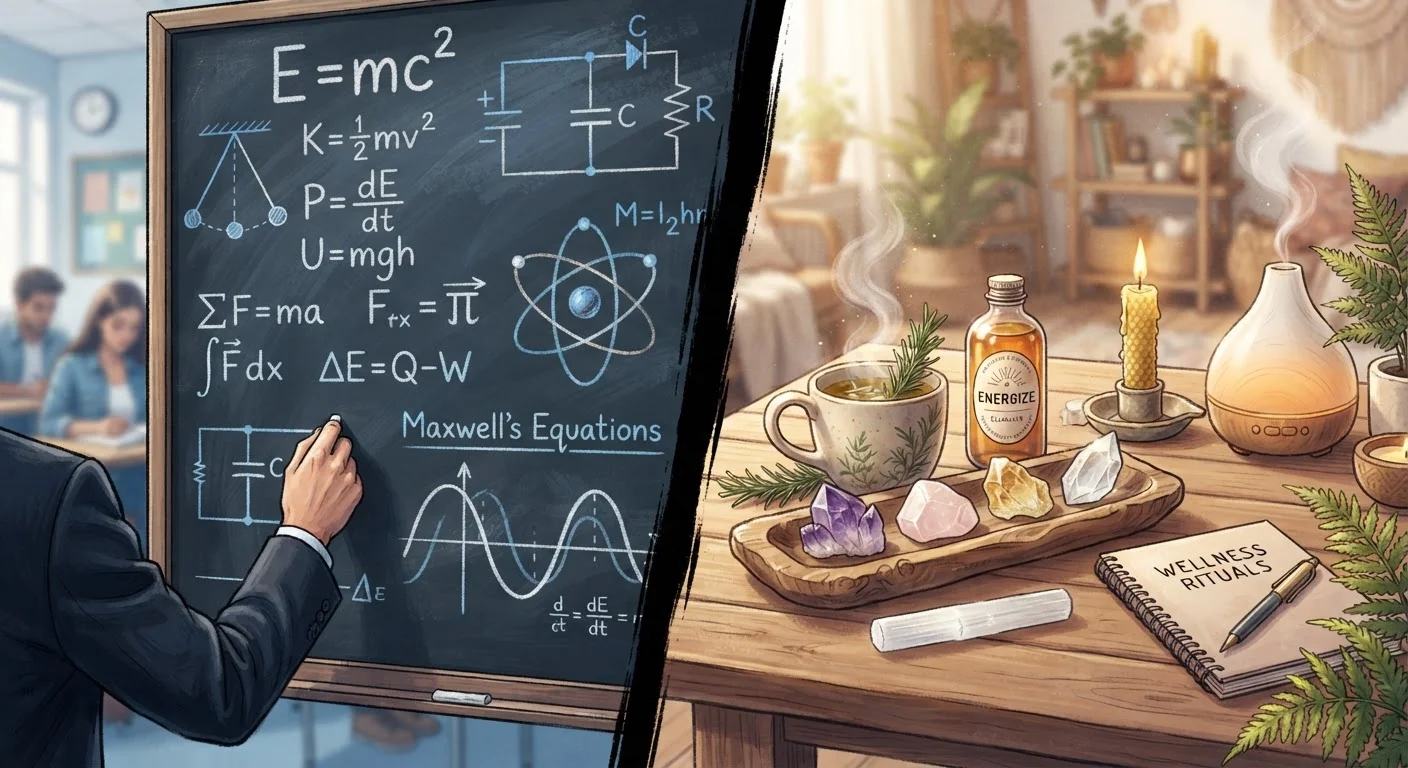
The principles below are not trivia. They are the operational logic underneath systems you depend on every single morning. Understanding them won't change how you scramble eggs, but it will change how you see the world - which is exactly what good science is supposed to do. For a deeper look at how physicists define the terms involved, see how physicists define energy - the everyday meaning and the technical one are often further apart than you'd expect.
Thermal Conduction at the Stovetop
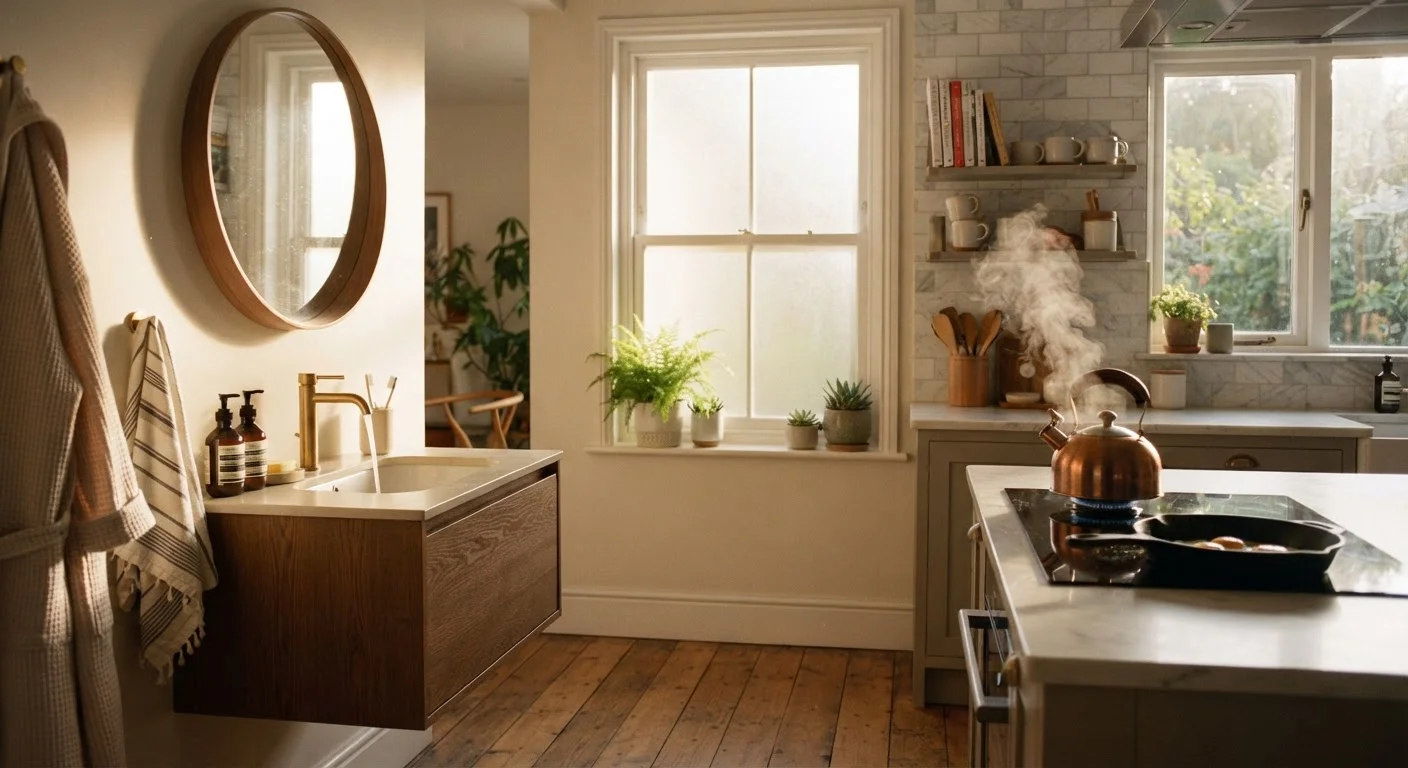
When you place a pan on a burner, heat moves into the metal through conduction - the transfer of thermal energy between particles in direct contact. Metals conduct heat efficiently because their electrons move freely, carrying energy quickly through the material. That's why a cast-iron pan stores heat so well (high thermal mass) while a thin aluminum pan responds faster to temperature changes (lower thermal mass but high conductivity).
The handle staying cooler than the cooking surface is also conduction at work - or rather, its deliberate interruption. Plastic and wooden handles are poor conductors, so thermal energy doesn't travel to your hand at the same rate it travels through the pan body.
Metals conduct heat through freely moving electrons - that's why your pan heats faster than its handle.
The Law of Reflection in Your Bathroom Mirror
A flat mirror works because light obeys a simple rule: the angle at which it strikes a surface equals the angle at which it bounces back, measured from an imaginary line perpendicular to that surface (called the normal). This is the law of reflection, and it holds whether the surface is a polished mirror, a calm lake, or a radar dish.
The reason a flat mirror produces a laterally reversed image - your right hand appears on the left - is a consequence of this geometry, not a flaw. The image you see is a virtual image: your brain traces the reflected rays backward to a point behind the mirror where they appear to originate.
Every mirror, from your bathroom to a radio telescope, operates on the same law of reflection.
Fluid Statics and Your Shower Pressure
Fluid statics - the physics of fluids at rest - explains why water exits your showerhead at useful pressure without you doing anything. The municipal water supply is pressurized, often using elevated storage tanks where gravitational potential energy does the work. The higher the water source above your fixture, the greater the pressure at the outlet.
Inside your home, pressure also builds as water sits in supply lines. When you open the valve, you're releasing that stored pressure differential, and Bernoulli's principle (relating pressure and flow speed) governs how the stream behaves. Understanding your home's plumbing layout makes these pressure dynamics easier to visualize.
Your shower pressure is gravitational potential energy converted to fluid flow - stored before you even wake up.
Buoyancy in the Sink and Shower
Buoyancy, described by Archimedes' principle, states that any object submerged in a fluid experiences an upward force equal to the weight of the fluid it displaces. You notice this every time a shampoo bottle floats or sinks in the tub depending on how full it is. A full bottle is denser than water on average and sinks; a mostly empty bottle traps air, lowering its average density below that of water, so it floats.
The same principle explains why a bar of soap sinks (denser than water) while a loofah floats (less dense on average due to trapped air). Buoyancy isn't unique to large objects - it's a property of every fluid interaction, operating at any scale.
Whether your shampoo bottle sinks or floats depends entirely on its average density relative to water.
Newton's Third Law and Every Door You Open
Newton's third law states that for every force, there is an equal and opposite reaction force. It's easy to misread this as forces canceling out - they don't, because they act on different objects. When you push a heavy door open, the door pushes back on your hand with equal force. You move the door because the net force on it (your push minus friction) is unbalanced. Your feet don't slide because the floor pushes back on them.
This principle is operating continuously - in the pressure your feet exert on the floor, in the tension of a cabinet spring, in the resistance of a stiff jar lid. For a plain-language walkthrough of all three of Newton's laws, this reference on Newton's laws connects the equations to situations you already know.
Newton's third law means every force you exert on the world is matched by a force the world exerts back.
Thermodynamics and the Coffee That Won't Stay Hot
The second law of thermodynamics tells us that heat flows spontaneously from hotter objects to cooler ones - never the reverse, without external input. Your coffee cools because thermal energy moves outward into the cooler air, mug surface, and countertop through a combination of conduction, convection (air currents carrying heat away), and radiation (infrared energy emitted by any warm object).
Insulated mugs slow this process by introducing vacuum gaps or low-conductivity materials that interrupt all three pathways. They don't eliminate heat loss - they reduce the rate of it. The second law isn't being broken; it's being delayed. This same logic governs home insulation, refrigeration, and every thermal system in engineering.
Insulated mugs don't stop heat loss - they slow the rate at which thermodynamics takes your coffee's warmth.
The Bigger Picture
These aren't isolated curiosities - they're connected. The fluid statics governing your shower pressure are the same principles engineers apply to municipal water towers. The conduction at your stovetop scales up to industrial furnaces. Once you recognize these patterns in the small, familiar world of your home, the larger built environment starts to make more sense too.
Start Noticing, Then Go Deeper
Try mentally labeling one physics principle each morning as you move through your routine. Conduction at the toaster, reflection at the mirror, buoyancy at the sink. This habit of active observation is how scientific intuition actually develops - not from memorizing formulas, but from connecting them to experience. Once the pattern clicks in your kitchen, it tends to click everywhere else too.
If this orientation to household physics has you curious about the infrastructure behind your walls, our guide to home plumbing systems explains exactly how water pressure and drain-waste-vent design keep things flowing. And for what happens once you step outside, the physics behind every pothole your car hits picks up where your front door leaves off.