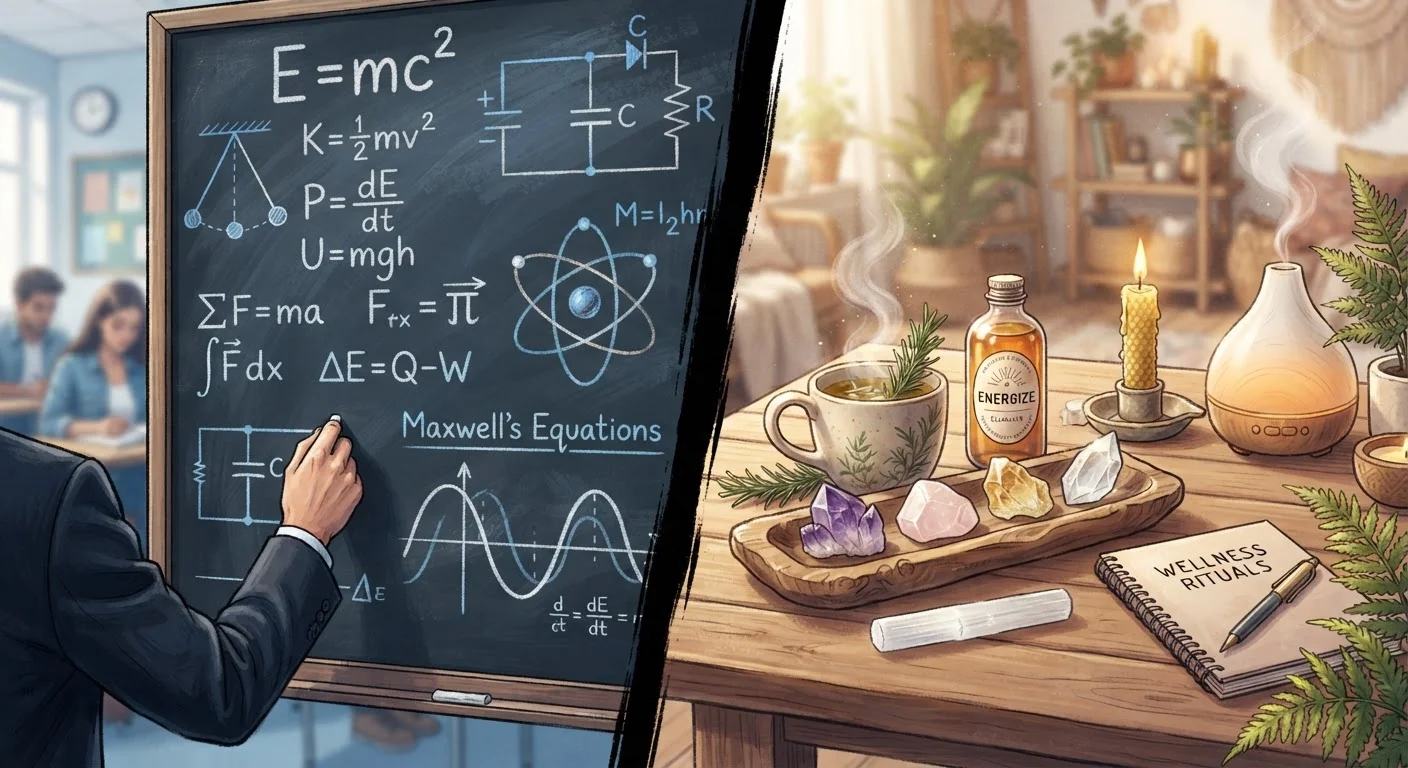

Why Physics Literacy Is a Practical Skill
Viral science claims spread faster than corrections. A post showing a gadget that 'runs on water,' a supplement that 'converts fat directly into energy,' or a new engine that 'defies thermodynamics' can rack up millions of shares before a physicist has time to respond. The good news is that you don't need years of study to evaluate these claims - you need a working knowledge of a small number of physical principles that underpin virtually all of modern science.
Physics isn't just lab equipment and equations. As explored in everyday physics you rely on before leaving the house, the science is embedded in your morning routine, your commute, and your kitchen. That familiarity is a starting point, not a barrier.
Conservation of energy
A fundamental law stating that energy cannot be created or destroyed - only converted from one form (like heat) to another (like motion). Total energy in a closed system remains constant.
Newton's Third Law
For every action (force), there is an equal and opposite reaction. If you push against a wall, the wall pushes back on you with the same force.
Thermodynamics
The branch of physics governing heat, energy, and work. Its first two laws - energy is conserved, and disorder tends to increase - rule out perpetual motion machines entirely.
Perpetual motion
A hypothetical machine that runs indefinitely without any energy input. It is physically impossible because it would require violating the laws of thermodynamics.
Peer review
The process by which other qualified scientists examine a study's methods and conclusions before it is published. It is the main quality-control mechanism in scientific publishing.
Measurability
The requirement that physical claims produce effects that can be detected and quantified by instruments, and that those measurements can be repeated by independent observers.
The Three Principles That Catch the Most Misinformation
Most physics-based misinformation breaks one of three foundational rules:
- Conservation of energy. Energy cannot be created from nothing or destroyed - it only changes form. A car engine converts chemical energy in fuel into motion and heat. A battery stores electrical energy and releases it. Any claim that a system produces more energy than it takes in should be treated as false until proven otherwise. As our companion article on common misreadings of the word 'energy' explains, loose use of 'energy' in popular media is itself a warning sign.
- Newton's Laws of motion. Forces have sources, and every action has an equal and opposite reaction. A claim that something moves without any force acting on it, or that a force appears without a corresponding reaction, violates well-tested mechanics. Newton's three laws in plain language connect these ideas to situations you already understand.
- Measurability. Physical quantities - force, pressure, temperature, velocity - are measurable. Extraordinary claims must produce measurable results that independent observers can verify. If a claim relies entirely on effects that can't be detected by instruments, that's not a gap in our instruments - it's a gap in the claim.
How to Apply These Principles to a Viral Claim
Consider a common type of viral claim: a small device attached to a car's fuel line that supposedly doubles gas mileage. Apply the three-principle check:
- Energy conservation: The fuel contains a fixed amount of chemical energy. Releasing more mechanical energy from it than the combustion process allows would require new energy from somewhere. Where does it come from? If the claim doesn't answer that, it fails.
- Forces and Newton's Laws: If the device is said to alter airflow or fuel atomization, ask whether there's a plausible mechanism - and whether it produces a measurable force change. Vague references to 'optimizing combustion' without a physical explanation are a red flag.
- Measurability: Has the claimed improvement been measured under controlled conditions by independent testers? Real improvements in fuel efficiency are detectable and repeatable. The physics of stopping distance is a good example of how measurable forces actually translate into real-world outcomes.
Running this mental checklist takes about thirty seconds and reliably separates plausible claims from physically impossible ones.
Red Flags in Science Reporting to Watch For
The 'Energy Source' Question Always Works
When evaluating any surprising claim, ask one question first: where does the energy come from? Every physical process requires an energy input, and that input must be accounted for. If a claim doesn't clearly identify its energy source - or implies the source is unlimited - conservation of energy tells you the claim cannot be physically valid.
Even legitimate science can be misrepresented in headlines. Beyond the physics itself, watch for these patterns in how claims are presented:
- 'Scientists discover…' without naming who or where
- Credible findings come from identifiable researchers at identifiable institutions publishing in peer-reviewed journals. Anonymity suggests the finding may not exist.
- The word 'proven'
- Science advances through evidence that supports or contradicts hypotheses - rarely through absolute proof. 'This proves X' language usually signals overreach.
- A single study presented as settled science
- One study, no matter how well designed, is a data point, not a conclusion. Consensus builds over many replicated studies.
- Claims that 'they' don't want you to know
- Suppression narratives are a hallmark of pseudoscience. Real scientific disputes happen openly in journals and conferences, not in secret.
For a related example of how misconceptions spread even about well-understood phenomena, see friction myths most people get wrong.
Building Your Own Physics Intuition
Physics intuition grows from paying attention to the world around you. When you feel the jolt of a pothole - which involves impulse, momentum transfer, and suspension forces as detailed in the physics behind every pothole - you're experiencing Newton's laws directly. Each of these moments is an opportunity to connect abstract principles to tangible experience.
Start with conservation of energy as your default skepticism tool. Ask 'where does the energy come from, and where does it go?' for any surprising claim. Add the measurability check: 'Has this been independently measured?' Most physics-based misinformation collapses under those two questions alone. The goal isn't to become a physicist - it's to hold claims to the same standard that physics holds the universe: consistent, measurable, and without mysterious exceptions.