Why Flat Surfaces Are a Clutter Magnet
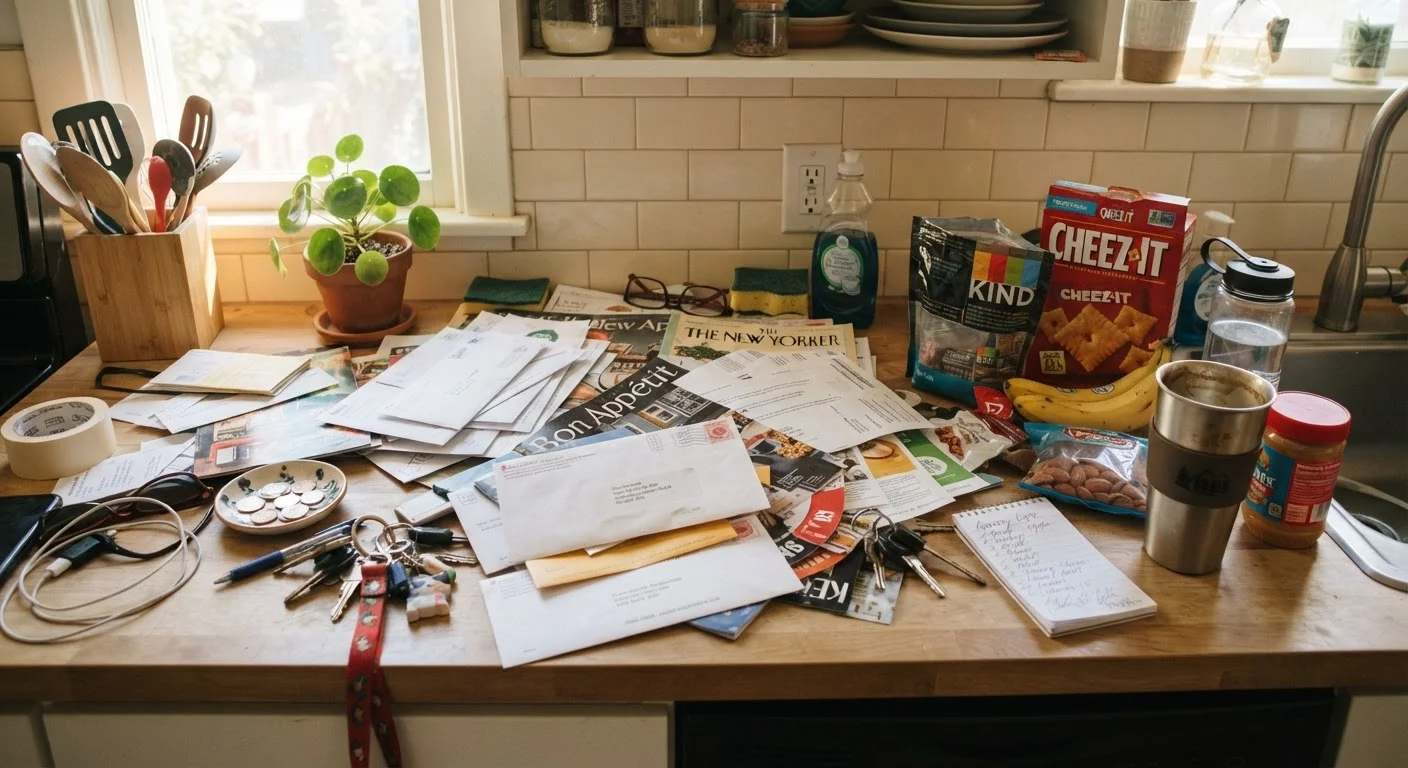
Every home has them: a counter that disappears under a week's worth of mail, a dining table that hasn't been fully cleared in months, a bedroom chair that functions as a fabric filing system. These aren't signs of laziness. They're the predictable outcome of how most homes are set up - or more precisely, how they're not set up.
Flat surfaces accumulate clutter for one fundamental reason: they're available. When an item doesn't have a clear, accessible home, it lands wherever there's room. Counters, tables, and chairs are almost always in the right place at the right moment, which makes them the path of least resistance.
Understanding this as a design problem - not a discipline problem - is the starting point. The goal isn't to tidy more frequently; it's to make tidying unnecessary by interrupting the habit at its source. To understand the concepts behind this approach, our home organizer's vocabulary guide lays out the foundational terms and systems clearly.
Clutter Isn't a Character Flaw
Surface clutter accumulates for structural reasons, not personal failings. When a home doesn't have a clear, accessible home for an item, that item will land on the nearest flat surface - every time. Addressing the structure is more effective than relying on motivation to keep tidying.
The Mistakes That Keep Surfaces Buried
Most surface clutter can be traced back to a small set of recurring mistakes. The patterns are consistent across households - and so are the fixes. Recognizing which mistakes apply to your home is the first step toward lasting change.
Using the kitchen counter as a default landing zone for mail, bags, keys, and random household items.
Why it happens: The counter is the first horizontal surface most people encounter when they walk in from outside, making it a natural dumping ground when no intentional entry zone exists.
Keeping appliances, containers, and tools on the counter "just in case" they're needed soon.
Why it happens: People overestimate how often they use certain items and underestimate how much counter real estate those items consume.
Treating the dining table as secondary storage between meals.
Why it happens: Tables feel "temporary" - items get placed there with the intention of moving them later, but later rarely comes.
Stacking items on chairs when seating isn't being used.
Why it happens: Unused chairs register as available horizontal space rather than functional furniture, especially in home offices or bedrooms.
Allowing decorative surfaces - shelves, nightstands, side tables - to fill up with unrelated objects.
Why it happens: Once one item is placed somewhere "temporarily," other objects naturally cluster around it, a phenomenon sometimes called the broken windows effect in organizing.
If these patterns sound familiar, you're not alone - and the solution rarely involves more storage. As we explore in our look at common organizing myths, adding more bins and baskets without addressing placement habits tends to make the problem worse, not better.
Clearing Surfaces Without a System Won't Last
Wiping a counter clean feels satisfying, but without a designated spot for each displaced item, everything will migrate back within days. Before you clear any surface, decide where each category of item will live permanently. Otherwise you're tidying, not organizing.
Building a Home Where Surfaces Stay Clear
The most effective organizing systems are ones that require almost no conscious effort to maintain. That means designing your space so the easy choice and the right choice are the same thing.
Start by auditing each flat surface in your home. Ask: what actually belongs here permanently, and what has drifted here without a real home? For items in the second category, find or create a specific place - a hook, a labeled drawer, a shelf - within a few steps of where the item keeps landing. Proximity matters enormously. If the solution requires walking to another room, it won't stick.
Trays are a particularly useful tool because they impose a natural limit. A tray on a counter signals: things go inside the tray, not beside it. When the tray is full, that's the cue that something needs a better home - not that the tray needs to be bigger.
80%
Of clutter is due to disorganization, not lack of space
This commonly cited organizing industry estimate suggests that most households have enough physical space - the problem is the absence of clearly defined homes for everyday items.
40%
Of Americans describe their homes as cluttered
A UCLA study on American family life found that clutter - particularly in shared and high-traffic spaces - was a significant source of household stress.
For shared households, the conversation about surface rules is just as important as the physical setup. Our article on getting your household on board with organizing offers practical ways to align everyone without turning into the household enforcer.
Keeping surfaces clear is ultimately a system question, not a willpower question. Once your home has a clear answer to "where does this go?" for every category of everyday item, the surfaces take care of themselves. For those ready to build on this foundation, our guide to organizational systems that last long-term covers what separates durable habits from short-lived tidying bursts.