Why Watering Myths Are So Persistent
Gardening knowledge often travels through informal channels - a tip from a neighbor, a phrase repeated in a gardening column, a habit passed down from a grandparent. Many of these practices started with a kernel of truth but became distorted over time or were never grounded in evidence to begin with. The result is a set of watering habits that feel right but frequently work against the plants they're meant to help.
Understanding how water actually moves through soil and how roots respond to moisture cycles is the foundation of effective irrigation. The myths below are among the most common - and the most likely to cause real harm to your garden.
50%
Outdoor water wasted through inefficient irrigation
The U.S. Environmental Protection Agency estimates that roughly half of the water used for landscape irrigation is lost to runoff, evaporation, or overwatering.
1-1.5 inches
Weekly water most lawns and gardens need
Cooperative Extension programs across the U.S. generally recommend this weekly target - counting rainfall - as a baseline for most temperate garden settings.
Common Watering Misconceptions, Corrected
Each of the following myths shapes the way millions of home gardeners water - often with unintended consequences ranging from wasted water to plant loss.
Myth
Watering plants in the middle of the day will burn their leaves because the droplets act like tiny magnifying glasses.
Fact
Leaf scorch from water droplets is not supported by scientific research under real garden conditions. The main problem with midday watering is evaporation loss, not burning.
The idea that water beads on leaves focus sunlight and scorch plant tissue has been repeated for generations, but studies - including research published in New Phytologist - have found the geometry of most leaf surfaces actually prevents droplets from focusing light at damaging intensities. The real reason to avoid midday watering is practical: high temperatures and direct sun cause water to evaporate quickly from the soil surface before roots can absorb it. Morning watering remains ideal because foliage dries before nightfall (reducing disease risk) and soil retains moisture longer during cooler hours.
Myth
More water is always better - plants can never really get too much.
Fact
Overwatering is one of the leading causes of plant decline and death in home gardens, causing root oxygen deprivation and promoting fungal disease.
Plant roots need both water and air to function. When soil stays saturated for extended periods, air pockets fill with water and roots begin to suffocate - a condition that looks deceptively similar to drought stress. Soggy roots also become vulnerable to pathogens like Phytophthora and Pythium, which cause root rot. The solution is to water deeply but allow the soil to partially dry between sessions, particularly for established plants. Container plants are especially at risk because drainage is more limited.
[important_callout]Myth
A little water every day is the best routine for keeping plants healthy.
Fact
Frequent shallow watering encourages roots to stay near the surface, making plants less resilient to heat and drought.
Roots grow toward moisture. When water is applied in small daily doses, it barely penetrates the soil and roots concentrate in the top inch or two. These shallow root systems are poorly equipped to handle a missed watering day, a heat wave, or a dry spell. By contrast, watering deeply and less frequently - typically every two to four days depending on soil type and weather - encourages roots to follow moisture down into cooler, more stable soil layers. This is how plants develop the drought tolerance that sustains them through summer. For guidance on building a garden designed around these principles, see our article on drought-tolerant landscaping.
Myth
Wilting always means a plant needs water immediately.
Fact
Wilting is a general stress response that can be caused by overwatering, root rot, pest damage, or heat - not only drought.
When plants wilt on a scorching afternoon and then recover overnight, the cause is often temporary heat stress rather than a water deficit. The plant is simply losing moisture through its leaves faster than roots can supply it, and recovery occurs naturally once temperatures drop. Wilting that persists into the cool morning hours is more likely tied to a genuine soil moisture problem - but that problem may be too much water, not too little. Check soil moisture at depth (two to three inches down) before watering a wilted plant.
[warning_callout]Myth
All garden soil absorbs and holds water the same way.
Fact
Sandy, clay, and loamy soils behave very differently, requiring different watering frequencies and volumes.
Sandy soils drain rapidly and dry out quickly, often requiring more frequent watering. Clay soils absorb water slowly but hold it for longer - and are particularly susceptible to becoming waterlogged. Loamy soil, with a balanced mix of sand, silt, and clay, offers the most forgiving middle ground. Gardeners who water by a fixed schedule without accounting for soil type often either under- or over-irrigate. Adding organic matter such as compost improves water retention in sandy soils and drainage in clay soils. Understanding your soil is the foundation of smart watering - a point that also affects plant productivity, as explored in our guide on why vegetable gardens underperform.
Putting Better Watering Into Practice
Correcting these habits doesn't require expensive equipment or complicated schedules. A few practical adjustments make a significant difference:
- Use a rain gauge or moisture meter. Guessing is the root cause of most watering errors. A simple rain gauge tells you how much water your garden has already received, and a soil moisture meter removes the ambiguity of judging by appearance alone.
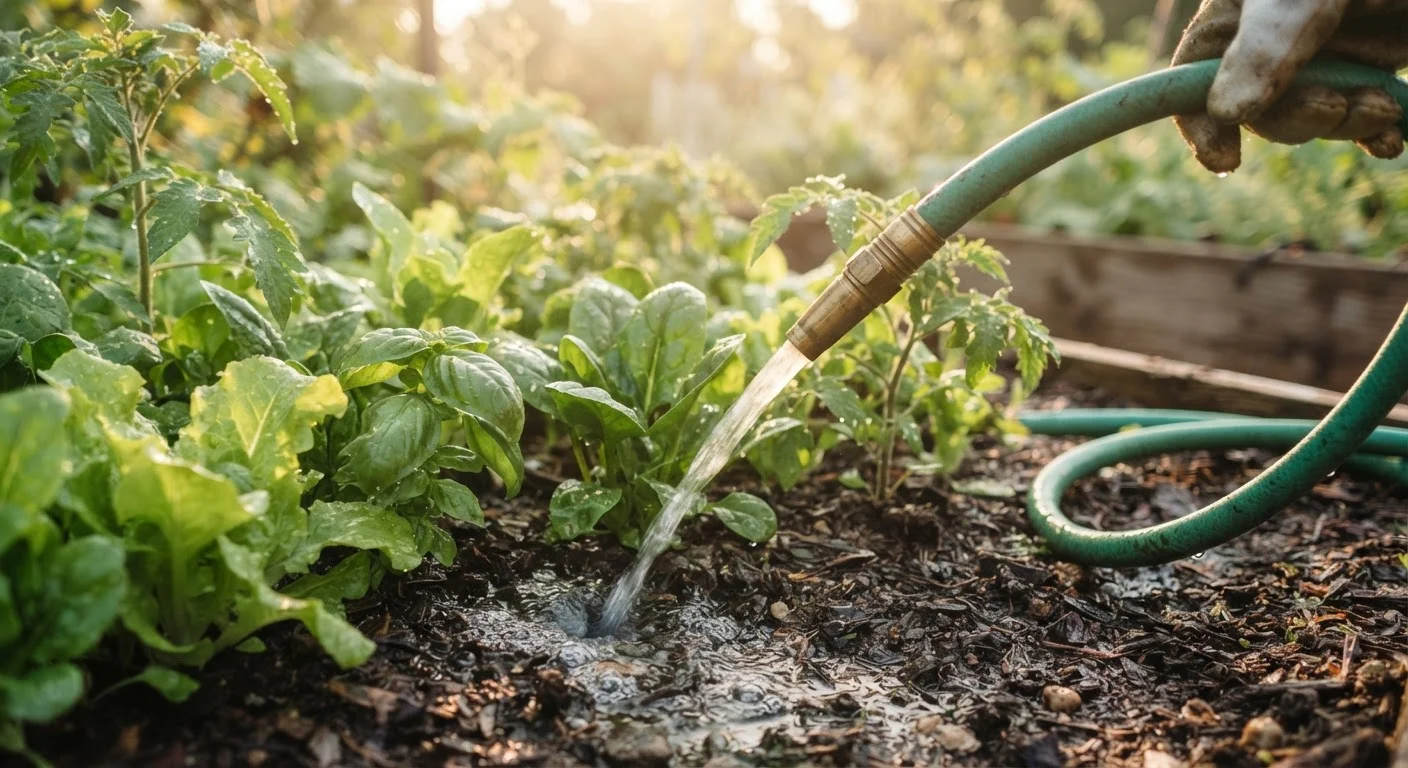
- Water at the base, not overhead. Drip irrigation or soaker hoses deliver water directly to the root zone, minimizing evaporation and keeping foliage dry - which reduces fungal disease pressure.
- Apply mulch. A two- to three-inch layer of organic mulch over the soil surface dramatically slows evaporation and moderates soil temperature, extending the time between necessary waterings.
- Account for your planting method. Raised beds drain more freely than in-ground plots and typically need more frequent attention - something worth factoring into your schedule. Our article on raised beds vs. in-ground planting walks through these drainage differences in detail.
Consistent, informed watering takes less effort than reactive watering - and produces noticeably healthier plants. For those looking to reduce water use further, lawn care fundamentals offers principles that apply broadly across the garden.