How Portions Grew - and Why Nobody Noticed
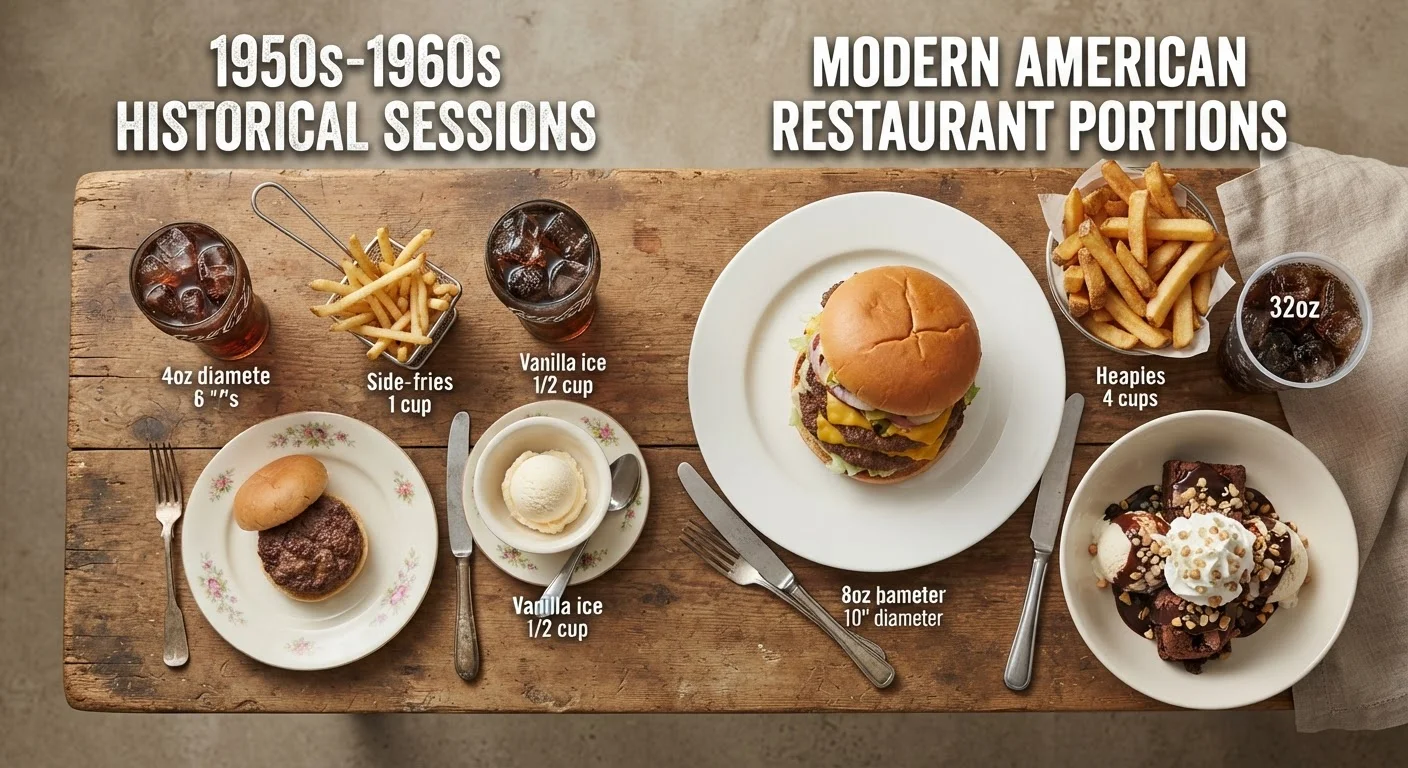
The supersizing of American food didn't happen overnight. Research published in public health journals has documented a consistent upward trend in portion sizes beginning in the 1970s and accelerating through the 1980s and 1990s. Bagels roughly doubled in diameter. Sodas expanded from an 8-ounce standard to 20-ounce convenience-store norms. A "medium" popcorn at movie theaters today often exceeds what was once sold as a large.
Because these changes occurred incrementally - a few more ounces per year, a slightly wider plate - the human brain adapted its reference point at each step. Psychologists call this phenomenon anchoring: our sense of "normal" adjusts to whatever we see most frequently. By the time researchers began measuring the gap systematically, generations of Americans had already internalized inflated portions as simply the way food comes.
The competitive restaurant industry played a significant role. Offering larger portions at modest price increases became a powerful marketing lever, particularly in fast-food and casual dining chains. Customers perceived greater value; operators realized that the cost of adding more food was often lower than the perceived value it created. The result was a commercial feedback loop that gradually redefined expectations for everyone - including at home.
The Perceptual Machinery Behind Oversized Servings
Portion distortion isn't simply a matter of restaurants serving more food. It operates through a web of environmental and psychological cues that shape consumption well before the first bite.
2-3×
Growth in average restaurant portion sizes since the 1970s
Research documented in the American Journal of Public Health found that marketplace portions of many common foods had grown two to three times larger compared to 1970s standards.
~500 cal
Extra daily calories linked to larger portions
Studies on portion size and energy intake suggest that individuals may consume several hundred additional calories per day simply due to larger default serving sizes, without any change in perceived hunger.
92%
Of food on plate typically consumed
Research by the USDA found that people tend to consume the majority of whatever portion is placed in front of them, regardless of actual hunger level - underscoring the influence of default serving size.
Plate size is among the most studied factors. A fixed amount of food looks substantially smaller on a 12-inch plate than on a 9-inch one - and people tend to serve themselves more to "fill" the space. Similarly, tall, narrow glasses cause people to pour less than wide, short ones of identical volume, a perceptual quirk demonstrated in research by Cornell University's Food and Brand Lab.
Packaging design adds another layer. Single-serve labels on containers that hold two or more servings create the impression that consuming the whole package is a single eating occasion. The 2016 FDA Nutrition Facts label update addressed some of this by revising reference serving sizes to reflect realistic consumption amounts - but the label reform describes what people eat, not what is recommended.
These cues interact with hunger signals in ways that can override internal satiety cues. When food is visible, plentiful, and easy to access, people often continue eating past the point of fullness - not from lack of discipline, but because the environmental design encourages it.
Portion Distortion in the Context of the Broader Diet
Portion size doesn't exist in isolation. It compounds with other dietary patterns that have shifted alongside it. When servings grow, so does the total intake of whatever those servings contain - including nutrients that many Americans already consume in excess. For a deeper look at one such nutrient, see our article on sodium in the American diet.
Understanding portion distortion is less about rigid restriction and more about rebuilding an accurate internal reference for what different amounts of food actually look like. Nutrition education researchers emphasize that visual comparisons - such as understanding that a standard protein serving is roughly the size of a deck of cards - can help recalibrate perception without requiring precise measurement at every meal.
Recalibrate Without Counting Every Calorie
One practical approach to navigating portion distortion is to use visual reference points - a closed fist for a vegetable serving, a palm for protein - rather than relying on how full a plate looks. Eating more slowly and pausing mid-meal to check in with hunger cues can also help the body's satiety signals catch up with consumption. These are general awareness strategies; a registered dietitian can provide personalized recommendations tailored to your health situation.
It's worth noting that appropriate portion sizes vary meaningfully by individual. Age, metabolic rate, activity level, and specific health conditions all influence how much of any food is right for a given person. A registered dietitian or healthcare provider is the appropriate resource for personalized guidance - the goal of understanding portion distortion is informed awareness, not a one-size-fits-all prescription.
This article is for general informational and educational purposes only and is not a substitute for professional medical or dietary advice. Consult a qualified healthcare provider for guidance specific to your health needs.