
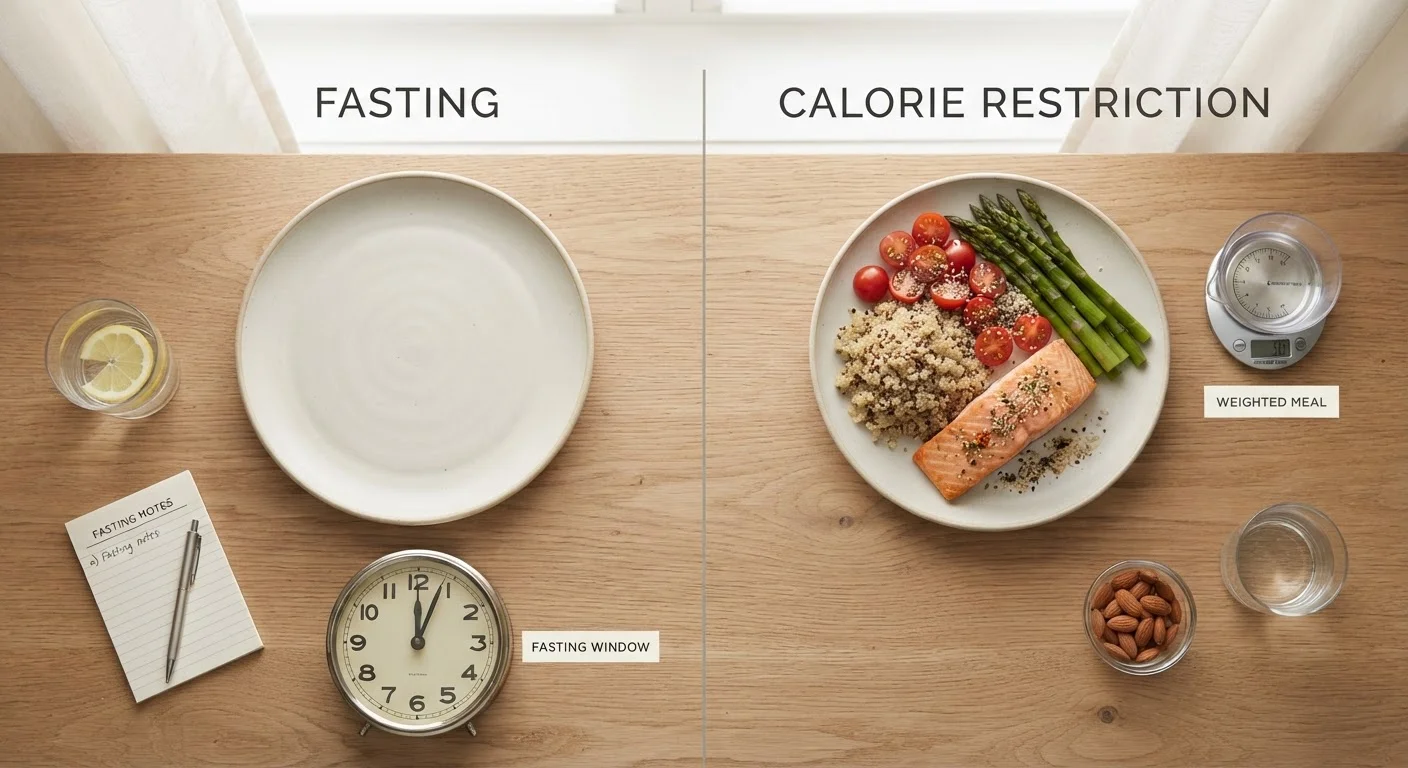
What Each Approach Actually Involves
At their core, both intermittent fasting (IF) and calorie restriction (CR) reduce the total energy your body receives. They differ in how that reduction is achieved.
Calorie restriction involves consistently consuming fewer calories than the body expends, spread across regular meals and snacks throughout the day. The focus is on quantity - tracking portions, food labels, or general serving sizes to stay within a target range set in consultation with a healthcare provider or dietitian.
Intermittent fasting limits when you eat rather than prescribing specific calorie targets. Common patterns include the 16:8 method (eating within an 8-hour window), the 5:2 approach (normal eating five days, very reduced intake two days), and alternate-day variations. Calorie reduction often happens as a byproduct of the compressed eating window, not necessarily through deliberate counting.
What the Evidence Shows
A substantial body of research has compared these two approaches head-to-head. A frequently cited 2022 clinical trial published in the New England Journal of Medicine found that time-restricted eating and continuous calorie restriction produced similar weight loss over one year when participants were matched for overall calorie intake. Earlier systematic reviews have reached comparable conclusions: neither strategy consistently outperforms the other in controlled settings.
Where research findings grow more nuanced is in metabolic effects beyond weight. Some studies suggest IF may improve insulin sensitivity and certain inflammatory markers independently of weight loss, though findings vary across populations and study designs. CR research, meanwhile, has a longer track record and remains the cornerstone of most clinical dietary guidance for weight management.
| Criterion | Intermittent Fasting | Calorie Restriction | |
|---|---|---|---|
| Primary mechanism | Restricts eating to set time windows | Reduces daily calorie intake directly | |
| Calorie tracking required | Not usually required | Generally recommended | |
| Meal timing flexibility | Low - eating window is fixed | High - spread meals throughout the day | |
| Weight loss evidence | Comparable to CR in trials | Well-established, long research track record | |
| Ease of social eating | Can be challenging around fixed windows | Generally more flexible | |
| Hunger experience | Concentrated hunger during fasting | More distributed, potentially milder hunger | |
| Adherence complexity | Timing discipline required | Ongoing portion awareness required |
It is important to note that most studies rely on self-reported dietary intake, which can introduce measurement error. Long-term adherence data beyond two years remain limited for both approaches.
Practical Trade-Offs to Consider
Evidence aside, real-world success with either approach depends heavily on lifestyle fit.
- Hunger management: IF concentrates hunger into specific windows, which some people find easier to manage socially and psychologically. Others find prolonged fasting periods cause irritability, difficulty concentrating, or overeating when the eating window opens.
- Social and family eating: Calorie restriction allows more flexibility to eat at conventional mealtimes, making it easier to participate in shared meals. Fixed eating windows can conflict with family dinners, early-morning workouts, or late-evening social events.
- Tracking burden: CR typically requires more consistent monitoring of food intake, which some find motivating and others find stressful. IF reduces the need for calorie counting but requires discipline around timing.
- Energy levels: Both approaches can temporarily affect energy, mood, and concentration, particularly during an adaptation period of several weeks.
Who Should Be Cautious
Neither approach is universally appropriate. Certain groups should consult a qualified healthcare professional before attempting either strategy:
- People with a history of disordered eating
- Those managing diabetes or other metabolic conditions
- Pregnant or breastfeeding individuals
- Children and adolescents
- Older adults at risk of undernutrition or muscle loss
- Anyone taking medications affected by food timing or intake
For these populations, dietary changes carry additional considerations that require personalized medical guidance rather than a general framework.
This article is for general informational and educational purposes only. It does not constitute medical or nutritional advice. Please consult a qualified healthcare provider or registered dietitian before making significant changes to your diet, particularly if you have an existing health condition or take medications.