The Core Trade-Off: Convenience vs. Resources
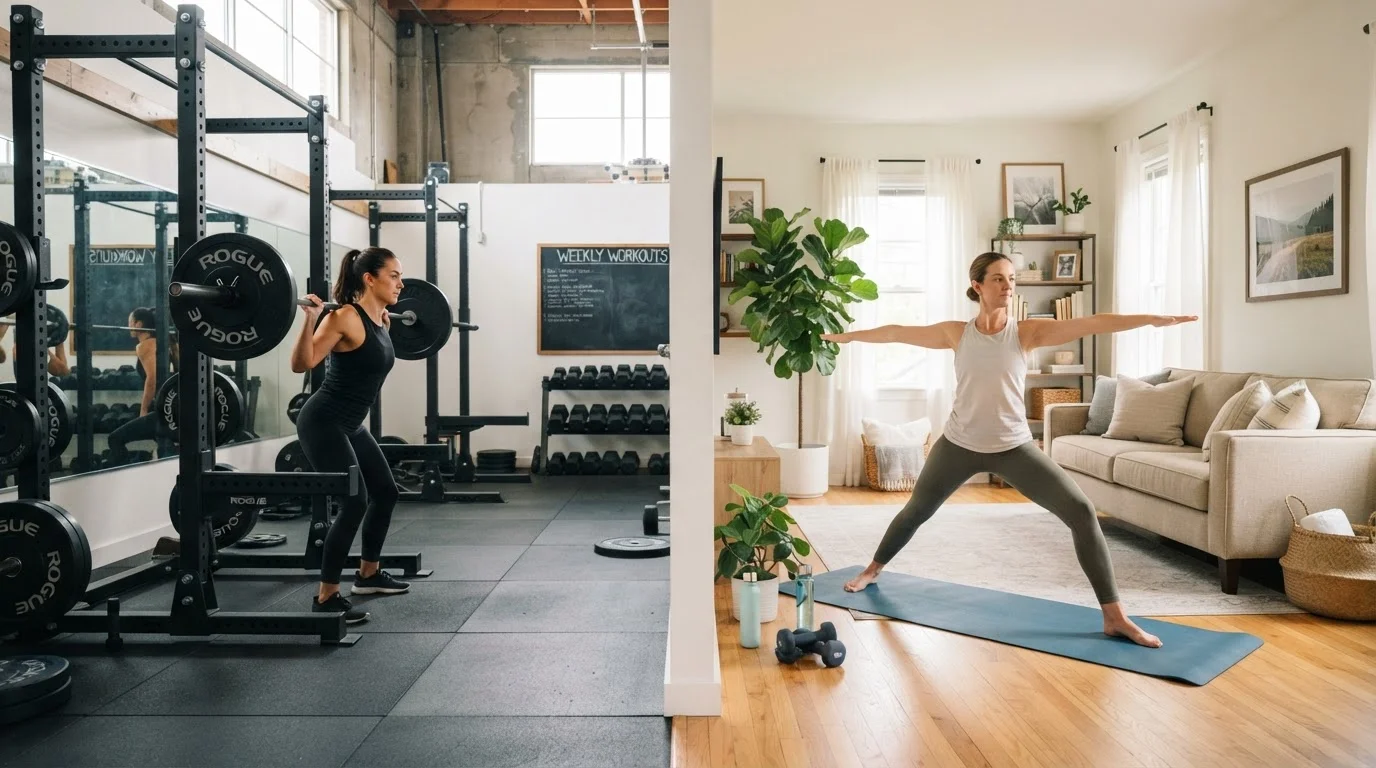
When weighing gym workouts against exercising at home, the central tension is almost always between access to resources and ease of showing up. Gyms typically offer a wide range of equipment - from free weights and resistance machines to cardio equipment and dedicated stretching areas - that would be prohibitively expensive or spatially impractical to replicate at home. That breadth matters if your goals include specific strength benchmarks, variety to prevent boredom, or structured programming like compound movement training.
Home workouts, by contrast, strip away the commute, the wait for equipment, and the social pressure of a shared space. For many Americans - particularly those managing demanding schedules, caregiving responsibilities, or social anxiety - that friction reduction is decisive. A 20-minute bodyweight session at home that actually happens beats a 90-minute gym session that gets skipped three times a week.
| Gym Workouts | Home Exercise | |
|---|---|---|
| Equipment variety | Extensive - machines, free weights, cardio | Limited by budget and space |
| Convenience | Requires commute and scheduling | Available immediately, no travel |
| Ongoing cost | Monthly membership plus extras | Low after initial equipment purchase |
| Privacy | Shared public space | Full privacy in your own home |
| Motivation support | Social atmosphere, structured environment | Self-directed; fewer external cues |
| Effectiveness for general fitness | High, with proper programming | High, with proper programming |
| Expert access | Trainers and classes often available | Requires seeking out online resources |
Cost Considerations: More Than Just the Membership Fee
Gym memberships in the U.S. range widely - from budget facilities to premium clubs - and the monthly fee is only part of the financial picture. Factor in transportation costs, parking, workout attire expectations, and add-on fees for classes or personal training, and the real expense can be significantly higher than the advertised rate.
Home exercise has its own upfront costs. A quality set of adjustable dumbbells, resistance bands, or a mat represents an initial investment, though these are generally one-time purchases. Streaming fitness programs or apps carry their own subscription fees, though typically lower than gym memberships. Over a multi-year horizon, home setups often become more cost-effective - but the math depends heavily on how much equipment you purchase and how consistently you use it.
The honest answer: neither option is inherently cheap if used carelessly, and neither is necessarily unaffordable if planned thoughtfully.
Effectiveness: Does Location Change Results?
Exercise science is clear that the physiological adaptations from training - improved cardiovascular fitness, increased muscle strength, better metabolic health - are driven by training variables like intensity, volume, frequency, and progressive overload. These variables can be manipulated in both settings. A well-designed home program using bodyweight progressions, resistance bands, or minimal equipment can produce meaningful fitness gains, as supported by a substantial body of research on resistance training and cardiovascular exercise.
That said, certain goals - such as maximal strength development, powerlifting, or sport-specific conditioning - are genuinely easier to pursue with access to a full gym's equipment. If your goals are more general, such as improving health markers, losing body fat, building moderate muscle, or improving cardiovascular endurance, a home environment is typically adequate. For a deeper look at how different training modalities compare, see what the science says about strength training vs. cardio.
It's also worth confronting common fitness misconceptions. Many people overestimate what gym access alone delivers and underestimate what disciplined home training can achieve. Our look at persistent exercise myths explores several of these beliefs in detail.
Motivation, Accountability, and Social Factors
One of the gym's underrated advantages is environmental design. The dedicated space, the presence of other people exercising, and the sunk cost of a paid membership can all reinforce the habit of showing up. Some research suggests that environmental cues - being in a space associated with exercise - can reduce the mental effort required to initiate a workout.
Home training removes those cues. Without external structure, self-motivation carries more weight. Some individuals thrive in that autonomous environment; others find it harder to maintain intensity or consistency when distractions are nearby. If social motivation is a significant factor for you, it's worth also considering group activities versus solo exercise as a framework - the gym-versus-home question intersects closely with how you respond to social accountability.
Try Before You Commit Long-Term
Many gyms offer short-term trial memberships or day passes that let you assess the environment before signing a contract. Similarly, testing a structured home program for four to six weeks can reveal whether self-directed training suits your personality. Giving yourself a genuine trial period with either approach - rather than abandoning it after one or two sessions - produces a much more accurate picture of what will work for you.
A hybrid approach - perhaps two gym sessions and two home sessions per week - is an option that many people find sustainably motivating, particularly if commuting to a gym on certain days is impractical.
Choosing What's Right for You
The most useful question isn't "Which is better?" but rather "Which will I actually stick with?" Consistency over months and years produces health outcomes; the optimal workout environment is the one that supports your long-term adherence. Consider your schedule realistically, your available space, your financial comfort, and whether you find social environments energizing or draining.
If you're newer to structured exercise, starting with lower-barrier options - a home routine, short walks that progress to more intense activity as discussed in walking vs. running - may help you build the habit before committing to a gym membership. If you have specific performance goals or need accountability from a structured environment, a gym trial period can clarify whether that setting works for you.
Neither setting is superior. Both can support a healthier life when used with intention and consistency. Speak with a healthcare provider or certified fitness professional before starting a new exercise program, especially if you have existing health conditions or have been sedentary for an extended period.
This article is for general informational and educational purposes only and is not a substitute for personalized medical or fitness advice. Always consult a qualified healthcare professional before beginning or changing an exercise routine.