Why Your Environment Does More Than You Think
Most readers assume that reading more is purely a willpower problem - they just need to find the motivation, set a goal, and push through. But the physical space around you is doing quiet, constant work either for or against that intention. A harsh overhead light, a chair that strains your back after twenty minutes, or a side table buried under mail all send the same subtle signal: this isn't really a place for reading.
Your brain is remarkably sensitive to environmental cues. When a space feels purposeful - warm, ordered, and quiet - it lowers the mental friction between you and picking up a book. That's part of what building a sustainable reading habit is really about: removing the small obstacles that accumulate into avoidance. The steps below are about designing those cues deliberately, even if you're working with a single corner of your living room.
What You'll Need Before You Start
You don't need to renovate or spend a lot to create a reading space that works. Most of what matters is intentional placement of things you likely already own.
What you will need
A supportive chair or armchair
Forms the anchor of your reading space - comfort and posture directly affect how long you stay.
A dedicated reading lamp
Provides warm, focused light at the right angle to reduce eye strain during long sessions.
A small side table or stool
Holds your book, a drink, and any reading accessories within arm's reach.
Noise-canceling headphones or earplugs
Reduces auditory distraction in shared or noisy households.
A blanket or cushion
Adds physical comfort signals that reinforce the space as a place to settle in.
Step-by-Step: Building Your Reading Space
Work through these steps in order - each one builds on the last. You can complete a basic setup in under an hour, then refine over time as you discover what works for your habits and home.
Choose a spot that already feels a little calm
Walk through your home and notice where your eyes and body naturally relax. It might be a window-facing corner, the far end of a sofa away from the TV, or a bedroom chair that rarely gets used. You're not looking for perfection - you're looking for a location that already has some distance from the highest-traffic, highest-noise areas of your home.
The spot doesn't need to be large. A two-foot-wide corner with the right chair and light can outperform a spacious room that's set up wrong.
Get the lighting right before anything else
Overhead lighting is almost always the wrong choice for reading. It casts shadows onto the page and creates a flat, institutional feel. Instead, bring in a floor lamp or table lamp positioned over your shoulder or slightly to your side - whichever matches your dominant hand. Aim for a warm white bulb (in the 2700K-3000K color temperature range) rather than a cool or daylight bulb, which can feel harsh over time.
If you read at night, a lamp with a dimmer or multiple brightness settings gives you flexibility as your eyes tire.
Set up your seat for the long haul
Your seating choice is where most reading spaces quietly fail. A chair that looks inviting but forces you into an awkward position will cut your sessions short every time. Sit in your chosen seat for five full minutes before committing - notice what happens to your lower back, neck, and shoulders. You should be able to hold a book at a comfortable angle without hunching.
If your current chair isn't quite right, a lumbar cushion behind the lower back or a firm pillow under the seat can make a meaningful difference without replacing the furniture entirely.
Clear and define the surface next to you
Place a small table, tray, or stool within arm's reach of your seat. Its job is simple: hold your current book, a bookmark, and whatever you like to drink while reading. Nothing else belongs on it permanently. A cleared, purposeful surface is a cue that this is an active space - not a storage area.
If surface clutter is a recurring challenge in your home, home organization strategies can help you develop systems that keep shared spaces from drifting back into disorder.
Address noise and digital interruptions
Before your first real session, take stock of what you'll hear and what devices will be within reach. Household noise is often unavoidable, but you can buffer it: a white noise app, a pair of headphones playing ambient sound, or soft instrumental music can all reduce the pull of background activity.
More importantly, your phone should not be in your reading spot. Place it across the room or in a different area entirely. The mere presence of a phone on a nearby surface - even face down, even silent - has been shown in behavioral research to reduce available cognitive attention. The space works better when the phone simply isn't part of it.
Add one or two personal signals that make it yours
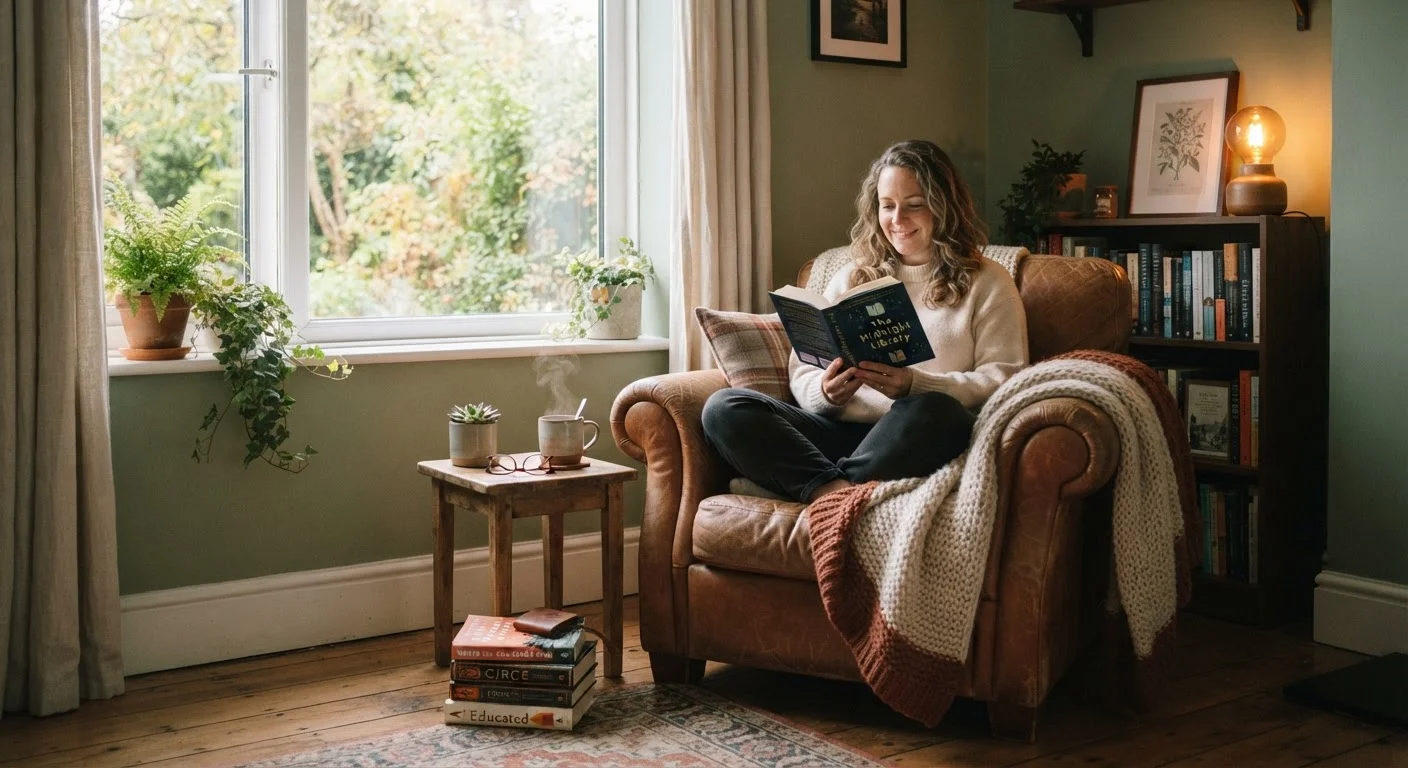
This is the step that transforms a functional setup into a space you actually want to return to. Add a single personal element that signals reading time to your brain: a specific mug you only use while reading, a small plant, a candle you light at the start of a session, or a blanket draped over the arm of the chair. These aren't decorative afterthoughts - they're behavioral anchors.
Over time, these small rituals compound. Your brain begins to associate the scent, texture, or visual of that object with the relaxed, focused state of deep reading. That's the same principle behind building any durable reading routine - the environment does some of the motivational work so you don't have to.
Protecting the Space Once You've Built It
A reading spot has a way of collecting clutter - laptops, charging cables, folded laundry - the moment you stop paying attention. The best defense is a light weekly reset: clear the surface, restock your bookmark or reading light batteries, and put your current book visibly on top. Visibility matters more than you'd expect. If your book is buried under other things, you'll reach for your phone instead.
If noise remains a recurring issue, it's worth understanding what specifically pulls your attention. What kills deep reading focus is often subtler than a loud TV - notifications, background conversation, and even mental restlessness all play a role. Pair a well-designed physical space with a few intentional habits - phone in another room, a defined start time - and the compound effect is significant.
If you're rebuilding a reading habit after a long break, a dedicated space is one of the lowest-effort, highest-impact moves you can make. Getting back into reading after a long absence often starts not with a book choice, but with making it easy to sit down in the first place.