
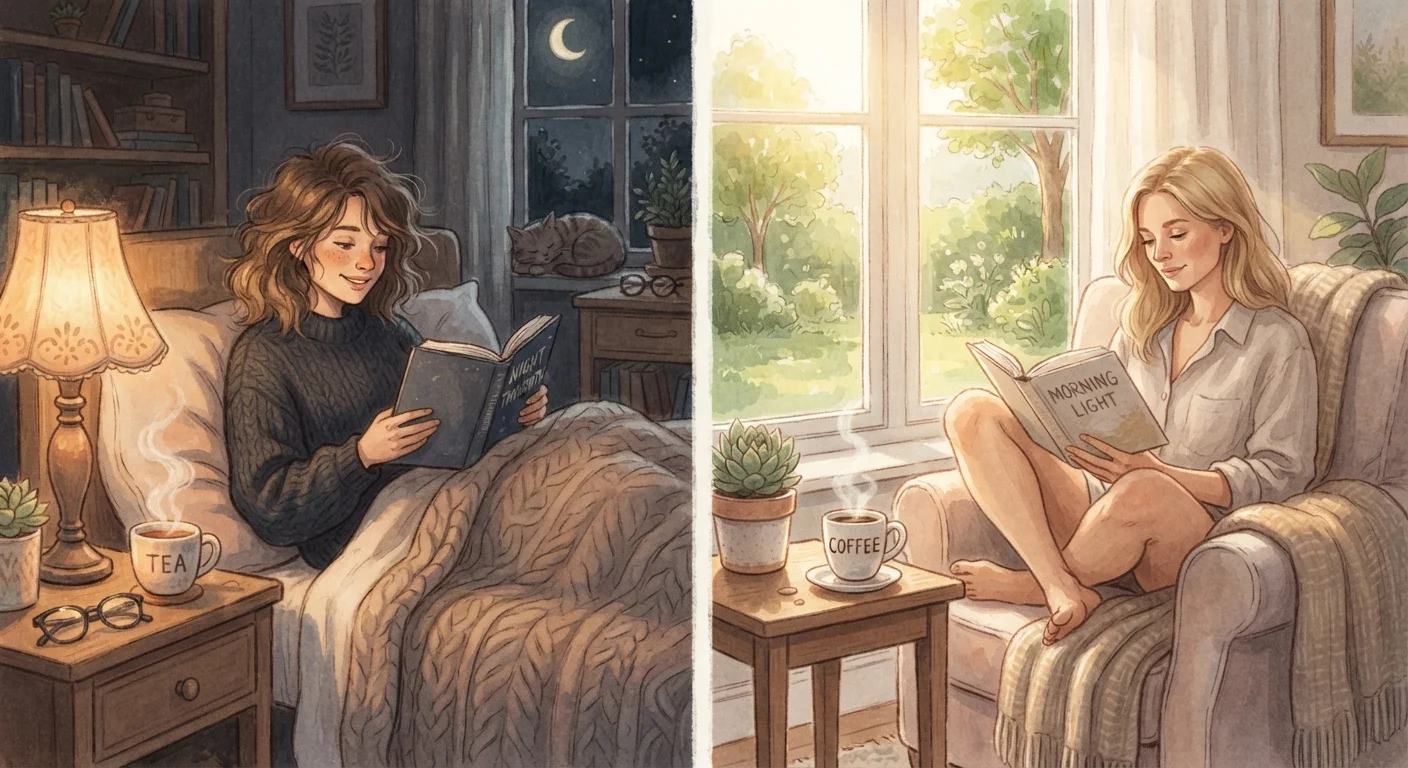
The Case for Reading Before Bed
For millions of readers, bedtime and books are inseparable. There's something deeply intuitive about reaching for a novel as the day winds down - a ritual that signals to the mind and body that the noise is finally over. And the intuition, it turns out, has some backing.
Research has suggested that engaging with a physical book before sleep - as opposed to scrolling through a phone - may help reduce cognitive arousal, making it easier to fall asleep. The act of following a narrative pulls attention away from the mental chatter that keeps many people awake. For readers who carry work stress or anxiety into the evening, a chapter or two can act as a kind of mental threshold. See our wind-down routine guide for more on building a pre-sleep structure around habits like this.
That said, bedtime reading has real limits. Fatigue means comprehension drops - most people find they've read the same paragraph three times without absorbing a word. For dense nonfiction, philosophical essays, or anything that requires active annotation, late-night reading is often the wrong tool. Fiction, narrative nonfiction, short stories, and poetry tend to be the genres that thrive in this window.
The light source also matters. Blue-light-emitting devices - even e-readers on full brightness - can interfere with melatonin production. Warm-toned reading lights or e-readers with adjustable color temperature are worth considering. What happens in the brain overnight shapes how well any pre-sleep habit serves you.
The Case for Reading in the Morning
Morning readers often describe the experience as protective - a way of claiming mental space before the demands of the day rush in. There's logic to it beyond the poetic: cognitive alertness for most people (particularly "morning types," or those with an early chronotype) tends to peak in the first few hours after waking. That mental clarity can translate into sharper reading comprehension and better retention of what you've read.
| Criterion | Reading Before Bed | Reading in the Morning |
|---|---|---|
| Cognitive alertness | Often lower due to fatigue | Generally higher after rest |
| Retention of complex material | Can be reduced when tired | Tends to be stronger |
| Stress relief | Strong - helps decompress | Moderate - more energising |
| Sleep onset support | Yes, especially with print | Not applicable |
| Interruption risk | Moderate (evening obligations) | Low (quieter window) |
| Best genre fit | Fiction, narrative, poetry | Nonfiction, dense prose |
| Habit consistency | High - natural daily anchor | Requires more discipline |
| Night owl compatibility | High | Low without chronotype match |
Morning is also, for many households, the quietest stretch of the day. Before notifications stack up and obligations multiply, there's a window - even 20 or 30 minutes over coffee - that belongs entirely to the reader. Readers who find their evenings frequently interrupted by family life, social plans, or simple exhaustion often find that mornings are more reliable.
The challenge, of course, is that mornings require preparation. Waking up even slightly earlier, having the book already on the nightstand or the reading chair ready, and resisting the pull of the phone all take deliberate effort. For natural night owls, this effort can be so significant that it undermines the habit entirely. Chronotype is not a character flaw - it's a real biological tendency, and fighting it daily is exhausting. Understanding what erodes reading focus can also help you protect whichever window you choose.
How to Find What Actually Works for You
The most honest answer to the "morning vs. night" question is: it depends - and that's not a cop-out. It depends on your chronotype, your book choices, your life schedule, and what you actually want reading to do for you.
A useful starting point is to ask what role reading plays in your day. If it's primarily an escape and a decompressor, evening often wins. If it's a form of learning or growth - working through history, science, philosophy, or craft - mornings tend to serve it better. Many consistent readers do both: lighter or narrative reading before bed, denser or more challenging material in the morning.
Building a sustainable habit also means being honest about where in your day you have reliable time. A slot that exists only in theory - the 6 a.m. session you plan but never execute - is less valuable than 20 minutes at 10 p.m. that you actually use. Our guide to what makes a reading habit last explores the structural elements that separate a routine that sticks from one that fades. And if you're rethinking how you measure reading success, setting goals that reflect how you actually read can reframe the whole exercise.
Ultimately, the best reading time is the one you return to consistently - not the one that looks best on a productivity list.