Two Genres, One Shared Impulse
Every reader has felt it - that pull toward a story set somewhere beyond the world we know. Science fiction and fantasy both answer that impulse, and both fall under the broader umbrella that critics call speculative fiction. But despite sharing shelf space in bookstores, they operate on fundamentally different logic.
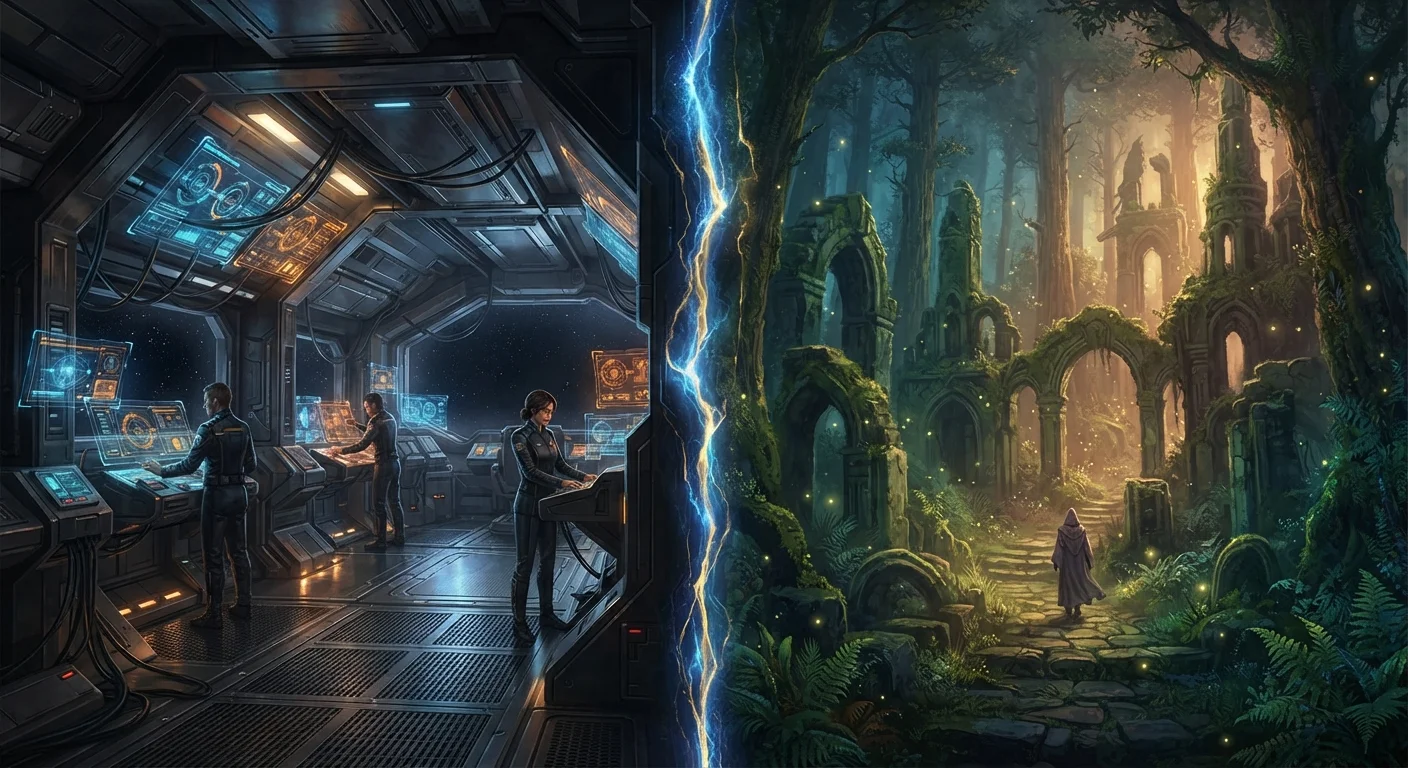
The simplest way to put it: science fiction imagines what could happen if scientific knowledge or technology advanced in a particular direction. Fantasy imagines what would be true if natural laws simply worked differently than they do. One extrapolates; the other invents. That single distinction cascades into very different reading experiences.
Science fiction tends to build its impossibilities on a foundation of existing knowledge - even when it stretches that knowledge to its limit. A faster-than-light drive may not be real, but a science fiction author will typically offer some in-universe rationale rooted in physics. Fantasy, by contrast, doesn't owe the reader an explanation. Magic is because magic is. Dragons fly because the story says they do. That's not a weakness - it's a different kind of contract with the reader.
What Each Genre Actually Asks of You
Reading science fiction often feels like thinking alongside the author. You're invited to follow a chain of reasoning - if this technology existed, then society might look like this, and then this conflict might arise. The pleasure is partly intellectual: tracking the internal logic of an imagined future or alternate reality. Works like Isaac Asimov's Foundation series or Ursula K. Le Guin's The Left Hand of Darkness use their invented worlds to pressure-test ideas about politics, identity, and human nature through careful extrapolation.
Fantasy asks something different: surrender. You're invited to accept the rules of the world as given and then live inside them emotionally. J.R.R. Tolkien's Middle-earth doesn't explain why the One Ring corrupts those who carry it through any scientific mechanism - it simply does, and the story's power comes from how characters respond to that reality. The genre's roots run deep into myth, folklore, and oral tradition, which is why fantasy so often feels archetypal and emotionally resonant in ways that bypass skepticism entirely.
| Criterion | Science Fiction | Fantasy |
|---|---|---|
| Source of the impossible | Extrapolated from real science | Invented rules accepted as given |
| Reader contract | Follow the logic | Surrender to the world |
| Roots | Enlightenment, scientific revolution | Mythology, folklore, oral tradition |
| Typical setting | Future, space, alternate timeline | Secondary world, ancient-feeling era |
| Core tension | Progress vs. consequence | Good vs. evil, order vs. chaos |
| Magic or technology? | Technology (or science-based power) | Magic, supernatural forces |
| Explanation required? | Usually, at least partially | Rarely - the world simply works this way |
It's worth noting that both genres traffic in the same raw material - human longing, fear, ambition, and wonder. As explored in our look at genre and literary fiction, the divide between serious literature and popular genre fiction is often overstated. Science fiction and fantasy are no exception.
Where the Lines Blur - and Why That's Fine
The honest truth is that many of the most celebrated works in either genre cheerfully ignore the boundary. Star Wars is science fiction in costume but fantasy in soul - it features spaceships and lasers alongside a mystical energy field, a chosen hero, and an ancient evil. Anne McCaffrey's Dragonriders of Pern series begins with what looks like classic fantasy dragons, then reveals a science fiction origin story underneath. These hybrids aren't failures of categorization - they're evidence that readers love both modes of wonder simultaneously.
What actually separates science fiction from fantasy in practice often comes down to a single question: where does the impossible come from? If the answer points toward science - even speculative or far-future science - the work leans toward science fiction. If the answer is simply the nature of that world, with no further explanation offered or needed, you're likely in fantasy territory. Neither answer is inherently more sophisticated, more fun, or more worthy of a reader's time.
If you're curious how these genres relate to other imaginative traditions, our piece on reading across genres makes the case for exploring beyond your usual section of the bookstore. And for readers who want to understand where all fiction sits on the broader map, fiction versus nonfiction offers useful grounding.
Ultimately, the genre you gravitate toward says something about the kind of wonder you find most nourishing. Some readers want the impossible explained; others want it embraced. Both are valid ways to love a story.