The Smallest Page With the Biggest Story
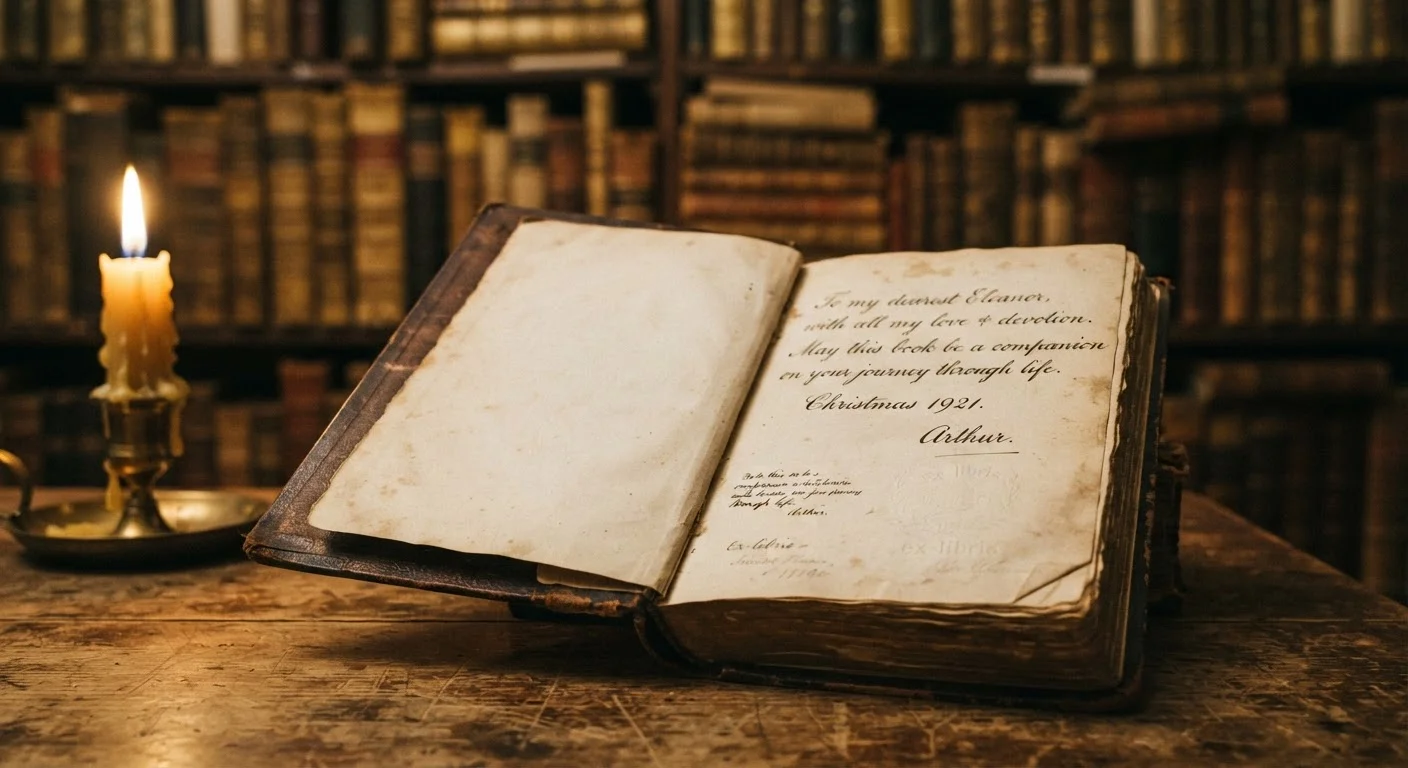
Most readers flip past the dedication page without a second glance - a name or two, maybe a cryptic phrase, and then on to chapter one. But those few words are often the most unguarded thing a writer ever commits to print. Unlike the polished prose that follows, dedications are rarely workshopped or edited by committee. They are, in many cases, the raw signal beneath all the literary noise.
Think of them as the private note slipped under the door before the public performance begins. Sometimes they're love letters. Sometimes they're elegies. Occasionally they're political acts dressed in plain language. And every so often, they're little jokes that only one person on earth was supposed to fully understand.
The stories behind famous dedications pull readers closer to the actual human lives that produced the books we love - which is exactly why they're worth knowing. Much like the personal letters explored in how authors' correspondence reveals what published work doesn't, dedications offer a candid glimpse that no finished chapter ever quite could.
F. Scott Fitzgerald and the Dream He Dedicated Twice
The Great Gatsby (1925) carries a dedication to Max Perkins - Fitzgerald's legendary editor at Scribner's - but what's less known is that early drafts reportedly circulated with dedications aimed at Zelda, his wife. The shift to Perkins reflects a complicated truth: the book was as much a product of their intense professional relationship as of Fitzgerald's personal romantic mythology. Perkins guided Gatsby through structural revisions that transformed it. Honoring him was, in a sense, Fitzgerald acknowledging that great books are rarely made alone.
Great books are rarely made alone - Fitzgerald's dedication quietly admitted as much.
J.K. Rowling's Dedication That Named the Real Dementors
The dedication in Harry Potter and the Prisoner of Azkaban (1999) reads, in part, to Rowling's friend Jill Prewett and Aine Kelly - but it's the dedication in Harry Potter and the Deathly Hallows (2007) that readers have dissected most. There, Rowling lists seven people, one of whom is her late mother, Anne. Given that Rowling has spoken openly about how her mother's death from multiple sclerosis shaped the series' treatment of mortality, that inclusion transforms the entire seven-book arc into something that was, at its core, about grief and the love that outlasts it.
Rowling's final dedication quietly revealed that the series was always, at its core, about grief.
Ernest Hemingway's Loaded Farewell to a War
A Farewell to Arms (1929) was dedicated simply to Hemingway's friend Guy Hickok. But the dedication's understated quality mirrors the novel's emotional strategy: say little, mean much. Hemingway scholars have long noted that the novel drew directly from his World War I experiences and his affair with nurse Agnes von Kurowsky, who declined to marry him. The restraint of honoring a male journalist friend - rather than the woman whose rejection inspired the love story - is itself a kind of literary deflection, and a telling one.
Hemingway's restrained dedication mirrored the novel's emotional strategy: say little, mean much.
Toni Morrison's Dedication as Memorial and Accusation
Beloved (1987) opens with a dedication to the "Sixty Million and more" - a figure Morrison used to represent the estimated number of Africans and African Americans who died as a direct result of the transatlantic slave trade and its aftermath. It is not a conventional dedication to a person but to a historical wound. Morrison described the dedication as an act of remembrance for those who had been deliberately erased from public consciousness. Before a single word of the novel is read, the dedication instructs readers on what kind of attention the book demands.
Morrison's dedication wasn't for a person - it was an act of remembrance for millions deliberately erased.
Vladimir Nabokov's Lifelong Love Letter
Across dozens of works, Vladimir Nabokov returned again and again to the same dedicatee: his wife, Véra. She was his first reader, his translator's collaborator, his literary agent in everything but title, and, by many accounts, an intellectual equal who shaped his work profoundly. The recurring dedication became something of a signature - a public record of a private partnership that lasted over fifty years. Literary historians have noted that separating Nabokov's work from Véra's influence may actually be impossible, making the dedications less a formality than an accurate credit line.
Nabokov's lifelong dedication to Véra was less a formality than an accurate credit line.
Kurt Vonnegut's Antiwar Dedication Hidden in Plain Sight
Slaughterhouse-Five (1969) is dedicated to Mary O'Hare, the wife of Vonnegut's war buddy Bernard O'Hare. The story behind it matters: when Vonnegut visited to discuss writing the book together, Mary grew cold and explained she feared he'd glamorize war and make young men want to fight. Vonnegut promised her he wouldn't - and then dedicated the book to her and named a character after her. The dedication functions as a contract, a public oath that the book would tell the truth about Dresden and about war's ugliness, witnessed and enforced by the person who called him on it.
Vonnegut's dedication was a public oath witnessed by the person who called him on his responsibility.
Reading the Front Matter Differently
How to Read a Dedication More Deeply
Before diving into a book's first chapter, spend a moment researching the dedicatee. A quick search on who they were to the author - a lost friend, a spouse, an estranged parent - can fundamentally reshape how you receive the story. Biographies, author interviews, and collected letters are often the richest sources for this kind of context.
Knowing the history behind a dedication doesn't just satisfy curiosity - it changes the reading experience in a meaningful way. When you understand that an author was mourning a specific person, defying a specific institution, or whispering across decades to a specific reader, the entire emotional register of a book can shift. You're no longer a stranger walking into a story; you're someone who's been handed a key.
Dedications remind us that every published book is the end product of a very human life - full of love, loss, argument, and loyalty. They are, perhaps, the most honest single page in any volume. Next time you open a book, pause there. The story has already started.