What Was the Harlem Renaissance?
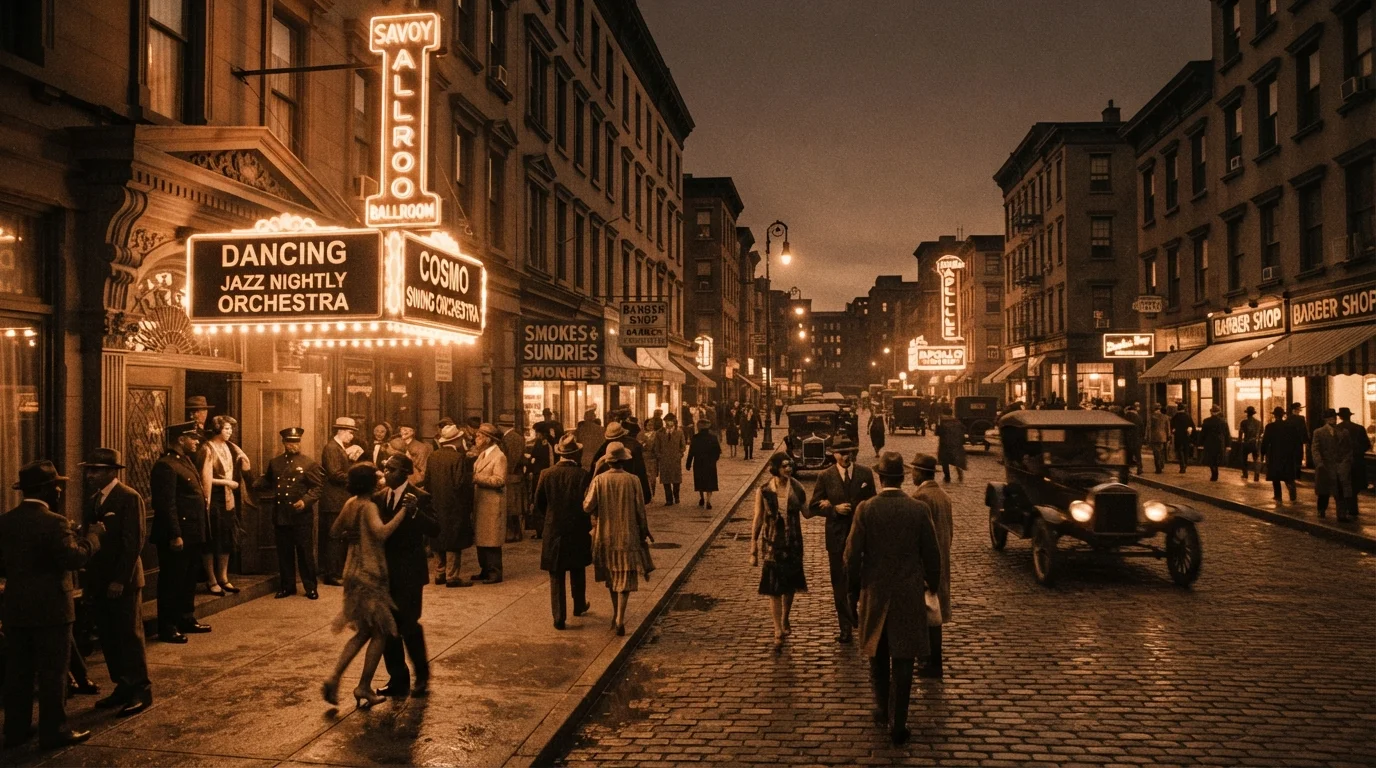
In the years following World War I, something extraordinary happened in a neighborhood in upper Manhattan. Black Americans - many of them migrants from the South who had arrived during what historians call the Great Migration - began building a cultural world unlike anything the country had seen. Harlem became the center of that world, and literature was one of its most powerful instruments.
The Harlem Renaissance is generally understood as a flourishing of Black artistic and intellectual life that ran roughly from the early 1920s through the mid-1930s. It was not a formal movement with a manifesto or a founding date. It was more like a conversation - loud, layered, sometimes contentious - conducted across poems, novels, essays, and magazines. Writers, musicians, visual artists, and intellectuals gathered in Harlem's salons and borrowed each other's energy.
What made this period so electric was the combination of necessity and ambition. Black writers were not simply creating art for its own sake; they were also challenging a dominant culture that had long refused to see them fully. Every sentence carried weight beyond its syllables.
A Movement Beyond New York
While Harlem was the symbolic center, the Renaissance had a wider geography. Writers participated from Washington D.C., Chicago, and abroad - Claude McKay wrote some of his most important work while living in Europe. Thinking of it strictly as a New York phenomenon can obscure the transatlantic dimensions of the cultural conversation.
The Writers Who Defined the Movement
No figure is more synonymous with the Harlem Renaissance than Langston Hughes. His poetry was jazz in printed form - syncopated, soulful, and grounded in the everyday lives of ordinary Black Americans. Hughes believed that Black vernacular speech and blues rhythms were not limitations but gifts, and he wove them directly into his work.
Zora Neale Hurston brought a different but equally vital gift. Trained as an anthropologist under Franz Boas at Columbia, she traveled through the American South collecting folklore, then transformed that raw cultural material into fiction. Her novel Their Eyes Were Watching God (1937) is widely regarded as one of the great American novels of any era.
Claude McKay, born in Jamaica, wrote with fierce political urgency. His sonnet "If We Must Die" - composed in the charged aftermath of the Red Summer of 1919 - became a declaration of dignified resistance that echoed far beyond the page. Jean Toomer, Countee Cullen, Nella Larsen, and Jessie Redmon Fauset each brought distinct voices and concerns, ensuring that the Renaissance was never a monolith but a chorus.
If you're new to the Harlem Renaissance, start with poetry before prose. Hughes's shorter poems give you the movement's rhythm and emotional temperature in just a few lines.
Poetry was the movement's most immediate form of expression, and Hughes in particular compressed complex ideas about race, joy, and struggle into highly accessible verse.
Read the writers' essays alongside their fiction. Hughes's 'The Negro Artist and the Racial Mountain' and Du Bois's 'Criteria of Negro Art' reveal the debates that shaped what these authors chose to write - and how.
The Harlem Renaissance was as much a philosophical argument as an artistic output; understanding the ideas in circulation helps readers grasp why specific creative choices were so charged.
Ideas That Powered the Page
The Harlem Renaissance was as much a philosophical project as a literary one. At its core was a debate about identity - specifically, what it meant to be Black in America and how that identity should be expressed in art.
Critic and philosopher Alain Locke was one of the movement's chief architects. In his landmark 1925 anthology The New Negro, he argued that a new cultural confidence had emerged - one that rejected the caricatures and stereotypes of minstrelsy and demanded full, complex humanity on the page. Locke envisioned art as a means of racial uplift and social transformation.
Not everyone agreed on the terms. Some writers, like Hughes, pushed back against the idea that Black art had to present only respectable or aspirational images. His 1926 essay "The Negro Artist and the Racial Mountain" is a manifesto for artistic freedom - an argument that Black writers should follow their own creative instincts rather than perform for white audiences or conform to middle-class Black expectations. That tension between representation and artistic autonomy is one that continues to shape literary culture whenever a single book becomes a cultural flashpoint.
The Role of Magazines and Anthologies
Literary movements need infrastructure, and the Harlem Renaissance had it. Two magazines in particular served as the movement's primary publishing venues: The Crisis, edited by W.E.B. Du Bois and published by the NAACP, and Opportunity: A Journal of Negro Life, published by the National Urban League and edited by Charles S. Johnson.
Both magazines ran literary contests, published fiction and poetry alongside political commentary, and created a readership hungry for exactly the kind of work Renaissance writers were producing. Winning a prize in either publication could launch a career. Alain Locke's anthology The New Negro served a similar function in book form, gathering poems, stories, and essays that announced the movement's arrival to a broader audience.
This ecosystem of publication - magazines, anthologies, salons, and lectures - reminds us that writers rarely change culture in isolation. The Harlem Renaissance flourished because it built the institutions necessary to sustain and circulate its ideas.
~6M
Black Americans who relocated during the Great Migration
Historians estimate roughly six million Black Americans moved from the South to northern cities between 1910 and 1970, fueling Harlem's cultural transformation.
1925
Year Alain Locke published The New Negro
Locke's landmark anthology, published in 1925, is widely considered the defining document of the Harlem Renaissance's intellectual ambitions.
1993
Year Toni Morrison received the Nobel Prize in Literature
Morrison's Nobel recognition highlighted a direct lineage from the Harlem Renaissance to contemporary Black American literary achievement.
The Legacy That Never Left
The Harlem Renaissance began to lose momentum as the Great Depression tightened its grip on American life. Patrons withdrew funding, magazines folded, and many writers scattered. But the ideas and forms they had pioneered did not disappear - they went underground and resurfaced, again and again, in the decades that followed.
The Black Arts Movement of the 1960s and 1970s explicitly claimed the Harlem Renaissance as its ancestor. Writers like Amiri Baraka and Nikki Giovanni drew on the same conviction that Black art could be simultaneously beautiful and political. Toni Morrison, whose Nobel Prize in Literature in 1993 honored a body of work rooted in Black American experience, spoke frequently of the writers of the Renaissance as foundational influences.
Today, readers encounter the Harlem Renaissance through high school curricula, university seminars, and an ever-growing body of literary scholarship. But the most direct way to feel its power is still to read the work itself - to sit with a Hughes poem or open Their Eyes Were Watching God and let the prose move through you the way music does. The world these writers built in words has never stopped being inhabited.