Why Tire Pressure Is Never Perfectly Stable
Many drivers assume tire pressure only changes when there's a puncture. In reality, PSI shifts constantly in response to factors you can't see or control. Understanding why pressure moves - and by how much - separates a driver who reacts to a flat tire from one who prevents it.
The three main forces behind PSI fluctuation are temperature changes, altitude changes, and slow air permeation. None of these require a leak to have a meaningful effect on your readings.
Check Pressure Before Long Trips
Before any highway drive of two hours or more, verify all four tires - including the spare - while they are still cold. Heat buildup at highway speeds amplifies the effects of underinflation, making pre-trip checks one of the simplest safety steps you can take.
Temperature is the most predictable variable. Air molecules move slower in cold conditions, reducing the pressure they exert inside the tire. For every 10°F drop in outside temperature, expect to lose approximately 1 PSI. That means a car parked outside with tires at 35 PSI in 70°F weather could read 32 PSI after a cold snap drops temperatures to 40°F - without a single molecule of air escaping.
Altitude plays a smaller but real role. At higher elevations, atmospheric pressure is lower, which causes your gauge to read slightly higher than it would at sea level. If you drive from a valley city to a mountain destination, you might notice a modest PSI increase that reverses on the way back down.
How to Check Tire Pressure Correctly
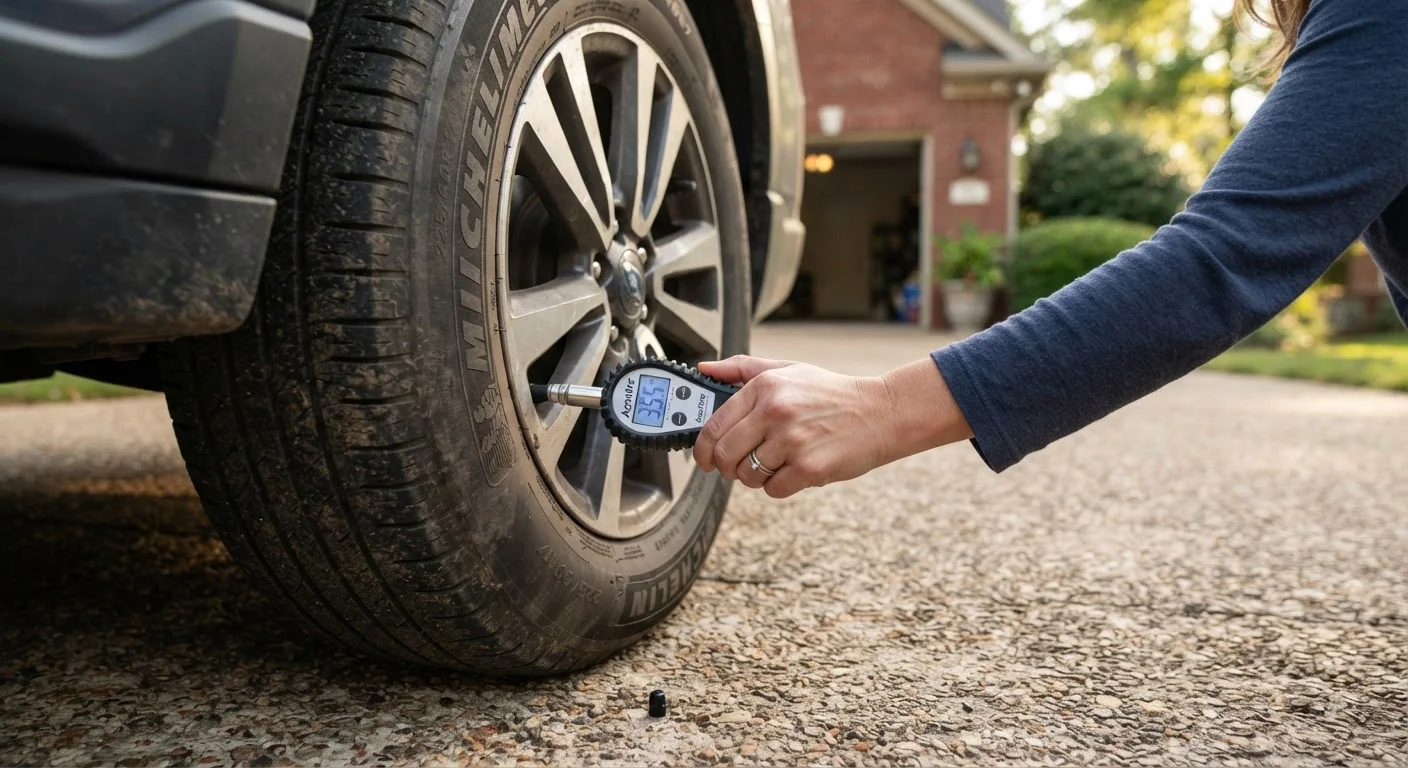
Using a pressure gauge takes about two minutes per tire, but timing and technique matter for an accurate reading.
- Check when cold: Tires should be driven fewer than one mile or parked for at least three hours. Heat from driving temporarily inflates PSI readings.
- Use a reliable gauge: Digital gauges and quality dial gauges give consistent results. Stick-type gauges can be imprecise over time.
- Know your target PSI: Check the sticker on the inside of your driver's door jamb. The number printed on the tire sidewall is the tire's maximum structural limit - not your target.
- Remove the valve cap fully: Press the gauge firmly and straight onto the valve stem. A hissing sound means the seal isn't complete and air is escaping as you read.
Check all four tires and the spare if your vehicle carries one. Front and rear tires sometimes have different recommended pressures - especially on trucks and performance vehicles - so confirm both figures in your owner's manual or door jamb sticker.
1 PSI
Pressure lost per 10°F temperature drop
This relationship between ambient temperature and tire PSI is a well-established principle of gas physics applied to vehicle maintenance.
25%
PSI drop that triggers TPMS warning
U.S. TPMS regulations require warning lights to activate when any tire falls 25% or more below the vehicle manufacturer's recommended inflation pressure.
1-2 PSI
Normal monthly pressure loss through permeation
Tire manufacturers and automotive safety organizations note that gradual air loss through rubber is expected and does not indicate a defect.
When Fluctuation Becomes a Problem
Normal permeation causes most tires to lose 1-2 PSI per month. Losses beyond that threshold point to something worth investigating. Common culprits include a small nail or screw embedded in the tread, a corroded or cracked valve stem, or a rim that isn't seating cleanly against the tire bead - particularly common after hitting a significant pothole.
If your vehicle is equipped with a Tire Pressure Monitoring System (TPMS), the dashboard warning light will typically illuminate when a tire drops about 25% below the manufacturer's recommended PSI. That warning means the tire is already significantly underinflated. For a vehicle specifying 35 PSI, the light may not appear until you've dropped to around 26 PSI - well into unsafe territory. Don't wait for the light; monthly manual checks are more protective. For a full breakdown of what dashboard warning indicators mean, see what your dashboard warning lights are actually telling you.
A tire losing more than 2-3 PSI per week should be inspected by a qualified mechanic. Driving on persistently underinflated tires generates excess heat, accelerates uneven tread wear, and increases the risk of a blowout. These are not risks worth delaying to address.