Understanding the DIY Electrical Boundary
Home electrical work sits in a unique category among DIY projects: the tasks that are genuinely manageable are quite narrow, and the consequences of mistakes can be severe. Unlike painting a room or replacing a faucet, electrical errors can cause fires, electrocution, or carbon monoxide hazards from faulty connections. That doesn't mean homeowners are helpless - it means they need a clear, honest picture of where the safe boundary lies.
The dividing line generally comes down to two factors: voltage and circuit complexity. Standard household circuits run on 120 volts for most outlets and lights, and 240 volts for appliances like dryers, ranges, and HVAC equipment. Work on 240-volt circuits and anything touching the main service panel carries significantly higher risk and is best left to licensed professionals. Similarly, any project that requires running new wire through walls, adding circuits, or modifying the panel falls into professional territory in virtually every U.S. jurisdiction.
Just as you'd weigh the risks before attempting vehicle repairs - see our guide to DIY car maintenance for a useful parallel - the same framework applies to electrical work: match the task to your skills and the stakes involved.
Electrical Tasks Reasonable for Careful DIYers
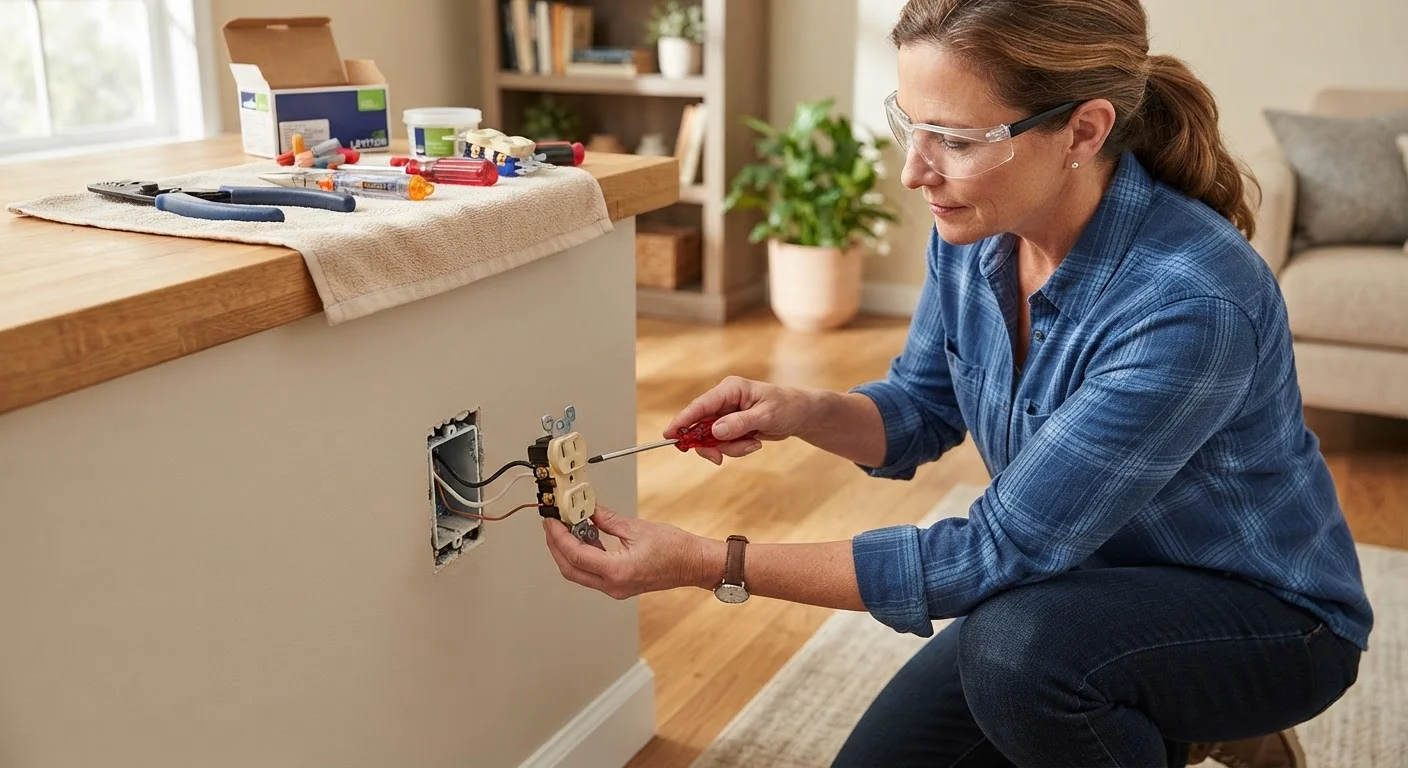
Several common electrical repairs fall within reach of a methodical homeowner who respects the safety basics. The key prerequisites are always the same: switch off the breaker controlling the circuit, verify the power is off with a non-contact voltage tester before touching any wire, and understand what you're looking at before disconnecting anything.
Replace a standard 120-volt outlet or switch after confirming power is off
Swapping a like-for-like receptacle or toggle switch involves disconnecting and reconnecting three wires (hot, neutral, ground) at clearly marked terminals. The risk is manageable when power is fully verified off and the replacement matches the original amperage and type.
Upgrade a two-prong ungrounded outlet to a GFCI receptacle
The National Electrical Code permits replacing ungrounded two-prong outlets with GFCI receptacles as a code-compliant alternative to rewiring. GFCI protection significantly reduces shock risk in ungrounded locations.
Replace a light fixture with one of the same or lower wattage rating
Swapping a ceiling fixture involves disconnecting three wires at a ceiling box, connecting the new fixture's wires to match (black to black, white to white, ground to ground), and securing the mounting. This is well within reach when the box is rated for the fixture's weight.
Install a programmable or smart thermostat on a low-voltage HVAC system
Most residential thermostats operate on 24-volt low-voltage wiring, which carries far less shock risk than standard household current. The wires are color-coded and the task is reversible if needed.
Reset a tripped GFCI outlet or circuit breaker - and investigate why it tripped
GFCI outlets and breakers trip to protect against fault conditions. Resetting them is safe, but repeatedly tripping breakers or GFCIs signals an underlying problem - a short, overload, or failing device - that needs diagnosis, not just repeated resets.
Tasks That Require a Licensed Electrician
Certain electrical jobs aren't just difficult - they're legally and structurally off-limits for unlicensed individuals in most states. Beyond the personal safety risk, unpermitted work can void your homeowner's insurance, create liability during a home sale, and lead to costly remediation. If your project falls into any of the categories below, contact a licensed electrician and, where required, pull the appropriate permit through your local building department.
- Main service panel work: Adding breakers, replacing the panel, or touching the main lugs (the two large wires feeding the panel from the utility) is dangerous even with the breaker off - the main lugs remain live. This is always a job for a licensed pro.
- Subpanel installation: Running a subpanel to a garage, workshop, or addition involves 240-volt feeds and load calculations that require professional expertise and almost always a permit.
- New circuit runs: Adding a dedicated circuit for an appliance, EV charger, or home office involves routing wire through walls and connecting to the panel - tasks requiring permits and inspection in virtually all U.S. jurisdictions.
- 240-volt appliance hookups: Dryers, ranges, water heaters, and central air conditioners operate on 240 volts and draw high amperage. Mistakes can cause fires or fatal shock.
- Aluminum wiring remediation: Homes built between roughly 1965 and 1973 may have aluminum branch wiring, which requires specific repair methods and professional evaluation.
- Outdoor and underground wiring: Buried conduit, exterior circuits, and wet-location wiring involve code requirements that vary by locality and are easy to get wrong.
Always Pull a Permit When Required
Many homeowners skip permits to save time or money, but this can backfire significantly. Unpermitted electrical work may be flagged during a home sale inspection, require costly tear-out and remediation, or affect insurance claims after a fire. Check with your local building department before starting any project beyond simple fixture or device swaps - requirements vary by municipality. When in doubt, ask.
Quick Wins: Start Safe Today
If you're ready to take on a straightforward electrical task, or simply want to improve your home's electrical safety right now, the following actions have meaningful impact with low risk.