What Magical Realism Actually Means
At its core, magical realism is a literary mode in which supernatural or fantastical elements appear within an otherwise realistic narrative - not as intrusions or surprises, but as natural, unremarkable parts of life. A woman might levitate when she prays. The dead might return to share a meal with the living. A village might be cursed to repeat the same century forever. These moments aren't treated as dream sequences or metaphors to be decoded. They simply are.
This is what separates magical realism from fantasy. In a fantasy novel, the magical world operates by its own rules, and readers enter it deliberately. In magical realism, the magic is already here - woven into the fabric of an ordinary Tuesday. The effect is disorienting in the best possible way: it forces readers to question what they consider "real" in the first place.
The term itself was coined by German art critic Franz Roh in 1925 to describe a post-expressionist style of painting, but it was Latin American writers of the mid-twentieth century who made it a defining literary force - and who gave it its emotional depth.
A Note on the Term "Magical Realism"
The label is applied broadly and sometimes loosely in popular conversation. Scholars often distinguish between Latin American magical realism - with its specific political and postcolonial roots - and works in other traditions that share surface similarities but emerge from different cultural contexts. Neither usage is wrong, but understanding the distinction helps readers appreciate what makes the Latin American tradition distinctively itself.
The Historical Roots of the Movement
To understand why magical realism took root so powerfully in Latin America, you have to understand what Latin America was living through. The region's writers were navigating layered legacies: colonial violence, political dictatorship, economic inequality, and the collision of Indigenous, African, and European worldviews. The result was a culture in which myth and history were genuinely difficult to untangle.
Indigenous oral traditions - rich with transformation, spirit worlds, and ancestors who walked among the living - had never fully disappeared under colonial rule. African spiritual traditions brought to the Americas through the slave trade also carried a cosmology in which the boundary between the physical and the spiritual was permeable. These weren't exotic beliefs to the people who held them; they were simply how the world worked.
When mid-century Latin American writers began experimenting with form, many found that straight realism couldn't hold all of what they needed to say. A novel about a military dictatorship felt incomplete if it couldn't also speak to the surreal terror that dictatorship produced - the way it made ordinary life feel haunted. Magical realism gave them the tools to tell the whole truth.
1967
Year One Hundred Years of Solitude was published
García Márquez's landmark novel went on to sell more than 50 million copies worldwide and has been translated into dozens of languages.
1982
Nobel Prize in Literature awarded to García Márquez
The Nobel Committee cited his novels and short stories in which the fantastic and the realistic are combined in a richly composed world of imagination.
50M+
Copies sold of One Hundred Years of Solitude
The novel became one of the bestselling Spanish-language books in history, a milestone for Latin American literature globally.
The Writers Who Defined the Genre
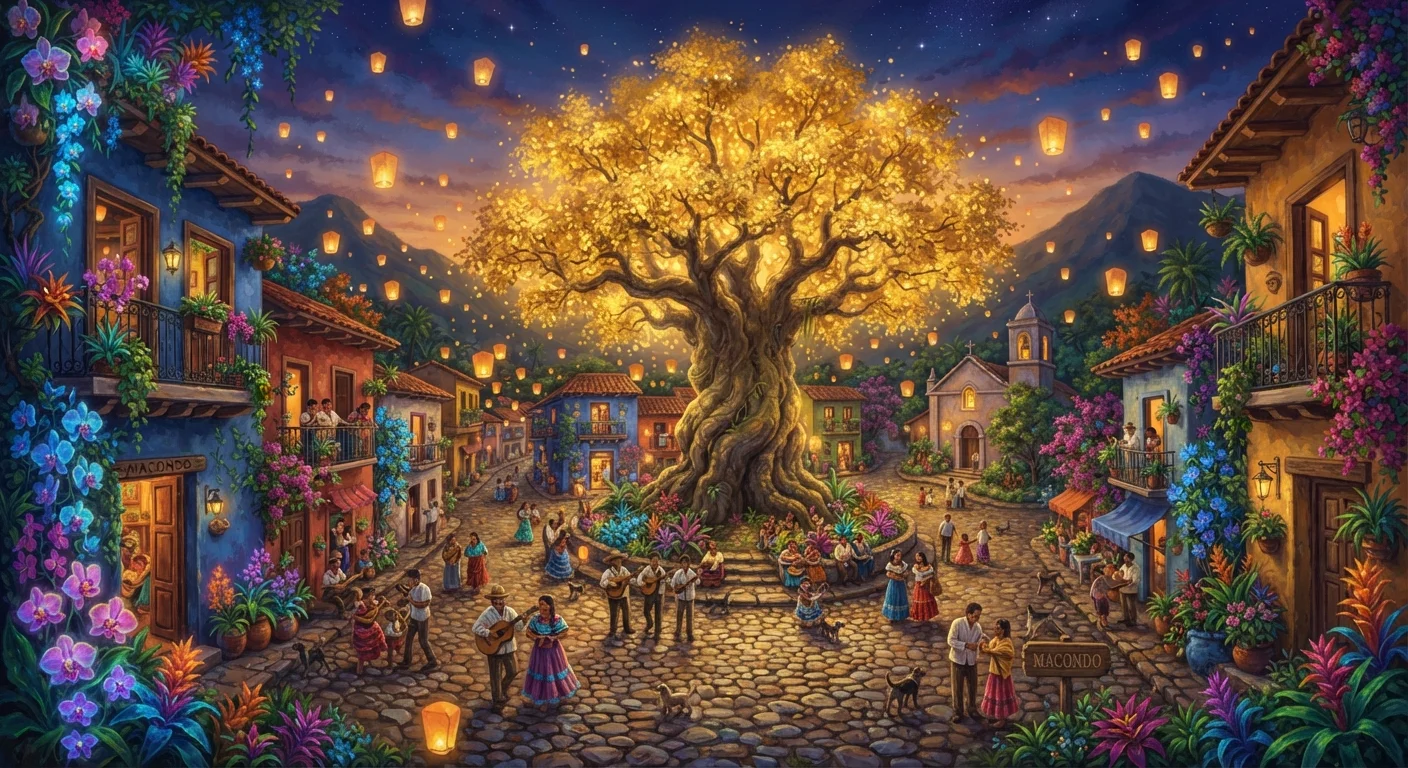
No author is more synonymous with magical realism than Gabriel García Márquez, the Colombian novelist whose One Hundred Years of Solitude (1967) became one of the most celebrated novels of the twentieth century. Set in the fictional town of Macondo, the novel follows the Buendía family across generations, blending civil war, banana plantation politics, and outright miracles into a single, seamless narrative. García Márquez drew heavily on his grandmother's storytelling style - she spoke of extraordinary events in the same calm, matter-of-fact voice she used for everything else. That flatness of tone became the genre's signature.
Juan Rulfo, a Mexican writer, shaped the movement even earlier with his slender 1955 novel Pedro Páramo. The book follows a man who travels to a ghost town to find his father - only to discover that nearly everyone he meets is dead. Rulfo's prose is spare and haunting, built from fragments and voices, and it influenced García Márquez so profoundly that he reportedly memorized it.
Isabel Allende of Chile brought magical realism to a new generation of readers with The House of the Spirits (1982), a multigenerational family saga in which clairvoyance and telekinesis sit alongside coups and class struggle. Her work, like García Márquez's, is rooted in political reality - her own family history includes the 1973 coup that ousted her relative, Salvador Allende.
Other essential voices include Laura Esquivel, whose Like Water for Chocolate explores how a woman's emotions literally flavor the food she cooks, and Jorge Luis Borges, the Argentine master of labyrinths, mirrors, and infinite libraries who, while not strictly a magical realist, laid essential intellectual groundwork for the entire movement.
When reading magical realism, resist the urge to immediately categorize a fantastical event as a dream or metaphor - sit with the image and let the story reveal its own logic.
The genre's power comes from its insistence that the magical and the mundane share equal footing; searching too quickly for symbolic meaning can short-circuit that experience.
Pair a magical realist novel with a brief history of the era and country it depicts - the political context almost always unlocks the deeper meaning of the novel's strangest moments.
Writers like Allende and García Márquez embedded real historical events and traumas into their fantastical narratives; knowing the history transforms a surreal detail into a pointed act of witness.
How Magical Realism Captured the World's Imagination
By the 1980s and 1990s, the influence of Latin American magical realism had rippled outward in ways its originators might not have predicted. Writers on nearly every continent began adapting the mode to their own cultural contexts. Toni Morrison in the United States wove the supernatural into the lived experience of slavery in Beloved - a ghost story that is also one of the most searing historical novels in American literature. Salman Rushdie in India and Britain used magical realism to grapple with the chaos of partition and postcolonial identity in Midnight's Children. Günter Grass had already brought something similar to Germany with The Tin Drum in 1959.
What these writers shared with their Latin American predecessors was the recognition that sometimes the truth of an experience - especially one marked by trauma, displacement, or systemic injustice - can only be told slant. The magic isn't escapism. It's a precision instrument.
García Márquez was awarded the Nobel Prize in Literature in 1982, a moment that brought enormous international attention to the Latin American literary tradition. But it also risked flattening that tradition into a single aesthetic - and critics have since noted that "magical realism" is sometimes used too broadly, in ways that obscure the specific political and cultural roots that made the original works so powerful.
Reading Magical Realism Today
If you're coming to magical realism for the first time, the experience can be pleasantly destabilizing. Readers accustomed to plot-driven, cause-and-effect narratives may initially feel adrift when a character's grief summons a swarm of yellow butterflies and no one in the story seems surprised. The instinct is to ask: Is this a dream? Is it symbolic? Magical realism asks you to resist that instinct, at least at first - to accept the image on its own terms and let meaning accumulate.
A useful entry point is to begin with shorter works. Rulfo's Pedro Páramo is under 130 pages. García Márquez wrote extraordinary short stories, including "A Very Old Man with Enormous Wings," that showcase the genre's tone without requiring weeks of commitment. From there, the longer novels - One Hundred Years of Solitude, The House of the Spirits - open up in richer ways once you've adjusted to the rhythm.
Reading about the historical contexts these novels emerged from also deepens the experience considerably. The magic in magical realism is rarely arbitrary. It tends to encode something - a grief, a political horror, a cultural memory - that the writer couldn't or wouldn't say plainly. Learning to read that encoding is part of the pleasure.
Contemporary writers continue to expand what the tradition can do. Authors like Mariana Enriquez from Argentina and Daniel Alarcón from Peru are bringing new urgency and strangeness to the form, proving that the everyday still has plenty of extraordinary left in it.
Where to Start With Magical Realism
Begin with García Márquez's short story "A Very Old Man with Enormous Wings" - it's free online and encapsulates the genre's tone in under twenty minutes of reading. From there, Rulfo's Pedro Páramo offers a full novel experience at a manageable length. Both will recalibrate your reading instincts before you take on the longer works.