
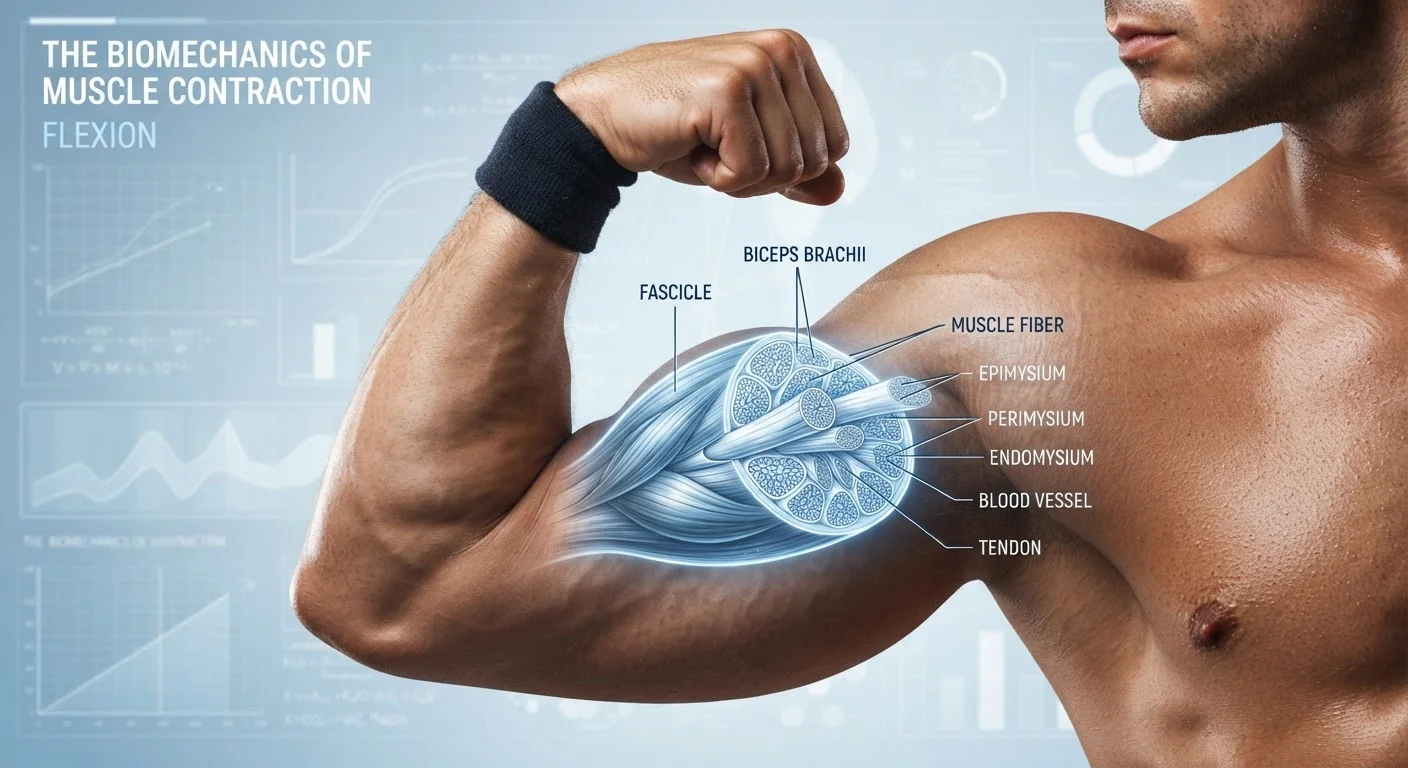
The Three Mechanisms That Trigger Muscle Growth
Sports scientists have identified three primary mechanisms that signal the body to build more muscle tissue. Understanding them helps explain why certain training approaches work - and why others fall short.
1. Mechanical Tension
When a muscle contracts against resistance - whether a barbell, a resistance band, or your own bodyweight - it generates mechanical tension across the muscle fiber. This tension is detected by specialized receptors in the muscle cell membrane, which then trigger a cascade of molecular signals that ramp up protein synthesis. Greater tension over a longer range of motion tends to produce a stronger growth signal, which is one reason full-range-of-motion exercises are favored in evidence-based training.
2. Metabolic Stress
During high-repetition or sustained effort training, metabolic byproducts like lactate accumulate in the muscle. This chemical environment - sometimes perceived as the "burn" - appears to contribute to hypertrophy through hormonal responses and cell swelling. Metabolic stress is a secondary driver, supporting growth rather than leading it.
3. Muscle Damage
Eccentric movements - the lowering phase of a squat or the descent of a bicep curl - cause microscopic tears in muscle fibers. The body's inflammatory repair response activates satellite cells, which are muscle stem cells that fuse to existing fibers, adding new contractile proteins. This rebuilding process is what makes muscles larger and more resilient over time. It is also the reason adequate recovery between sessions is non-negotiable.
Train Through a Full Range of Motion
Research suggests that performing resistance exercises through a complete range of motion generates greater mechanical tension across the muscle and produces superior hypertrophy compared to partial-range alternatives. Unless injury limits your mobility, prioritize full-range movements like deep squats and full-extension curls for better long-term muscle development.
Protein Synthesis: The Cellular Engine of Growth
At the molecular level, muscle growth comes down to a balance between protein synthesis (building new muscle proteins) and protein breakdown (dismantling old or damaged ones). Net muscle gain only occurs when synthesis consistently exceeds breakdown - a state called a positive net protein balance.
Resistance training acutely elevates muscle protein synthesis for 24 to 48 hours after a session. Dietary protein supplies the amino acid building blocks needed during this window. The amino acid leucine, found in high quantities in animal proteins and some plant sources like soy, is particularly effective at triggering the mTOR pathway - a key molecular switch for protein synthesis.
This is why nutrition and training are inseparable in any serious muscle-building strategy. To understand how your muscles' energy systems support this demanding process, see our explainer on aerobic vs. anaerobic energy in your muscles.
48 hrs
Post-workout protein synthesis elevation window
Research indicates muscle protein synthesis remains elevated for up to 48 hours following a resistance training session, highlighting the importance of timely protein intake.
2×/week
Optimal training frequency per muscle group
A meta-analysis published in the Journal of Strength and Conditioning Research found that training each muscle group twice per week produced greater hypertrophy than once-per-week protocols.
~0.5-1 lb
Realistic monthly muscle gain for beginners
Exercise science researchers suggest that drug-free beginners can realistically gain roughly 0.5 to 1 pound of muscle per month under consistent, well-structured training conditions.
Progressive Overload: The Non-Negotiable Principle
The body adapts to the demands placed on it - and then stops adapting if those demands don't change. Progressive overload is the principle of systematically increasing the training stimulus over time to keep triggering hypertrophy. This can mean adding weight, performing more repetitions, increasing training volume, or reducing rest periods.
Without progression, the body reaches a plateau. This is why following the same workout at the same weight for months produces diminishing returns. Structured progression - even in small increments - keeps the mechanical tension signal strong and the muscle-building response active.
It is also worth noting that many popular beliefs about training don't align with the actual science. For a closer look at common misconceptions, our article on training myths that persist in gyms examines what the evidence actually supports.
Recovery, Sleep, and the Hormonal Environment
Training is the stimulus; recovery is where muscle growth is completed. During deep sleep, the body releases growth hormone - one of the key anabolic (muscle-building) hormones - which drives tissue repair and protein synthesis. Consistently getting fewer than seven hours of sleep per night is associated with reduced anabolic hormone levels and impaired recovery.
Chronic stress also matters. Elevated cortisol - the body's primary stress hormone - promotes protein breakdown and can blunt the hypertrophic response to training. Managing overall life stress, alongside training load, is a legitimate performance and physiology concern.
Finally, training frequency plays a role. Most research supports training each muscle group at least twice per week for optimal hypertrophy, giving enough stimulus while allowing sufficient recovery between sessions.
A person starts a beginner strength program and notices their arms look visibly larger after three months of consistent training.
An experienced gym-goer stops progressing in size despite working out regularly for a year.
A college athlete increases protein intake and prioritizes sleep during a heavy training block and sees faster recovery and better strength gains.
This article is for general informational and educational purposes only and is not a substitute for professional medical or fitness advice. Consult a qualified healthcare provider or certified fitness professional before beginning any new exercise program.