
Start Here: What Both Systems Are Actually Doing
No matter what kind of physical activity you're doing - a slow walk or a full-out sprint - your muscles have one core job: make ATP (adenosine triphosphate). ATP is the molecule that directly powers muscle contraction. Your body can't store much of it, so it must be produced continuously, and the method it uses depends heavily on how fast you need it.
That's where aerobic and anaerobic metabolism come in. These aren't separate "modes" that switch cleanly on and off. They're two overlapping energy systems, both running at the same time, with intensity determining which one carries more of the load. Think of them less like light switches and more like two engines sharing the work - one efficient and steady, the other fast and powerful but quick to fatigue.
For a broader look at how these systems shape actual training decisions, see how aerobic and anaerobic training differ physiologically.
Aerobic Metabolism: Oxygen as the Key Ingredient
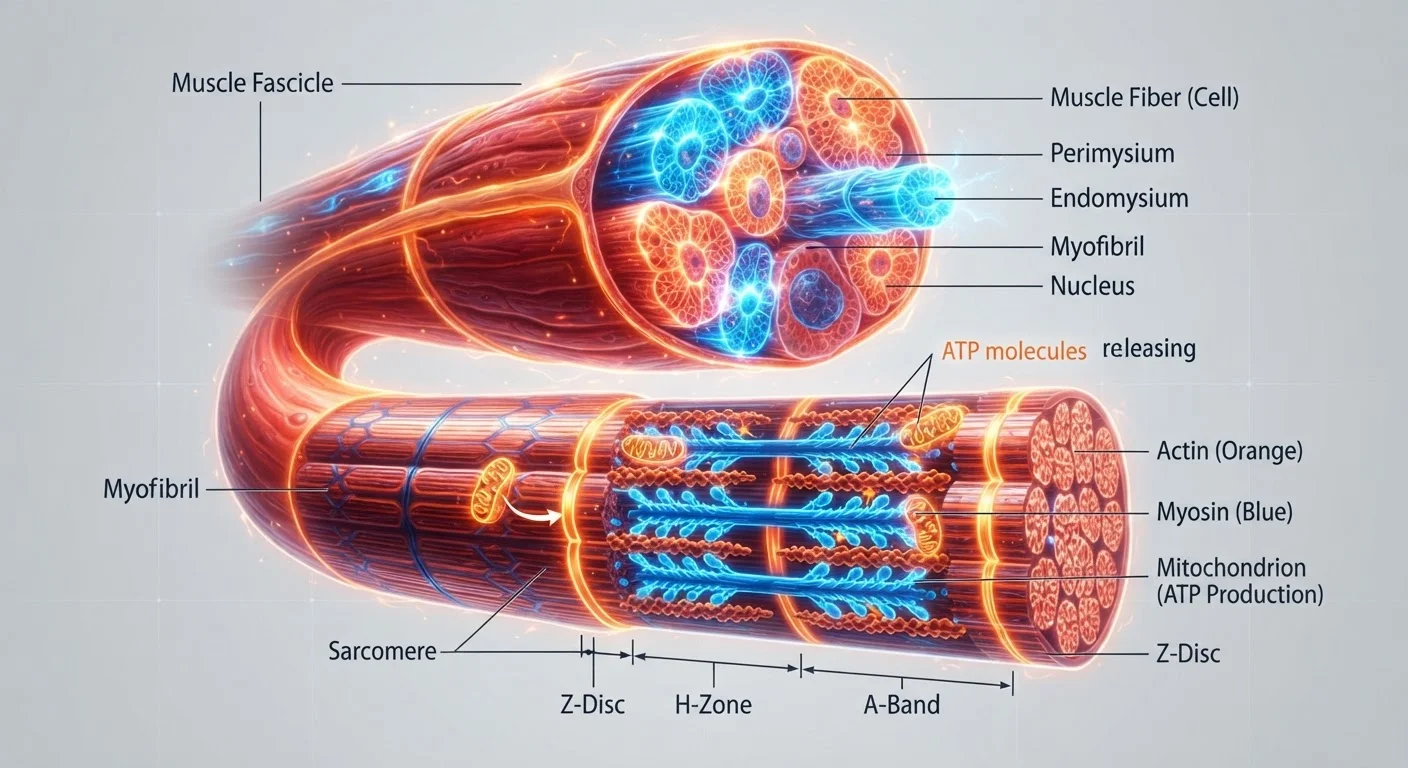
Aerobic metabolism occurs inside structures called mitochondria - often called the powerhouse of the cell - and it requires a steady supply of oxygen. When oxygen is available, your body breaks down glucose and fats through a chain of chemical reactions (glycolysis, the Krebs cycle, and the electron transport chain) that together generate up to 36-38 ATP molecules per glucose molecule.
That's a remarkably efficient return. The trade-off is time: the full aerobic pathway is relatively slow. It suits activities like distance running, cycling, or swimming at a comfortable pace - efforts where your breathing and circulation can keep oxygen flowing to working muscles.
Fat, notably, is almost exclusively an aerobic fuel. At lower intensities, your body draws heavily on stored fat. As intensity rises, the balance shifts toward carbohydrates. This is why endurance athletes often talk about "fat adaptation" - training the body to rely more on fat at higher intensities, preserving limited carbohydrate stores.
| Criterion | Aerobic Metabolism | Anaerobic Metabolism |
|---|---|---|
| Oxygen required? | Yes | No |
| ATP yield per glucose | ~36-38 ATP | ~2 ATP |
| Speed of ATP production | Slower | Faster |
| Primary fuels | Glucose, fats, protein (minor) | Glucose, creatine phosphate |
| Key by-products | CO₂, water | Lactate, hydrogen ions |
| Duration of dominance | Minutes to hours | Seconds to ~2 minutes |
| Typical activities | Jogging, cycling, swimming | Sprinting, heavy lifting, HIIT |
Anaerobic Metabolism: Fast Energy Without Oxygen
When effort ramps up past the point where oxygen delivery can keep pace - say, during a hard sprint or a heavy lift - the aerobic pathway can't produce ATP fast enough. Your muscles shift to anaerobic glycolysis: breaking down glucose without oxygen. This is much faster, but far less efficient, yielding only about 2 ATP per glucose molecule.
The by-product you've probably heard of is lactic acid (more precisely, lactate plus hydrogen ions). Contrary to a long-standing myth, lactate itself isn't the cause of muscle soreness the next day - that's a separate process. But the hydrogen ions released during intense anaerobic work do contribute to the burning sensation and fatigue you feel in the moment.
There's also a third, ultra-fast system - the phosphocreatine (PCr) system - which powers the first 8-10 seconds of maximal effort using stored creatine phosphate. It's anaerobic too, producing ATP almost instantly but exhausting itself rapidly. Understanding this three-system picture is foundational to grasping what strength training and cardio each do to your body.
The Crossover Point: Where Intensity Determines the Mix
Scientists describe a concept called the lactate threshold - the exercise intensity at which lactate begins to accumulate in the blood faster than the body can clear it. Below this threshold, aerobic metabolism handles most of the workload. Above it, anaerobic glycolysis increasingly takes over, and fatigue accelerates.
This threshold isn't fixed. Consistent aerobic training raises it, meaning you can work harder before tipping into predominantly anaerobic territory. That's one reason trained endurance athletes can sustain paces that would leave untrained individuals breathless in minutes. Low- and high-intensity activity serve different purposes, and understanding your energy systems makes those differences clearer.
For athletes playing multiple sports or mixing training types, both systems are constantly being called upon in different proportions - a reality explored in depth when considering the physical demands of switching between sports.
Lactate Is Not the Villain It Once Seemed
For decades, lactic acid was blamed for muscle soreness and fatigue. Current research tells a more nuanced story: lactate is actually a fuel source that can be shuttled to other muscles and the heart during exercise. It's the accompanying hydrogen ions - not lactate itself - that interfere with muscle contraction and cause the burning sensation. Next-day soreness (DOMS) is largely caused by microscopic muscle damage and inflammation, a separate process entirely.
This article provides general educational information about human physiology and is not medical or exercise advice. Consult a qualified healthcare or fitness professional before beginning any new exercise program, especially if you have an existing health condition.