The Core Difference: Time and Scale
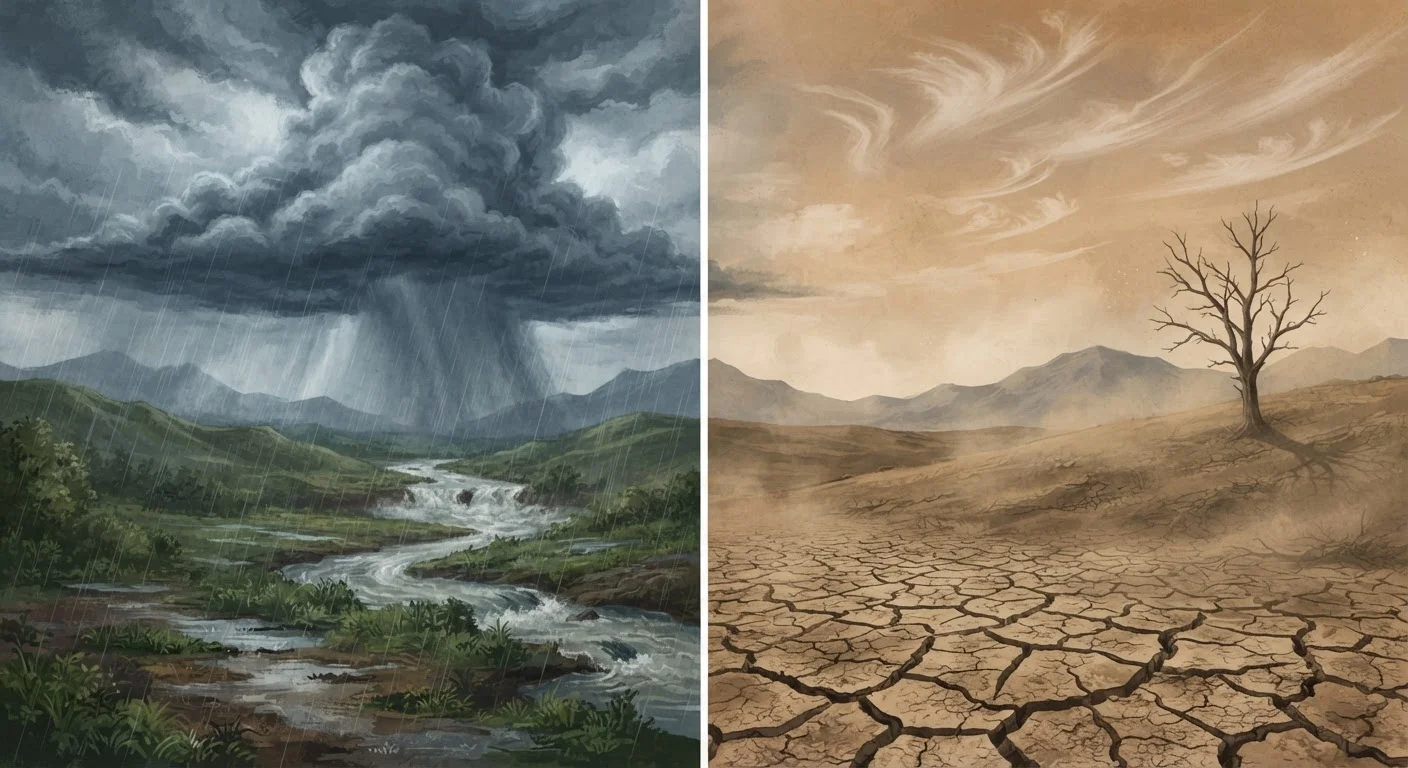
Weather is what happens outside your window right now - a thunderstorm rolling in, an unexpected frost, a humid August afternoon. It reflects the current state of the atmosphere: temperature, humidity, wind speed, precipitation. Weather can change hour by hour and is notoriously difficult to predict beyond about two weeks.
Climate, by contrast, is the long-term average of those atmospheric conditions - typically measured over a minimum of 30 years, which is the standard reference period used by the World Meteorological Organization. When someone says Phoenix is hot and dry or Seattle is rainy, they're describing climate: what the atmosphere tends to do in a given region over many years.
A useful analogy: weather is your mood on a given day; climate is your personality. One bad day doesn't define your character, and one record-cold February doesn't redefine a region's climate trend.
| Criterion | Weather | Climate |
|---|---|---|
| Timescale | Hours to days (up to ~2 weeks) | Decades to centuries (30+ years standard) |
| What it measures | Current atmospheric conditions | Long-term averages and trends |
| Predictability | Reliable up to ~10-14 days | Long-term trends modeled with high confidence |
| Primary tools | Radar, satellites, weather stations | Historical records, climate models, proxy data |
| Example statement | "It will rain Thursday." | "This region averages 40 inches of rain per year." |
| Can prove/disprove global warming? | No - too short-term | Yes - when analyzed across decades |
Why the Confusion Gets Exploited
The weather-vs.-climate distinction is one of the most frequently misused concepts in public discourse about climate change. The error usually sounds like this: "It's snowing in April - so much for global warming." This conflates a single weather event with a decades-long trend in global average temperatures - two things operating on fundamentally different scales.
Scientists who study climate don't look at what happened last Tuesday. They analyze temperature records, ocean heat content, sea ice extent, glacier mass, and atmospheric CO₂ concentrations across decades and centuries. The Intergovernmental Panel on Climate Change (IPCC), which synthesizes thousands of peer-reviewed studies, uses exactly this kind of long-term data to establish scientific consensus - not the weather on any given morning.
That said, the relationship between weather and climate isn't one-way. As global average temperatures rise, weather events are influenced - heat waves become more intense and frequent, precipitation patterns shift, and storm behavior may change. But the link runs from climate trends down to weather probabilities, not from individual weather events back up to climate conclusions.
For a fascinating parallel in how distinct-seeming events are often confused, see our piece on solar flares, CMEs, and geomagnetic storms, where similar terminology confusion has real consequences.
Reading Both Accurately
Understanding this distinction makes you a more informed reader of both weather forecasts and climate news. When a report says "the last decade was the hottest on record," that's a climate statement - grounded in globally averaged data. When your local forecast says tomorrow will be 20 degrees below average, that's a weather statement - and it's fully compatible with living in a warming world.
Weather literacy has practical, everyday value too. Knowing how to read atmospheric cues - cloud formations, wind shifts, pressure changes - helps you anticipate short-term conditions before they arrive. Our article on reading the weather from natural clues explores those time-tested signals. And for drivers, weather patterns have very real seasonal consequences - see our guide on seasonal car care for how climate-driven seasonal shifts affect vehicle maintenance needs.
The bottom line: both weather and climate are real, measurable, and important. Keeping them clearly separated isn't just a matter of scientific precision - it's essential to having an honest, productive conversation about the state of the planet.