
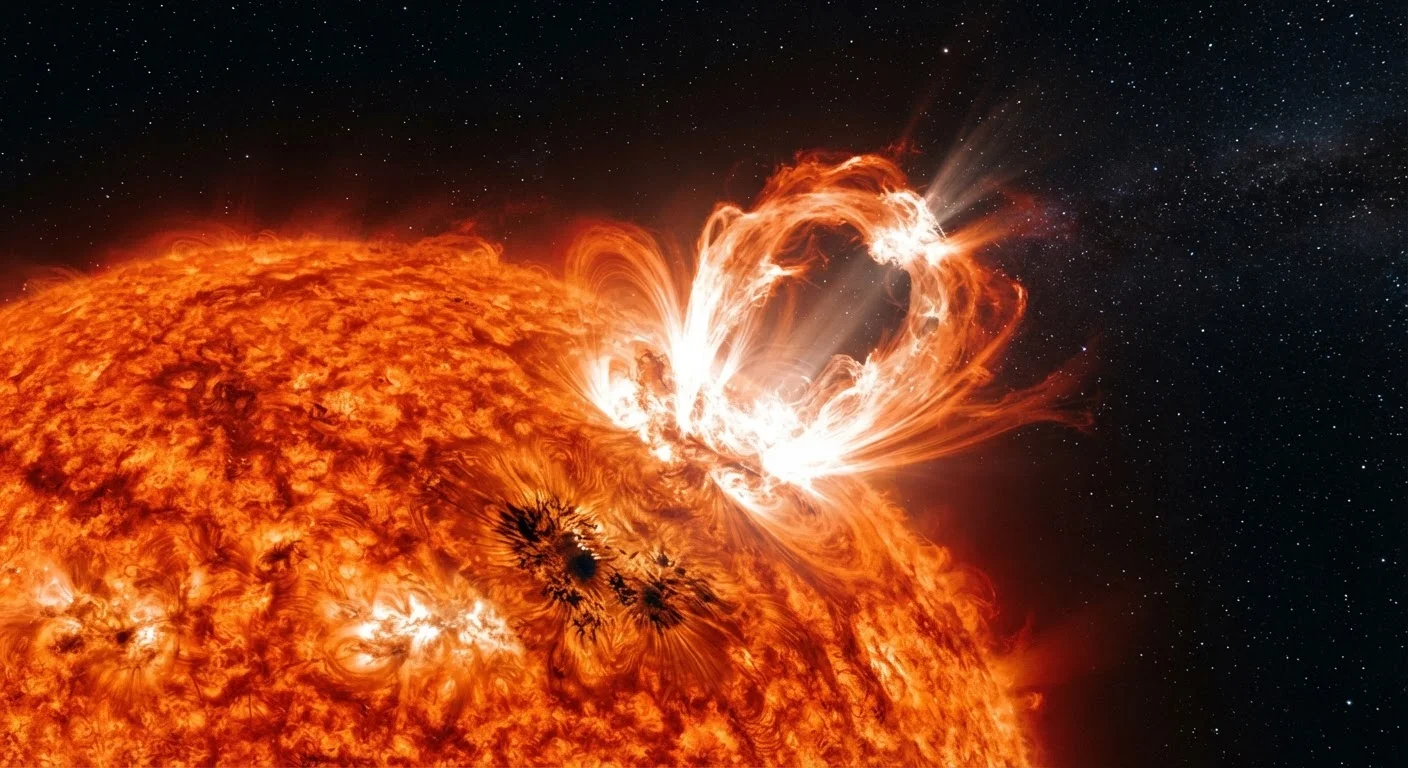
Why Space Weather Terms Get Confused
Turn on cable news during an active stretch of solar activity and you'll hear "solar flare" and "geomagnetic storm" used almost interchangeably. They're not the same thing. The sun can produce all three events - solar flares, coronal mass ejections (CMEs), and geomagnetic storms - in rapid succession, which is why the distinction gets blurry. But they operate on different timescales, involve different physical processes, and pose different risks to Earth's infrastructure and population. Sorting them out is the first step to understanding what scientists mean when they say space weather is active.
Just as there's an important difference between a cold snap and a long-term climate shift - a distinction explored in our breakdown of climate vs. weather - the differences between solar weather events are meaningful and worth understanding clearly.
Solar Flares: The Speed-of-Light Event
A solar flare is an intense, localized burst of electromagnetic radiation - primarily X-rays and ultraviolet light - originating from magnetically active regions on the sun's surface called sunspots. When tangled magnetic field lines suddenly snap and reconnect (a process called magnetic reconnection), enormous amounts of energy release in seconds to minutes. That energy travels as radiation at the speed of light.
Because light takes roughly eight minutes to travel from the sun to Earth, a solar flare's effects arrive almost immediately from our practical standpoint. The flood of X-rays ionizes Earth's upper atmosphere (the ionosphere), which can disrupt or completely black out high-frequency (HF) radio communications on the sunlit side of Earth. Pilots and mariners who depend on HF radio notice this most acutely. GPS accuracy can also degrade slightly during strong flares.
Flares are classified by peak X-ray output: A, B, C, M, and X, with each letter representing a tenfold increase in intensity. An X-class flare is the most powerful category. The 2003 Halloween flares were so intense they briefly overwhelmed the sensors used to measure them. Crucially, a solar flare by itself does not cause auroras or widespread power outages - that requires the next link in the chain.
| Solar Flare | Coronal Mass Ejection (CME) | Geomagnetic Storm | |
|---|---|---|---|
| What it is | Burst of electromagnetic radiation | Ejection of magnetized plasma | Disturbance of Earth's magnetosphere |
| Travel time to Earth | ~8 minutes (speed of light) | 1-3 days (varies by speed) | Begins at CME arrival |
| Primary Earth effects | HF radio blackouts, GPS errors | Triggers geomagnetic storms | Grid disruption, auroras, satellite drag |
| Occurs without the others? | Yes, often no CME follows | Yes, can occur without strong flare | No - requires CME impact |
| Measurement scale | A/B/C/M/X class (X-ray flux) | Speed in km/s, mass in kg | Kp index (0-9) / G1-G5 scale |
| Warning time available | Minutes or none | Hours to days | Hours after CME detection |
Coronal Mass Ejections: The Physical Punch
A coronal mass ejection is a massive expulsion of magnetized plasma from the sun's outer atmosphere (the corona). CMEs can carry billions of tons of charged particles and travel at speeds ranging from roughly 250 to over 3,000 kilometers per second. Unlike flares, CMEs are not bursts of light - they are matter, and they move considerably slower than radiation. Most Earth-directed CMEs arrive between one and three days after leaving the sun.
CMEs often accompany large solar flares, but they don't have to. A powerful flare can occur without a significant CME, and vice versa. When scientists detect a CME with coronagraph instruments aboard spacecraft like SOHO or the STEREO probes, they calculate its speed and trajectory to determine whether Earth is in the firing line. Not every CME hits Earth - the sun's plasma blasts spread across a wide arc, and only a fraction intersect our planet's position.
CMEs become dangerous primarily when their embedded magnetic field is oriented southward (opposite to Earth's northward-pointing magnetic field). This orientation allows them to breach Earth's protective magnetosphere, triggering the third event in the chain.
Geomagnetic Storms: Earth's Response
When a CME's magnetic field interacts with Earth's magnetosphere, it compresses and distorts the magnetosphere dramatically - sometimes pushing the boundary that normally sits 65,000 kilometers sunward down to geosynchronous orbit altitude. The resulting disturbance is called a geomagnetic storm, and it's the event with the broadest set of real-world consequences.
Earth's magnetic field is a remarkable but complex system - for a deeper look at its quirks, see eight phenomena that reveal how strange our magnetic field really is. During a geomagnetic storm, rapidly changing magnetic fields induce electrical currents in long conductors - pipelines, communication cables, and most significantly, electrical power grids. The most severe geomagnetic storm on record, the Carrington Event of 1859, set telegraph wires on fire and induced currents that allowed operators to send messages without battery power.
Modern consequences are less dramatic but still significant: induced currents can damage or destroy large power transformers, satellite operations are disrupted by atmospheric drag changes at low orbits, and GPS positioning errors increase. On the positive side, geomagnetic storms push auroras - the northern and southern lights - far toward lower latitudes, sometimes making them visible across the continental United States. Storms are graded on the Kp index (0-9) and NOAA's G-scale (G1-G5).
How to Follow Space Weather Alerts
NOAA's Space Weather Prediction Center (SWPC), at spaceweather.noaa.gov, is the authoritative public source for real-time alerts covering all three types of events. The center issues separate watches, warnings, and alerts for solar radiation storms (driven by energetic particles from flares and CMEs), radio blackouts (from flare X-ray flux), and geomagnetic storms. Subscribing to these free alerts is genuinely useful for amateur radio operators, aviation professionals, satellite operators, and anyone curious about aurora viewing opportunities.
Reliable space weather literacy also pairs well with broader skills in reading environmental signals, much like the traditional methods described in reading weather from natural clues - a reminder that paying attention to signals, solar or terrestrial, has always been a practical skill.
The key habit is to distinguish the event (a flare or CME) from the impact (a geomagnetic storm). A headline reading "Massive Solar Flare Erupts" may or may not mean that a geomagnetic storm is coming - it depends on whether the flare was accompanied by an Earth-directed CME.