
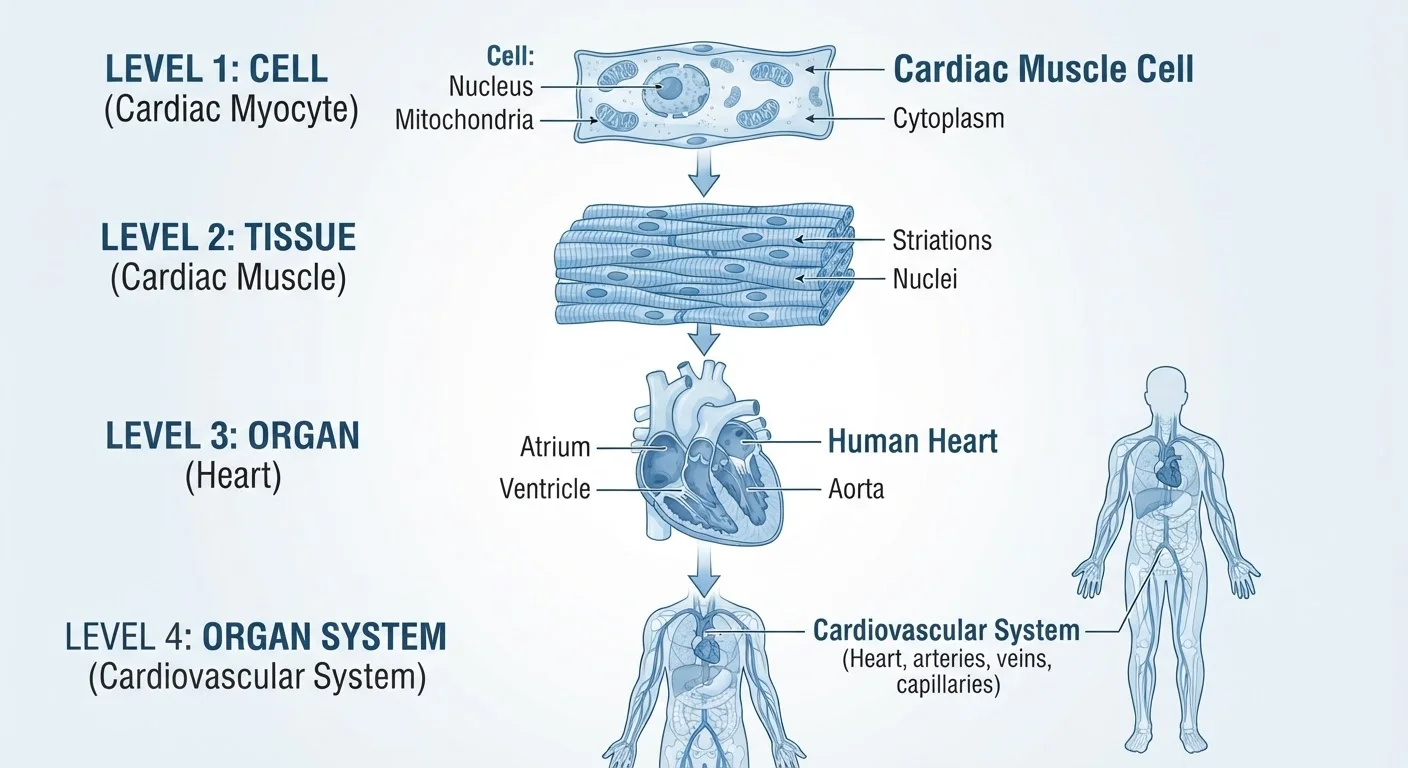
The Four Levels, Explained
The human body contains roughly 37 trillion cells. Yet somehow, those cells don't just exist as a chaotic mass - they're arranged into a precise, layered hierarchy that gives rise to everything from a heartbeat to a thought. Biologists describe this hierarchy using four levels of organization: cells, tissues, organs, and organ systems.
Each level is built from the one beneath it. Cells group into tissues. Tissues combine to form organs. Organs coordinate within systems. This structure isn't accidental - it's the result of billions of years of evolution fine-tuning how life manages complexity. For anyone trying to make sense of human anatomy, health, or disease, understanding this framework is the essential first step. For a plain-language reference on related biology vocabulary, see our guide to key human biology terms.
Cell
The smallest unit of life capable of carrying out basic biological functions. All living things are made of one or more cells.
Tissue
A group of similar cells that work together to perform a shared function, such as muscle tissue contracting to produce movement.
Organ
A distinct body structure made of two or more tissue types that carries out a specific, complex function - like the heart pumping blood.
Organ system
A group of organs that coordinate to accomplish a larger physiological goal, such as the digestive system breaking down and absorbing food.
Eukaryotic cell
A cell that contains a membrane-bound nucleus housing its DNA. All human cells are eukaryotic.
Organelle
A specialized structure within a cell that performs a specific job - for example, mitochondria generate energy for the cell.
Epithelial tissue
Tissue that covers body surfaces and lines internal cavities, acting as a protective barrier and often handling absorption or secretion.
Connective tissue
The body's structural and support tissue, including bone, cartilage, fat, and blood, all characterized by a surrounding non-cellular matrix.
Cells: The Starting Point
A cell is the smallest unit capable of carrying out life's fundamental processes - taking in nutrients, generating energy, reproducing, and responding to its environment. Human cells are eukaryotic, meaning they contain a nucleus that houses DNA, the genetic instruction manual for every function the cell performs.
The body contains over 200 distinct cell types, each shaped and equipped for a specific job. Red blood cells are disc-shaped and packed with hemoglobin to carry oxygen efficiently. Neurons extend long, branching projections to transmit electrical signals across great distances. Muscle cells are loaded with protein filaments that slide past each other to generate force. Despite their differences, all these cells share the same core structures: a cell membrane, cytoplasm, and organelles - tiny internal structures that handle specific tasks, much like organs do at a larger scale.
What makes the cell-level perspective so powerful is that most disease begins here. Cancer, for instance, originates in a single cell whose replication controls malfunction. Understanding cells is understanding where health and illness both start.
Tissues: Teamwork at the Microscopic Level
When similar cells with a shared function cluster together, they form a tissue. The human body has four primary tissue types, and they appear in virtually every structure you can name.
- Epithelial tissue covers body surfaces and lines cavities - your skin, the inside of your lungs, and the lining of your digestive tract are all epithelial. It acts as a barrier and often absorbs or secretes substances.
- Connective tissue is the body's structural scaffolding. Bone, cartilage, blood, fat, and the fibrous material binding organs together are all connective tissue. Its defining feature is a matrix - a non-cellular material that surrounds and supports the cells within it.
- Muscle tissue is specialized for contraction. There are three varieties: skeletal muscle (voluntary movement), cardiac muscle (the heart), and smooth muscle (found in the walls of organs like the stomach and blood vessels).
- Nervous tissue is built for communication, transmitting electrical signals throughout the body with remarkable speed and precision.
Tissue Type Tells You About Healing
When learning about tissues, pay attention to their regenerative capacity - it directly affects how the body heals. Epithelial tissue turns over rapidly and heals quickly, which is why surface wounds close within days. Nervous tissue, by contrast, repairs very slowly and incompletely, which is why spinal cord injuries are so serious. Knowing this helps explain why some medical conditions recover fully while others require long-term management.
Each tissue type has its own repair capacity. Epithelial tissue regenerates quickly - that's why minor skin cuts heal fast. Cardiac muscle, by contrast, has very limited regenerative ability, which is why heart attack damage is often permanent.
Organs and Organ Systems: Where It All Comes Together
An organ is a structure composed of at least two tissue types working together to carry out a specific function. The heart, for example, is primarily cardiac muscle tissue - but it also contains epithelial tissue lining its chambers, connective tissue forming its outer sac, and nervous tissue coordinating its rhythm. None of those tissue types alone could pump blood; together, they can.
Other familiar organs include the liver (which filters blood, produces bile, and performs hundreds of metabolic tasks), the kidneys (which regulate fluid balance and filter waste), and the skin - the body's largest organ by surface area, combining epithelial, connective, and nervous tissues into a versatile protective barrier.
At the highest level of organization, organs group into organ systems. The human body has 11 recognized organ systems. The cardiovascular system circulates blood. The respiratory system exchanges gases. The digestive system breaks down food and absorbs nutrients. The endocrine system releases hormones. The nervous system processes information and coordinates responses - a topic worth exploring further in our overview of the central, peripheral, and autonomic nervous system.
No organ system works in isolation. The cardiovascular system delivers oxygen that the respiratory system captures. The endocrine system releases hormones that regulate how the digestive system processes food. This interdependence is what makes the body so resilient - and also why a problem in one system can ripple through others. Grasping the four-level framework gives you a map for understanding all of it.
This article is for general educational purposes only and is not a substitute for professional medical advice. Consult a qualified healthcare provider with any questions about your health.