
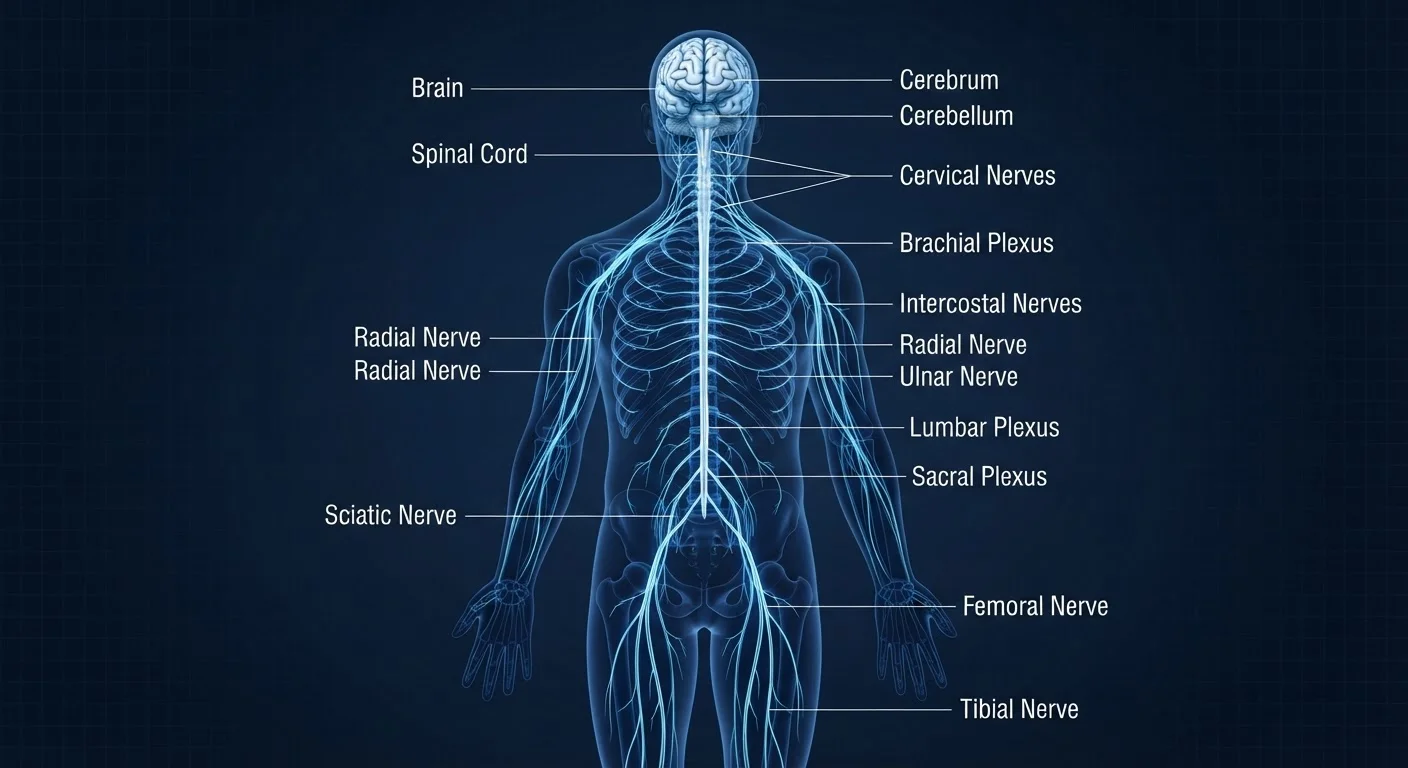
Three Divisions, One System
Think of the nervous system less as a single structure and more as an integrated trio of networks that collectively manage every function your body performs - from reading these words to keeping your lungs inflating while you do it. Understanding how those divisions are organized is one of the most useful things you can know about your own biology.
As part of a broader look at how the body organizes itself - explored in depth in our guide to cells, tissues, organs, and systems - the nervous system stands out as arguably the most complex organ system in the body. Its three main divisions each carry distinct responsibilities, but they work in constant coordination.
Divisions Are Conceptual, Not Physical
The terms "central," "peripheral," and "autonomic" describe functional divisions rather than physically separate structures. Neurons from all three systems interact constantly, and many textbooks present them in overlapping rather than strictly separate categories. When you read about the nervous system in different sources, the terminology and groupings can vary slightly - the underlying biology remains the same.
The Central Nervous System: Command Central
The central nervous system (CNS) consists of just two structures: the brain and the spinal cord. Despite that apparent simplicity, these two components are responsible for virtually all conscious thought, sensation, and voluntary movement - as well as a vast amount of unconscious processing that happens below the level of awareness.
The brain itself is divided into specialized regions. The cerebral cortex handles higher-order functions like reasoning, language, and memory. The cerebellum coordinates balance and fine motor control. The brainstem regulates the most basic life-sustaining functions - breathing, heart rate, and blood pressure - and acts as the gateway between the brain and the spinal cord.
The spinal cord serves as the main communication highway, routing signals between the brain and the peripheral nervous system. It also manages a class of fast, automatic responses called spinal reflexes - like pulling your hand away from heat before your brain has fully registered pain.
~86 billion
Neurons in the human brain
According to research published by neuroscientist Suzana Herculano-Houzel using cell-counting methods, the human brain contains approximately 86 billion neurons.
~120 m/s
Top nerve signal speed
The fastest nerve signals in the body - carried by large, myelinated motor neurons - travel at speeds up to roughly 120 meters per second, according to established neurophysiology literature.
31 pairs
Spinal nerve pairs in the human body
The human spinal cord gives rise to 31 pairs of spinal nerves, each serving a specific region of the body, as described in standard anatomical references.
The Peripheral Nervous System: The Body's Wiring
If the CNS is the command center, the peripheral nervous system (PNS) is the wiring that connects it to the rest of the body. It encompasses all the nerves outside the brain and spinal cord - the cranial nerves extending from the brainstem, the spinal nerves branching from the spinal cord, and the vast web of sensory and motor nerves reaching every muscle and organ.
The PNS has two main functional branches. The somatic nervous system governs voluntary movement and carries sensory information - touch, temperature, pain - from the body's surface and muscles back to the CNS. The autonomic nervous system, the PNS's second branch, operates largely below conscious awareness and is discussed in its own section below.
Sensory (afferent) neurons carry information toward the CNS; motor (efferent) neurons carry instructions away from it. This two-way flow is continuous and simultaneous.
The Autonomic Nervous System: Running on Autopilot
The autonomic nervous system (ANS) controls the body's involuntary functions - the ones that proceed without any conscious direction. Heart rate, blood pressure, digestion, pupil dilation, glandular secretion: all managed automatically, around the clock.
The ANS operates through two opposing but complementary divisions. The sympathetic division mobilizes the body in response to stress or perceived danger, triggering what is commonly called the "fight-or-flight" response: heart rate accelerates, pupils dilate, digestion slows, and blood is directed toward muscles. The parasympathetic division does the opposite - it promotes rest, recovery, and digestion, slowing the heart and stimulating the gut. This is sometimes called the "rest-and-digest" state.
A third division, the enteric nervous system, governs the gastrointestinal tract so independently that it is sometimes called the "second brain" - it can regulate digestion with minimal input from the CNS, though the two remain connected.
Most of the time, these divisions are not toggling between extremes. They work in balanced, dynamic tension - with the body modulating its state continuously in response to activity, environment, and internal cues.
Why These Distinctions Matter
Understanding the basic layout of the nervous system helps explain a wide range of health concepts - from why stress affects digestion, to why a spinal cord injury affects movement below the injury site, to why some medications target specific nerve pathways to treat conditions like high blood pressure or anxiety.
It also underscores just how integrated these systems are. The divisions described here are conceptual tools, not physical barriers. Neurons communicate across all three divisions constantly, and disruption in one area routinely affects the others.
This article is for general educational purposes only and is not a substitute for professional medical advice. If you have concerns about your nervous system health, consult a qualified healthcare provider.