
Why Biology Has Its Own Language - and How to Read It
Human biology is filled with terminology that can feel like a second language - and for good reason. Much of it traces back to Latin and Greek roots, standardized centuries ago so scientists worldwide could communicate precisely. The result is a vocabulary that is rigorous but often opaque to anyone outside a classroom.
This reference guide cuts through that opacity. Whether you're reading a health article, supporting a student, or simply curious about how your body works, the terms here represent the core vocabulary of anatomy, physiology, and cell biology. Each definition is written in plain English, with enough context to make the concept genuinely useful.
For readers interested in how the body structures itself from the ground up, our companion article on biological organization walks through the four levels - cells, tissues, organs, and systems - in accessible detail.
This Is General Education, Not Medical Advice
The definitions and explanations in this article are intended for general scientific literacy and education only. They are not a substitute for professional medical guidance. If you have questions about your health or a specific condition, consult a qualified healthcare provider.
The Core Glossary: Terms You'll Encounter Most Often
The definitions below cover the terms that appear most frequently in popular science writing, health journalism, and introductory biology. They are organized thematically rather than alphabetically, so related concepts appear near each other.
Cellular and Molecular Basics
At the smallest scale, biology is chemistry. Cells carry out thousands of reactions every second, governed by proteins like enzymes and regulated by signals like hormones. Understanding these molecular-level terms makes the bigger picture of organ function much clearer.
Structural Terms
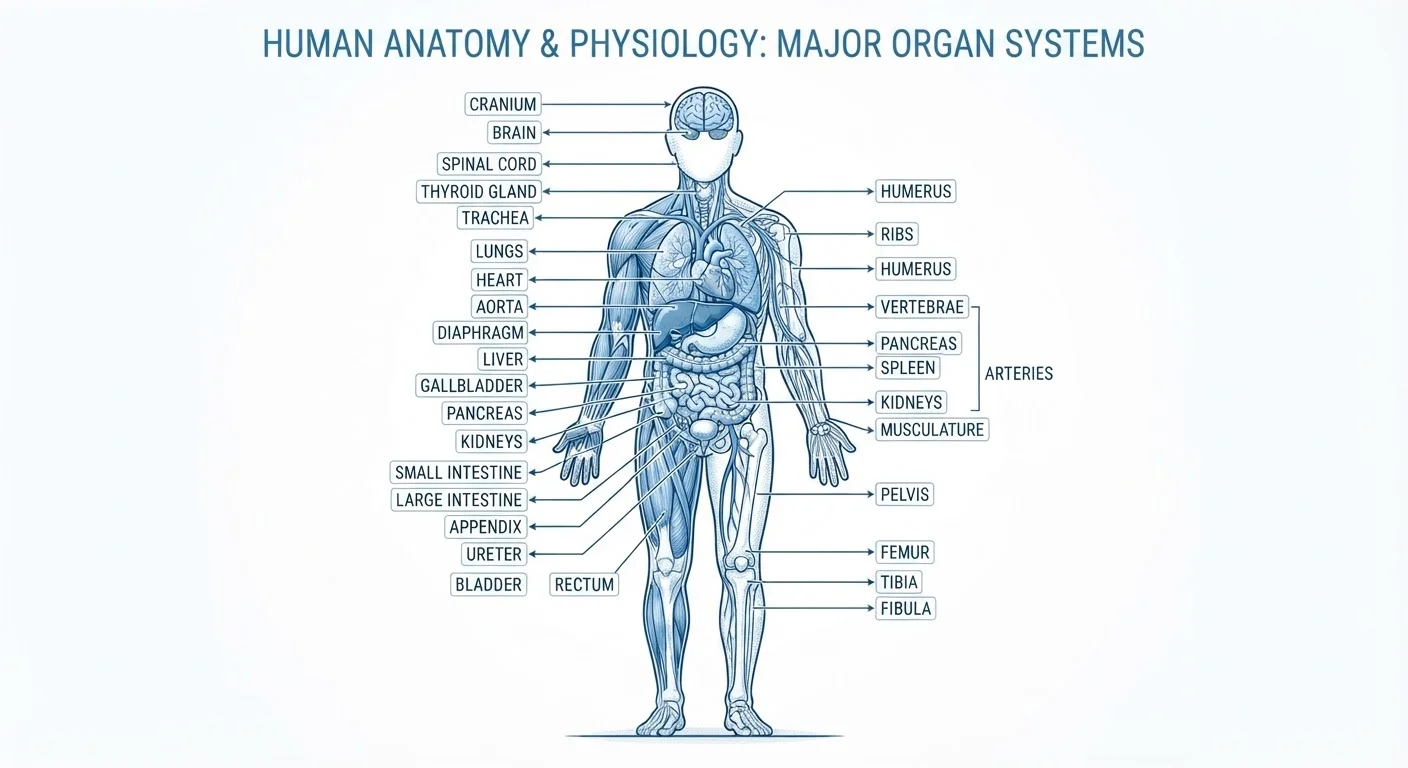
Above the cellular level, the body organizes itself into tissues, then organs, then systems - a hierarchy worth understanding. Fitness and exercise science use some overlapping language, though with different emphasis; see the physical activity glossary for terms like VO2 max and progressive overload that apply specifically to movement science.
Key Numbers and Benchmarks in Human Biology
Biology isn't only vocabulary - it's also a science of remarkable numbers. A few reference figures help anchor abstract concepts like cell count or genome size in something concrete.
| Estimated number of cells in the adult human body | ~37 trillion (Bianconi et al., Annals of Human Biology, 2013) |
| Number of distinct organ systems | 11 (Standard anatomical classification) |
| Percentage of human DNA shared with chimpanzees | ~98.7% (National Human Genome Research Institute) |
| Number of protein-coding genes in the human genome | ~20,000-25,000 (Human Genome Project findings) |
| Average lifespan of a red blood cell | ~120 days (Standard hematology reference) |
| Body water content (adult average) | ~60% (U.S. Geological Survey / general physiology consensus) |
These figures reflect scientific consensus from major research institutions and should be understood as well-established approximations rather than fixed constants. Biological measurements often vary by sex, age, hydration, and individual physiology.