Why Insulation Type Matters
Choosing the wrong insulation for a specific location can leave gaps in your home's thermal envelope - the continuous barrier that separates conditioned indoor air from the outdoors. Even insulation installed at the correct R-value can underperform if it doesn't suit the shape or accessibility of the space. Understanding the fundamental differences between batt, blown-in, and spray foam insulation helps you make a decision grounded in your home's actual structure, not just marketing language.
Batt Insulation: The Classic Choice
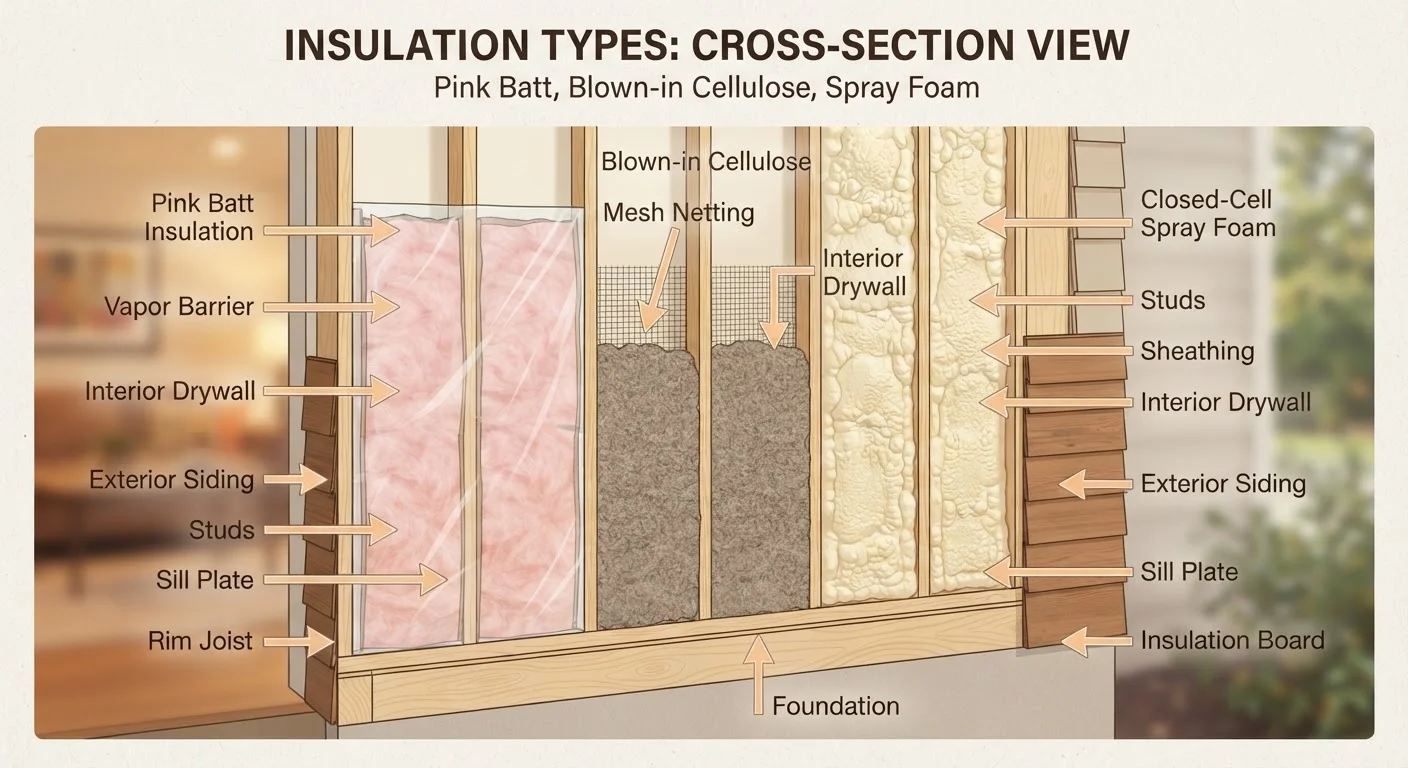
Batt insulation - typically made from fiberglass or mineral wool - comes in pre-cut panels sized to fit between standard wall studs, floor joists, and ceiling rafters. It's the most familiar type for homeowners, widely available, and can be installed without specialized equipment in most open-cavity situations.
Best applications: Unfinished basement ceilings, open exterior walls before drywall is hung, and floors above unconditioned spaces.
Limitations: Batts don't conform well to irregular framing, pipes, or wiring. Gaps around obstacles reduce effectiveness significantly. They also provide minimal air-sealing on their own - air can still flow around them unless the cavity is otherwise sealed.
Combine Types for Best Results
Many energy-efficient homes use more than one insulation type. A common approach is to use spray foam around rim joists and penetrations for air sealing, then fill the remaining cavity with batts or blown-in for bulk thermal resistance. This layered strategy addresses both air infiltration and heat transfer without relying on a single material to do everything.
Blown-In Insulation: Flexibility for Existing Spaces
Blown-in insulation - also called loose-fill - is made from cellulose (recycled paper fiber), fiberglass, or mineral wool. It's installed using a blowing machine that propels loose material into a space, allowing it to settle and fill irregular shapes, corners, and existing cavities without opening walls.
Best applications: Attic floors, finished walls (via small drilled holes), and spaces with complex framing or many penetrations.
Limitations: Attic blown-in can settle over time, reducing its effective R-value. It typically requires renting or borrowing a blowing machine, though many home improvement centers offer these with material purchase. For wall cavities, drilling and patching is required, which may not appeal to all homeowners.
| Batt | Blown-In | Spray Foam | |
|---|---|---|---|
| Typical R-value per inch | R-3 to R-4 | R-2.5 to R-3.8 | R-3.7 to R-7 |
| DIY-friendly | Yes, for open cavities | Moderate, equipment needed | Small gaps only |
| Air sealing ability | Low | Low to moderate | High |
| Best location | Open walls, floors | Attics, finished walls | Crawl spaces, rim joists |
| Relative installed cost | Lower | Moderate | Higher |
| Works in irregular spaces | No | Yes | Yes |
Spray Foam Insulation: High Performance, Higher Stakes
Spray foam comes in two forms: open-cell and closed-cell. Open-cell foam is softer and more affordable, with lower R-value per inch. Closed-cell foam is dense, rigid, and provides some of the highest R-values available - roughly R-6 to R-7 per inch - along with a strong vapor and air barrier.
Best applications: Rim joists, crawl spaces, hard-to-seal attic hatch perimeters, and areas where air infiltration is a known problem.
Limitations: Professional installation is strongly recommended for most spray foam applications. DIY spray foam kits exist for small gap-filling tasks, but full-wall or attic applications involve chemical handling, curing times, and ventilation requirements that are difficult to manage safely without training. Improperly installed spray foam can also be difficult and costly to remove.
For any insulation project involving finished walls, crawl spaces, or large-scale attic work, consulting a licensed insulation contractor is advisable. Local building codes may also require permits or specific material standards - verify requirements with your local building department before beginning work.