How They're Built - and Why It Matters
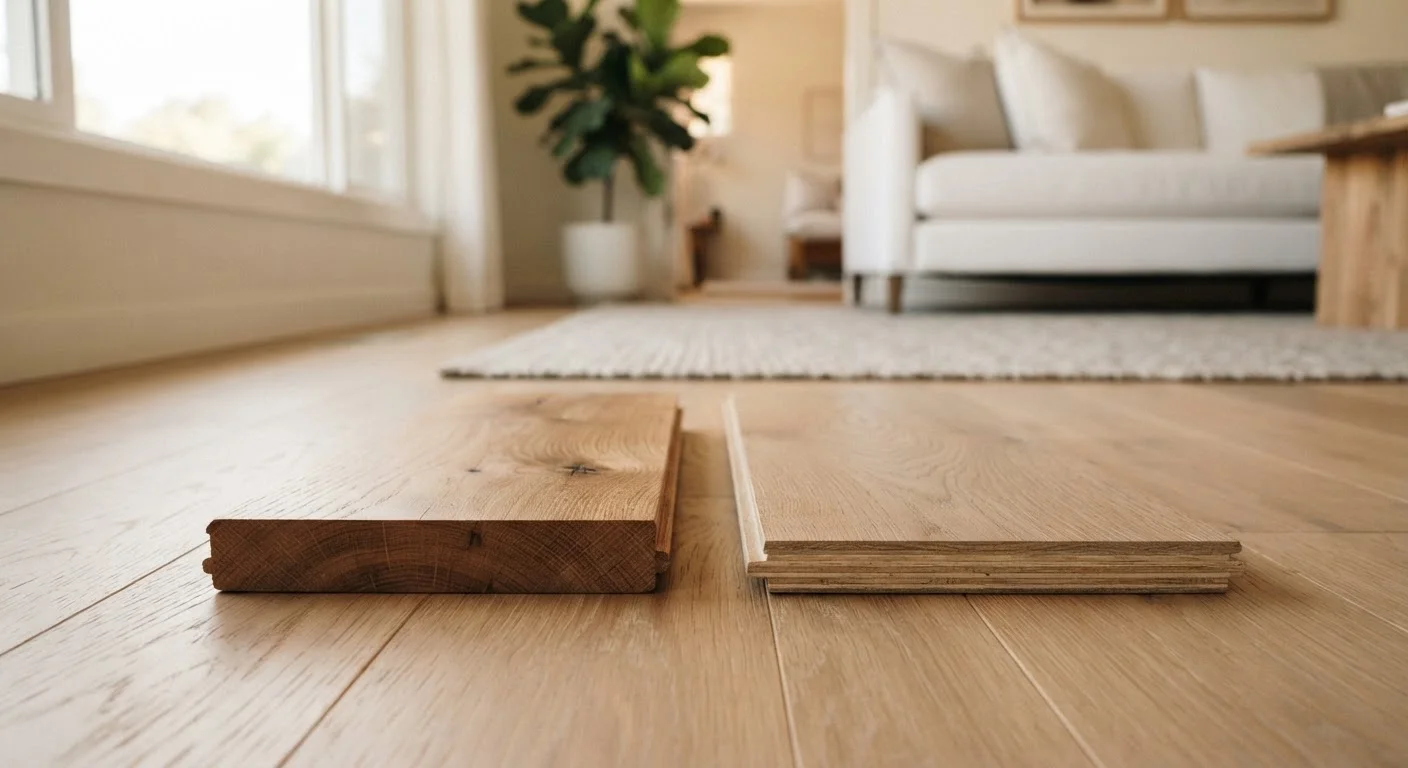
Solid hardwood flooring is milled from a single piece of wood throughout its entire thickness, typically ¾ inch. That uniform depth is what gives it refinishing longevity - when the surface shows wear, you sand it down and recoat. Virtually every species from oak to hickory to maple is available in solid form.
Engineered wood flooring uses a thin veneer of real hardwood bonded over a core of cross-layered plywood or high-density fiberboard (HDF). The layered construction is the key: each ply runs in an alternating grain direction, counteracting the natural tendency of wood to expand and contract with humidity changes. The top veneer can range from 1 mm to 6 mm thick - a critical spec when refinishing is a consideration.
Despite different constructions, both products carry real wood on the surface. That means the visual difference between a well-selected engineered floor and a solid one is minimal to nonexistent once installed.
| Criterion | Solid Hardwood | Engineered Wood |
|---|---|---|
| Core construction | Single solid wood plank | Hardwood veneer over cross-ply core |
| Typical thickness | ¾ inch | ⅜ to ¾ inch |
| Moisture tolerance | Low - avoid humid areas | Moderate - handles humidity well |
| Below-grade installation | Not recommended | Generally suitable |
| Refinishing potential | 5-8 times over lifespan | 0-3 times (veneer-dependent) |
| DIY installation options | Nail-down or glue-down | Float, glue, or nail-down |
| Radiant heat compatibility | Limited - verify with manufacturer | Generally compatible |
| Typical lifespan | 50-100+ years with care | 25-50 years with care |
Moisture, Subfloors, and Where Each Can Go
Moisture tolerance is the single biggest functional dividing line. Solid hardwood expands when it absorbs moisture and contracts in dry conditions. In a basement or a poorly ventilated kitchen, those repeated cycles can cause cupping, crowning, or gapping over time. Most flooring manufacturers and installers advise against solid hardwood below grade.
Engineered wood's plywood core distributes stress across alternating grain directions, resisting that movement significantly better. This makes it viable over concrete slabs, in basements, and on radiant heat systems - areas where solid wood would be risky. That said, engineered wood is not waterproof. Standing water or a chronic moisture problem will still damage it; it simply tolerates everyday humidity swings more gracefully.
Acclimation Is Required for Both Types
Before installing either solid or engineered wood flooring, the planks must acclimate to the room's temperature and humidity - typically 3-5 days for engineered and up to 7 days for solid hardwood. Skipping this step is a leading cause of post-installation gapping, buckling, and warranty voids. Store the flooring flat in the installation room, not in a garage or unheated space.
Before purchasing either product, test your subfloor for moisture using an inexpensive moisture meter. Most hardwood flooring manufacturers publish acceptable moisture content ranges - typically 6-9% for solid wood and slightly higher for engineered - and subfloor readings must fall within those limits before installation begins.
Refinishing, Lifespan, and Long-Term Value
Solid hardwood's greatest advantage is longevity through refinishing. A ¾-inch plank can typically be sanded 5-8 times across its lifetime, allowing you to strip old finish, address surface scratches, or even change stain color. Floors installed decades ago can be restored to near-original condition, which contributes to their appeal in older homes.
Engineered wood's refinishing ceiling depends entirely on veneer thickness. A 2 mm veneer may tolerate one light sanding at most. A premium 4-6 mm veneer offers two or three refinishing passes. When the veneer is exhausted, the floor must be replaced rather than renewed. For many homeowners, especially those without plans to stay in a home for 30+ years, this trade-off is entirely acceptable.
In terms of daily durability, both perform comparably when the same hardwood species is used for the veneer. A thin engineered veneer of Brazilian cherry is no harder than solid Brazilian cherry - wear resistance is a function of species and finish, not construction method.