
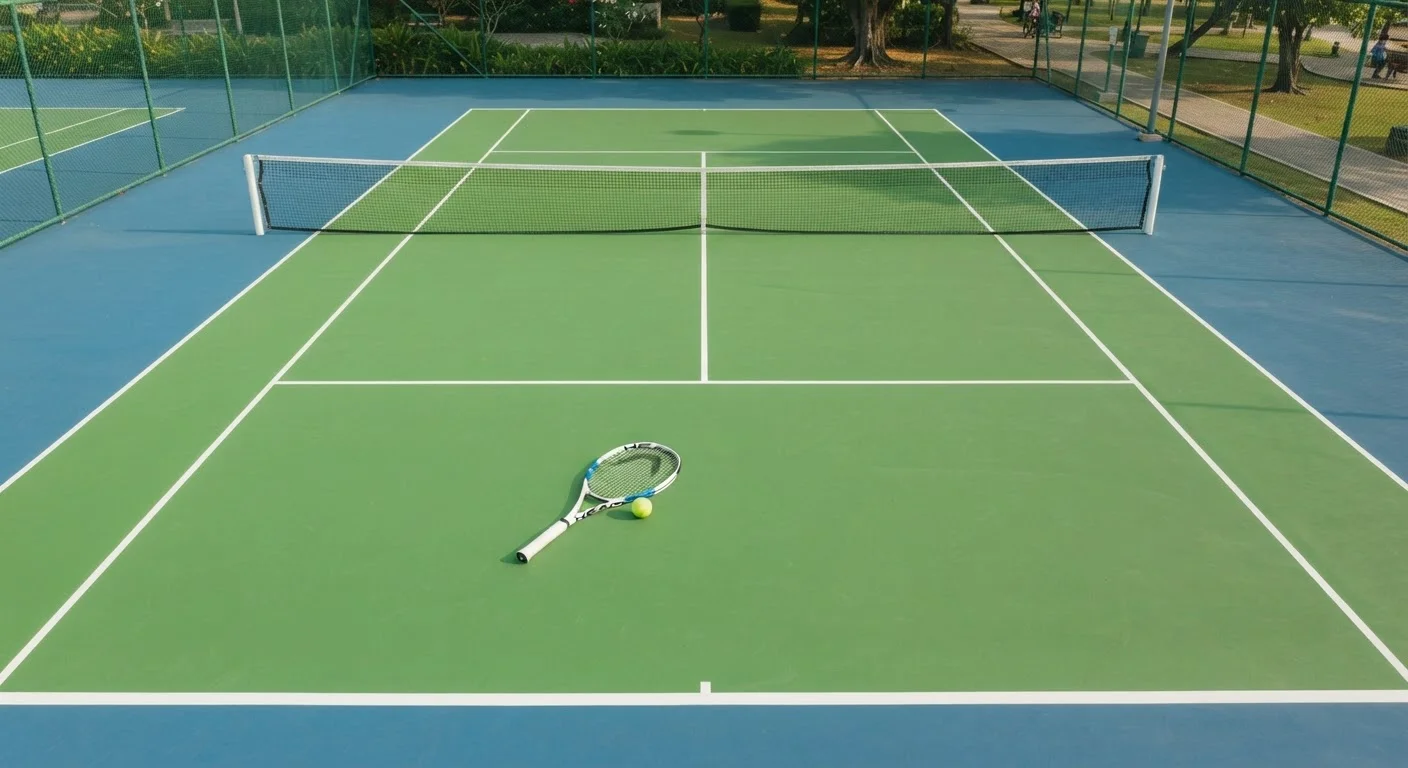
The Court: Layout and Key Zones
A standard tennis court is a rectangle measuring 78 feet long and 27 feet wide for singles play (36 feet wide for doubles). A net divides the court exactly in half. Knowing the major zones helps you understand where to stand and where to aim your shots.
Baseline
The back boundary line of the court at each end. Most players position themselves here during rallies.
Service box
The rectangular zone where a serve must land. There are two service boxes on each side of the net, and the serve must go into the box diagonally opposite the server.
Deuce
The score when both players have reached 40 points in a game. A player must then win two consecutive points to win the game.
Tiebreak
A special game used to decide a set when the score reaches 6-6. The first player to reach seven points with a two-point margin wins.
Fault
A serve that does not land in the correct service box. Two consecutive faults (a double fault) result in losing the point.
Let
A serve that clips the net cord but still lands in the correct service box. The serve is replayed with no penalty.
- Baseline: The line at the far back of each side. Most rallies begin and end near here.
- Service boxes: Two rectangular areas on each side of the net, divided by the center service line. Your serve must land in the diagonally opposite box.
- No-man's land: The mid-court area between the service line and baseline. Beginners should avoid lingering here - it's a tough spot to defend from.
- Alley: The extra strip of court on each side, only in play during doubles matches.
Surface type also matters. Hard courts (common in the U.S.), clay, and grass each play differently, affecting how fast the ball moves and how high it bounces.
How Tennis Scoring Actually Works
Tennis scoring is one of the sport's biggest stumbling blocks for newcomers. Unlike most sports, points don't count up by ones. Within a single game, the progression is: 0 (love) → 15 → 30 → 40 → game. Score is always announced server first - so "30-love" means the server has 30 points and the receiver has zero.
When both players reach 40, the score is called deuce. From deuce, a player must win two consecutive points. The first point beyond deuce gives that player advantage. Win the next, and the game is yours. Lose it, and you're back to deuce.
Games are grouped into sets. The first player to win six games - by at least two - wins the set. At 6-6, most formats use a tiebreak to decide the set. Matches are typically played as best-of-three or best-of-five sets depending on the competition level.
If you enjoy learning how unusual scoring systems work across sports, you might also find it worthwhile to explore how golf scoring works - another sport where the numbers don't behave as expected.
The Basic Rules of Play
Each point begins with a serve. The server stands behind the baseline and must hit the ball into the diagonally opposite service box. Two attempts are allowed - a missed first serve is called a fault; missing both is a double fault and the opponent wins the point.
Once the ball is in play, players must hit it back over the net before it bounces twice. The ball must land within the court boundaries. Key fault situations include:
- Hitting the ball out of bounds
- Letting the ball bounce twice
- Touching the net with racket or body during a point
- Hitting the ball before it crosses the net (except in certain follow-through scenarios)
A let occurs when the served ball clips the net and still lands in the correct service box - in this case, the serve is replayed with no penalty. Tennis has many nuanced rules beyond these basics. For a broader look at rules that confuse fans across sports, see the most misunderstood rules in American sports.
Essential Shots and Skills for Beginners
You don't need a full arsenal of shots to enjoy recreational tennis, but understanding the fundamentals gives you a solid foundation:
- Forehand groundstroke: The most common shot. Hit from your dominant side as the ball bounces up from the court.
- Backhand groundstroke: Hit from your non-dominant side. Beginners often favor a two-handed backhand for added control.
- Serve: The most technically complex shot. Focus first on getting it in consistently before worrying about power or spin.
- Volley: A shot hit before the ball bounces, usually near the net. Requires quick reflexes and compact swing.
- Lob: A high, arching shot used to move an opponent back or to buy time in a rally.
Start With Grip - It Changes Everything
A correct grip makes forehands, backhands, and serves far easier to learn. Most beginners start with an Eastern forehand grip - imagine shaking hands with the racket handle. Locking in proper grip early prevents deeply ingrained bad habits that can limit your progress for years.
Grip is the foundation of every shot. Most beginners start with an Eastern forehand grip - imagine shaking hands with the racket handle. A coach or a reliable instructional resource can help you confirm proper technique early.
Tips for Getting Started
The best way to learn tennis is to actually play - but a few practical steps will smooth the path considerably:
- Find a beginner lesson or clinic. Many public parks and recreation departments offer affordable group lessons. Even two or three sessions provide a substantial head start.
- Use a low-compression ball at first. Slower-bouncing balls (often color-coded red, orange, or green) are designed for beginners and give you more time to react.
- Rally before competing. Spend most of your early practice just keeping the ball in play, rather than trying to win points. Consistency is the first skill to develop.
- Learn the etiquette. Call your opponent's shots out loud and honestly. Tennis relies on player integrity, especially in recreational settings.
Tennis shares something with many other sports: watching it live dramatically deepens appreciation for what the athletes are doing. If you're curious how that experience translates to other games, watching a live baseball game follows a similar journey from confusion to understanding.
This article is for general informational and educational purposes only. Consult a qualified tennis instructor or sports medicine professional before beginning a new physical activity, particularly if you have pre-existing health concerns.