How a Magnetron Generates the Waves
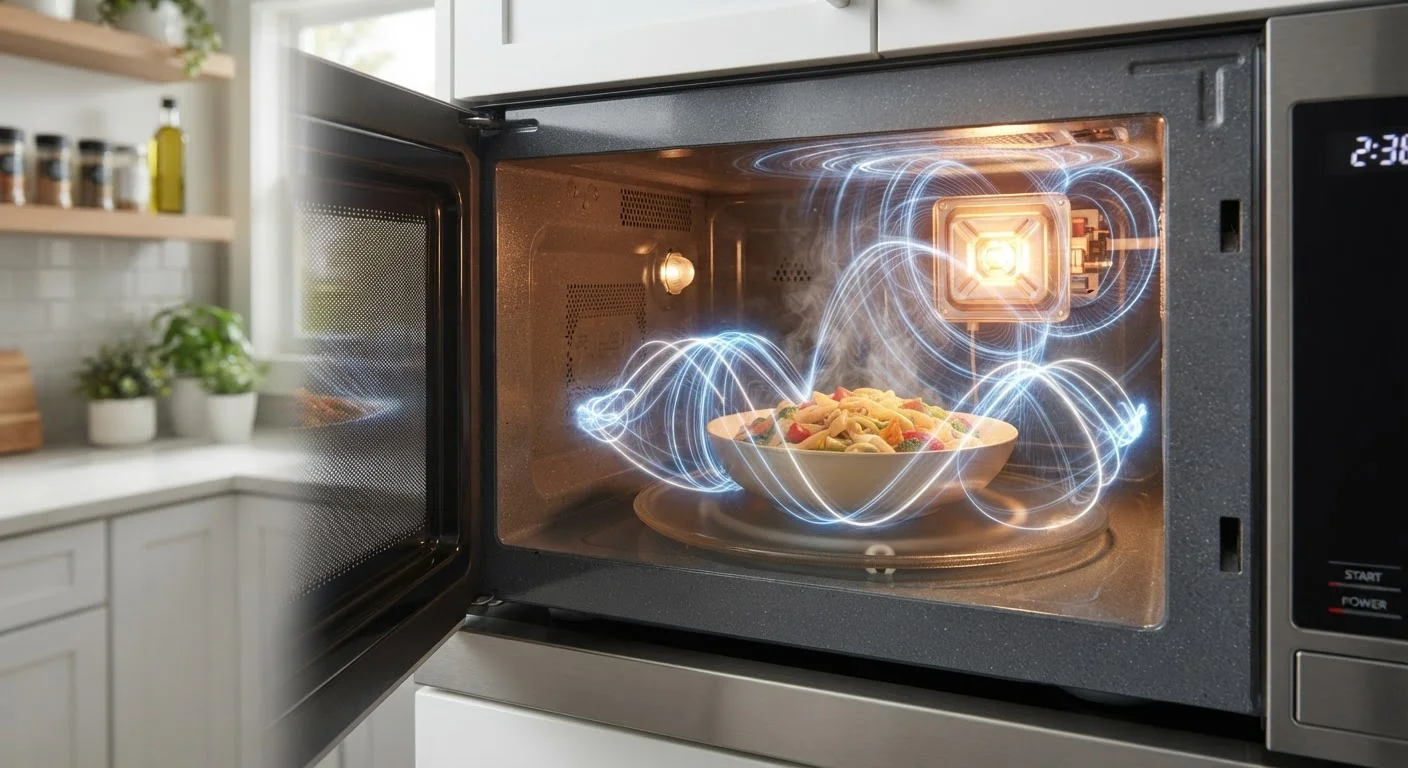
At the heart of every microwave oven is a device called a magnetron - a vacuum tube that converts electrical energy into electromagnetic radiation. When you press start, a high-voltage transformer powers the magnetron, which uses a magnetic field to spin electrons into a resonant cavity. That spinning generates microwaves at a precise frequency: 2.45 gigahertz (GHz), meaning the electric field oscillates 2.45 billion times per second.
These waves travel from the magnetron into the cooking chamber, where a wave stirrer or rotating turntable helps distribute them. The metal walls of the oven act as mirrors, reflecting the microwaves back and forth rather than letting them escape. This containment is why a properly sealed microwave poses no radiation exposure risk to people standing nearby. The same metal-as-reflector principle is why you see sparks when you accidentally leave a fork inside - metal objects reflect and concentrate the electromagnetic energy in ways the oven was not designed to handle.
See how the same electromagnetic principles show up elsewhere in your daily routine in our everyday physics explainer.
Why Water Molecules Do the Heating
Water is a polar molecule - meaning one end carries a slight positive charge and the other a slight negative charge. When the oscillating electric field of a microwave passes through food, these polar molecules frantically try to align with the field as it flips billions of times per second. This rapid rotation and friction between neighboring molecules generates heat.
This is fundamentally different from a conventional oven or stovetop, which transfers heat from a hot surface to the outer layer of food, which then conducts inward. A microwave excites molecules within the food directly, to a penetration depth of roughly one to two inches. Beyond that depth, heat must still travel inward the old-fashioned way - by conduction. That's why the physics of microwave heating don't make a thick roast cook faster all the way through.
“The microwave oven is a case study in applied electromagnetism - it takes a phenomenon discovered in radar research and turns it into something that heats your lunch. The underlying physics are the same; only the application changed.”
— Robert Lerner, Physics educator and science communication author
Foods with low water content, such as crackers or dry bread, respond poorly to microwaves for exactly this reason. Fats and sugars also absorb microwaves but through less efficient polar interactions, which is why a butter-rich pastry can develop dangerously hot pockets while other areas remain barely warm.
Standing Waves and the Cold-Spot Problem
When microwaves bounce off the oven's metal walls and overlap with incoming waves, they form standing waves - a physics phenomenon where peaks and troughs lock into fixed positions. In a standing wave pattern, certain locations in space consistently receive maximum energy (antinodes), while others receive almost none (nodes). Inside your microwave, those nodes become cold spots.
This is the real physics behind unevenly heated leftovers. If a portion of your food sits at a node, it absorbs far less microwave energy than food sitting at an antinode, even if they're just an inch apart. Rotating turntables help by continuously moving food through different energy zones over time. Pausing the microwave mid-cycle and letting food rest allows heat to conduct from hot zones into cooler ones, smoothing out temperature differences.
2.45 GHz
Frequency at which consumer microwaves operate
This frequency is regulated internationally to avoid interfering with communication signals and is specifically effective at exciting water molecules in food.
1-2 inches
Typical microwave penetration depth into food
Beyond this depth, heat from microwave absorption must travel further inward via conduction, the same process at work in conventional cooking.
~90%
Share of U.S. households owning a microwave
According to U.S. Energy Information Administration household survey data, the microwave is one of the most widely owned kitchen appliances in American homes.
Microwave manufacturers work to minimize standing-wave effects through careful cavity design and wave-stirring mechanisms, but they cannot be eliminated entirely. This is one reason even premium ovens recommend stirring soups or rotating dishes partway through cooking - the physics demand it, not just the recipe.
For more on how heat behaves in everyday kitchen objects, check out why your mug choice affects heat retention.
What the Oven's Design Gets Right
The microwave oven is a surprisingly elegant piece of engineering precisely because it channels fundamental physics toward a practical outcome. The metal cavity isn't just a box - it's a resonant chamber tuned to reinforce the 2.45 GHz frequency of the magnetron. The mesh screen on the door window has holes small enough to block microwaves (which have a wavelength of about 4.8 inches) while still letting visible light pass through so you can watch your food.
The choice of 2.45 GHz is itself a deliberate balance. Higher frequencies would be absorbed too quickly, heating only the very surface of food. Lower frequencies would pass through food without being absorbed efficiently. The chosen frequency strikes a practical middle ground - deep enough penetration to heat through a realistic portion size, while being strongly absorbed by water molecules.
Understanding these principles also clarifies common microwave myths. Microwaves do not make food radioactive. They do not selectively destroy nutrients beyond what any other heat-based cooking method does. And they are not secretly harmful to people in the room - the energy stays inside the chamber where the physics of reflection and absorption were designed to keep it.