Two Types of Eclipse, One Geometric Cause
At its core, an eclipse is a shadow problem. Every object in sunlight casts a shadow, and when a moon or planet drifts into or blocks another body's shadow, an eclipse results. From Earth's perspective, this plays out in two distinct ways.
A solar eclipse happens at new moon, when the Moon passes directly between Earth and the Sun, casting its shadow on a portion of Earth's surface. A lunar eclipse happens at full moon, when Earth sits between the Sun and Moon and our planet's shadow falls across the Moon. Both require remarkable three-body alignment - and that alignment is far less common than the roughly 29.5-day lunar cycle might suggest.
Understanding this geometry connects to broader principles explored in everyday physics - the same predictable rules that govern light, shadow, and orbital motion make eclipses calculable centuries in advance.
Why Eclipses Don't Happen Every Month
If the Moon orbits Earth every month, why isn't there a solar eclipse at every new moon and a lunar eclipse at every full moon? The answer lies in the 5.1-degree tilt of the Moon's orbital plane relative to Earth's orbit around the Sun (the ecliptic).
Most months, the Moon passes a few degrees above or below the Sun-Earth line - close, but not close enough for shadows to intersect. Eclipses only happen when the Moon is near one of the two lunar nodes: the points where the Moon's tilted orbit crosses the ecliptic. These windows are called eclipse seasons, and they occur roughly twice a year, each lasting a few weeks.
~2/year
Average number of solar eclipses globally
On average, Earth experiences at least two solar eclipses per year somewhere on the planet, though total solar eclipses at any one location are far rarer.
5.1°
Tilt of Moon's orbit relative to Earth's
This orbital tilt is the primary reason eclipses don't occur every month - alignment requires the Moon to be near a node.
~375 years
Average wait for a total solar eclipse at one spot
Any given location on Earth's surface experiences a total solar eclipse only once every 375 years on average, according to NASA eclipse data.
Even within an eclipse season, whether you see a total, partial, or no visible eclipse at your location depends on exactly where you are on Earth's surface relative to the shadow's path.
Solar Eclipses: Total, Annular, and Partial
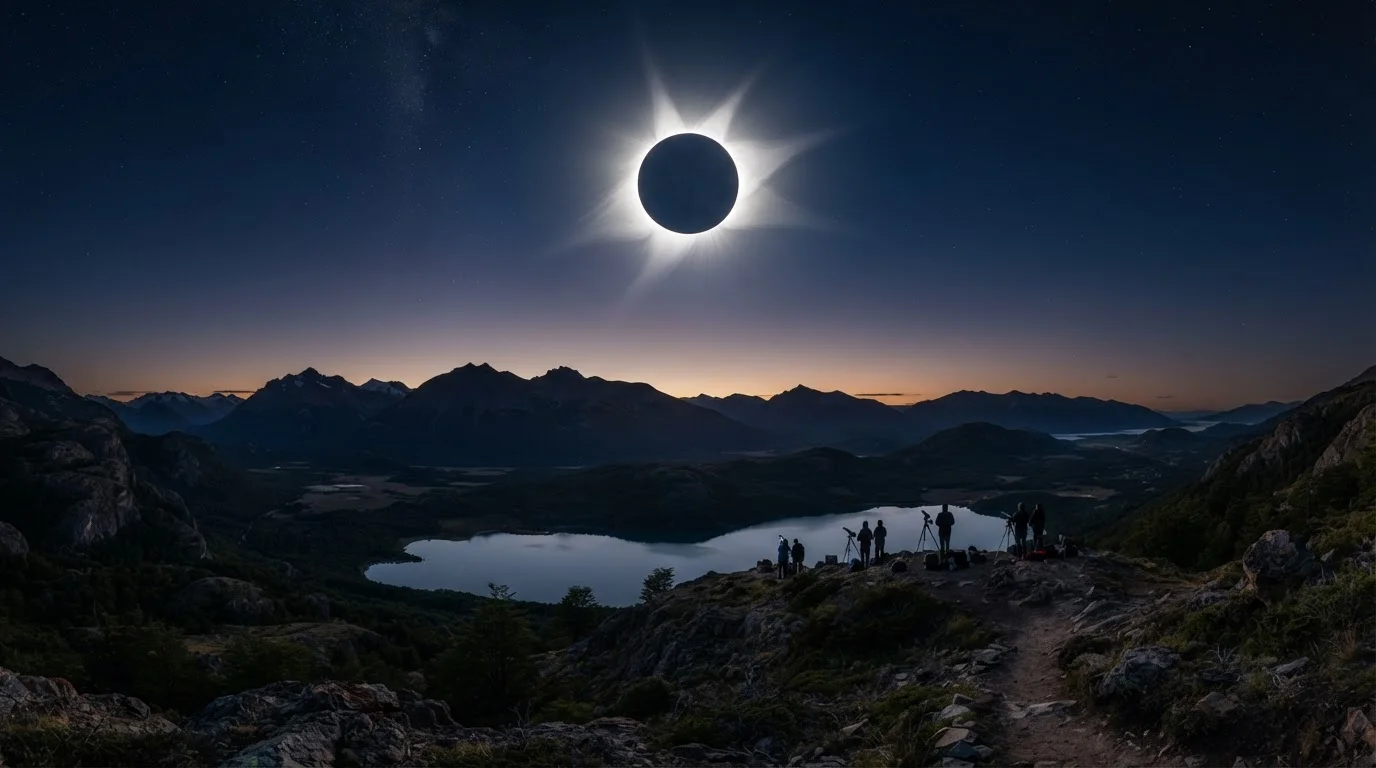
The Moon's shadow has two zones: the dark central umbra and the softer outer penumbra. Only observers within the umbra's path experience totality - a sky that darkens to twilight, stars become briefly visible, and the Sun's outer atmosphere, the corona, blazes into view. This is one of the most dramatic spectacles in nature, and it happens because the Sun and Moon appear almost exactly the same angular size in Earth's sky - a cosmic coincidence that won't last forever, as the Moon slowly drifts outward from Earth at about 1.5 inches per year.
When the Moon is near apogee - its farthest orbital point from Earth - it appears slightly smaller, and the umbra doesn't quite reach Earth's surface. The result is an annular eclipse, where a bright ring of sunlight surrounds the Moon. Observers outside the central path of any solar eclipse see only a partial eclipse, where the Moon covers a portion of the Sun's face.
Safety note: Looking directly at any phase of a solar eclipse except full totality requires certified solar eclipse glasses or appropriate solar filters. The Sun's intensity can cause permanent eye damage in seconds.
Lunar Eclipses: Why the Moon Turns Red
Lunar eclipses are gentler in one practical sense: they're visible from the entire night-side of Earth simultaneously, and they require no special eye protection. But the physics behind them is just as elegant.
As the Moon glides into Earth's umbra, sunlight reaching it must first pass through Earth's atmosphere - a natural prism that scatters blue light away while bending longer red and orange wavelengths around the curve of the planet. The result is that the Moon glows in warm copper or blood-red hues during totality, a color astronomers describe using the Danjon scale. The exact shade depends on atmospheric conditions at the time: heavy volcanic aerosols in the stratosphere produce darker, more muted eclipses.
Lunar eclipses also have phases: the Moon first enters the lighter penumbral shadow (subtle dimming), then the full umbral shadow (the dramatic red phase). The geometry of Earth's large shadow means totality can last up to 107 minutes - far longer than total solar eclipses.
Solar eclipses generate an entirely different set of space environment effects. For the Sun's influence on Earth more broadly, see our piece on solar flares, CMEs, and geomagnetic storms.