What Is Plate Tectonics?
The ground beneath your feet feels permanent - solid, stable, unchanging. But Earth's outer shell, called the lithosphere, is actually broken into a mosaic of rigid slabs called tectonic plates. These plates float atop a partially molten layer of the mantle known as the asthenosphere, and they are always moving, grinding, spreading, and colliding in a planetary-scale slow dance.
The theory of plate tectonics is geology's grand unifying framework - the equivalent of what evolution is to biology. It explains why the Himalayas exist, why California shakes, why Iceland sits on top of a volcanic hot zone, and why the coastlines of South America and Africa look like matching puzzle pieces. The idea was largely confirmed by seafloor spreading evidence collected in the 1950s and 1960s, cementing a revolution in our understanding of the planet.
Earth has roughly 15 major plates and several smaller ones, ranging from the enormous Pacific Plate to the relatively small Juan de Fuca Plate off the Pacific Northwest coast. Together they cover the entire surface of the planet, carrying the continents and ocean floors as passengers.
The Engine Beneath: What Drives Plate Movement
Plates don't move on their own - they are driven by heat. Earth's interior is extraordinarily hot, partly from residual heat left over from the planet's formation and partly from the radioactive decay of elements like uranium and thorium deep within the mantle. This heat creates convection currents: hot mantle rock rises slowly, spreads laterally, cools, then sinks again, much like the circulation you see in a pot of heating soup.
But convection isn't the whole story. Scientists now recognize that slab pull - the weight of a cold, dense oceanic plate sinking into the mantle at a subduction zone - is likely the dominant driving force. Think of it as gravity dragging the leading edge of a plate downward, pulling the rest of the plate along behind it.
When thinking about slab pull versus convection, picture a tablecloth sliding off a tilted table - gravity doing most of the work, with convection as a background nudge rather than the primary driver.
Research over the past two decades increasingly points to slab pull as the dominant force in plate motion, yet many textbooks still lead with convection, which can leave readers with an incomplete picture.
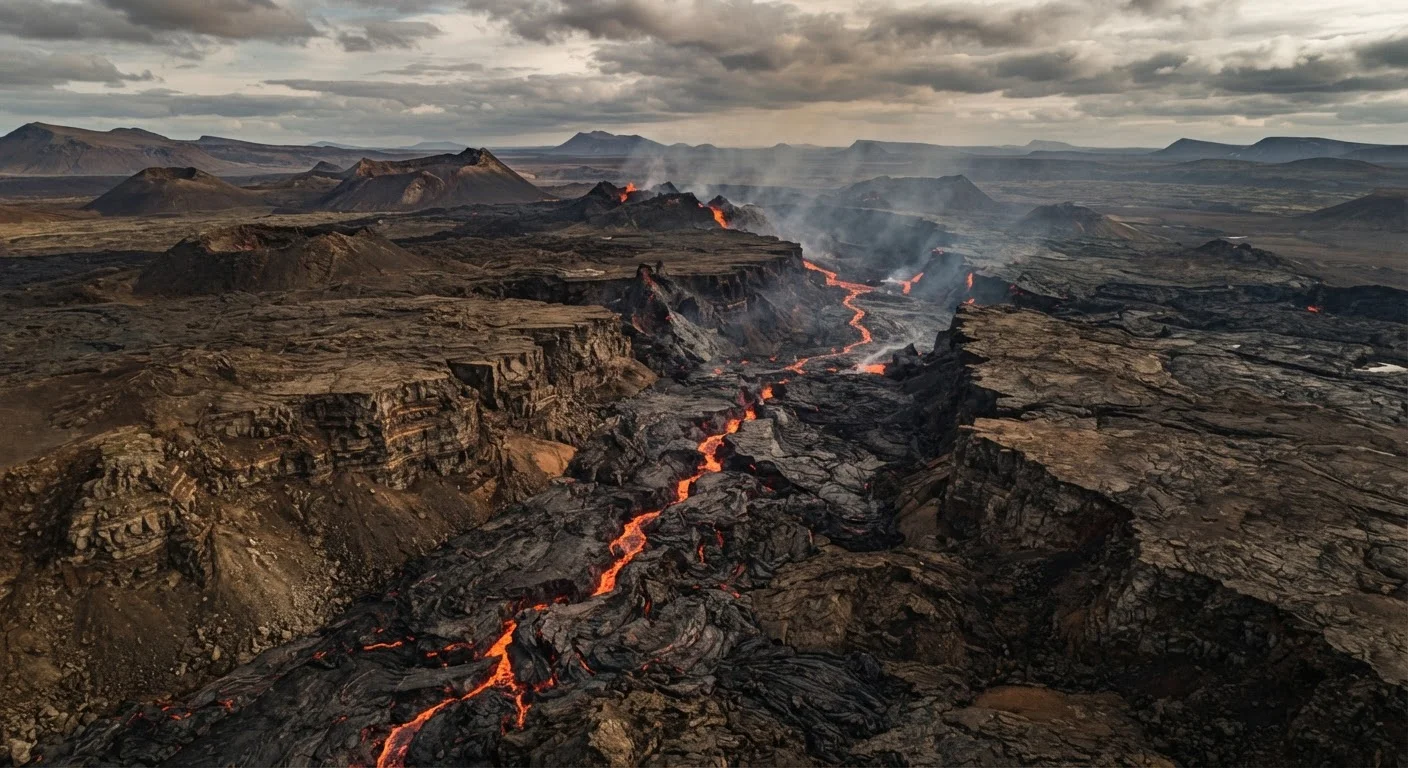
If you want to visualize an active plate boundary up close without leaving the country, visit Hawaii Volcanoes National Park - its lava flows are new oceanic crust forming in real time.
The Hawaiian hot spot provides one of the most accessible and visually dramatic demonstrations of mantle-driven volcanism and crustal creation available to the public.
A third mechanism, ridge push, occurs at mid-ocean ridges where newly formed rock is elevated and slides outward under its own weight, adding another gentle nudge. The result of all these forces combined is motion - typically between 1 and 10 centimeters per year, roughly the rate your fingernails grow.
Types of Plate Boundaries
Where plates meet, the geological action is most intense. There are three fundamental boundary types, each producing a dramatically different landscape.
Divergent Boundaries
At divergent boundaries, plates move apart. Magma wells up to fill the gap, creating new oceanic crust. The Mid-Atlantic Ridge - a 10,000-mile underwater mountain chain - is the best-known example. Iceland sits directly on this ridge and is literally being split in two, with the eastern half drifting toward Europe and the western half toward North America.
Convergent Boundaries
When plates collide at convergent boundaries, one of two things happens. If an oceanic plate meets a continental plate, the denser oceanic crust slides beneath the lighter continental crust in a process called subduction, forming deep ocean trenches and triggering volcanism inland. The Cascade volcanoes of the Pacific Northwest - including Mount St. Helens - exist because the Juan de Fuca Plate is subducting beneath North America. When two continental plates collide, neither subducts easily; instead, the crust crumples and thickens, building mountain ranges. The Himalayas formed - and are still rising - from the ongoing collision of the Indian and Eurasian plates.
Transform Boundaries
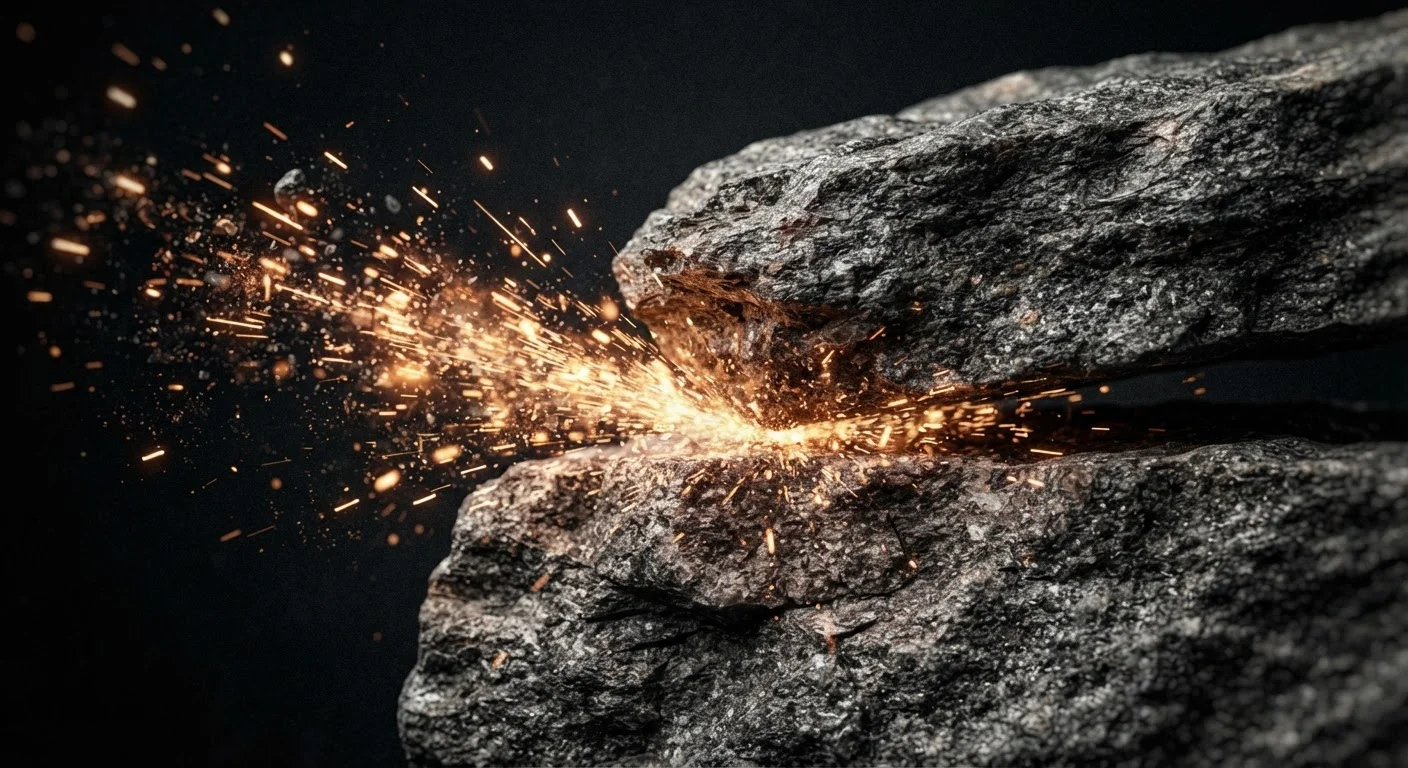
At transform boundaries, plates slide horizontally past each other. No crust is created or destroyed, but the friction builds enormous stress. California's San Andreas Fault is a classic example - the Pacific Plate grinds northward relative to the North American Plate, making the region one of the most seismically active in the United States. To understand what happens when that stress releases suddenly, see our detailed explanation of earthquake mechanics.
How Plate Tectonics Shapes the World We Live In
Plate tectonics is not an abstract geological curiosity - its effects are woven into everyday life across America and the globe.
- Earthquakes: More than 80% of the world's largest earthquakes occur along the Pacific Ring of Fire, a belt of subduction zones and transform faults encircling the Pacific Ocean.
- Volcanoes: The majority of Earth's active volcanoes cluster near plate boundaries, where magma finds pathways to the surface. Hawaii is an exception - it sits over a mantle hot spot, a plume of unusually hot rock independent of plate boundaries.
- Mountain building: Every major mountain chain on Earth traces back to a plate collision, past or present - from the Appalachians (a remnant of an ancient collision) to the still-rising Alps and Himalayas.
- Mineral and energy resources: Ore deposits, geothermal energy, and even petroleum accumulation are strongly tied to the tectonic history of a region.
Understanding plate tectonics also connects to the physics principles we encounter in daily life, since the same laws of heat transfer, pressure, and gravity governing your kitchen operate on a planetary scale inside Earth.
The Tectonic Future: Where Are the Continents Headed?
Roughly 335 million years ago, all of Earth's major landmasses were fused into a single supercontinent called Pangaea. Over the following 100 million years, plate movements broke it apart into the configuration we know today. Geologists are confident this cycle will continue.
Models suggest that in approximately 250 million years, the Atlantic Ocean will close as the Americas drift back toward Europe and Africa, eventually forming a new supercontinent - sometimes called Pangaea Proxima or Amasia, depending on the model. These are projections based on current plate velocities and directions, not certainties, but the broad trajectory is well-supported by the geological record of previous supercontinent cycles.
For now, Los Angeles is inching toward San Francisco at about 5 cm per year along the San Andreas Fault. Australia is drifting north toward Asia. And the Atlantic Ocean is widening by roughly 2.5 cm annually - about as fast as your hair grows. None of this is something you will notice in a lifetime, but over geological time, it is the most consequential force shaping the surface of our planet.