Why Moon Myths Are So Persistent
The moon is Earth's closest celestial neighbor, visible to the naked eye and woven into human culture for thousands of years. That familiarity has done little to prevent a thick layer of myth from building up around it. From folklore to viral social media posts, claims about the moon's appearance, behavior, and influence on human life circulate constantly - often with the confident tone of settled fact.
The good news: the science of the moon is actually quite well established. Lunar scientists, sleep researchers, and astronomers have studied these questions rigorously. What follows is a plain-language fact-check of the most common lunar misconceptions, grounded in what research and physics actually tell us.
If you enjoy having myths corrected by evidence, you might also appreciate our look at common friction misconceptions - another everyday topic that turns out to be more surprising than most people expect.
Lunar Myths Corrected
The following myth-and-fact pairs address beliefs that surveys and science communicators consistently identify as widely held. Each one has a clear, evidence-based answer.
Myth
The moon has a 'dark side' that never receives sunlight.
Fact
Every part of the moon's surface receives sunlight roughly half of each lunar month.
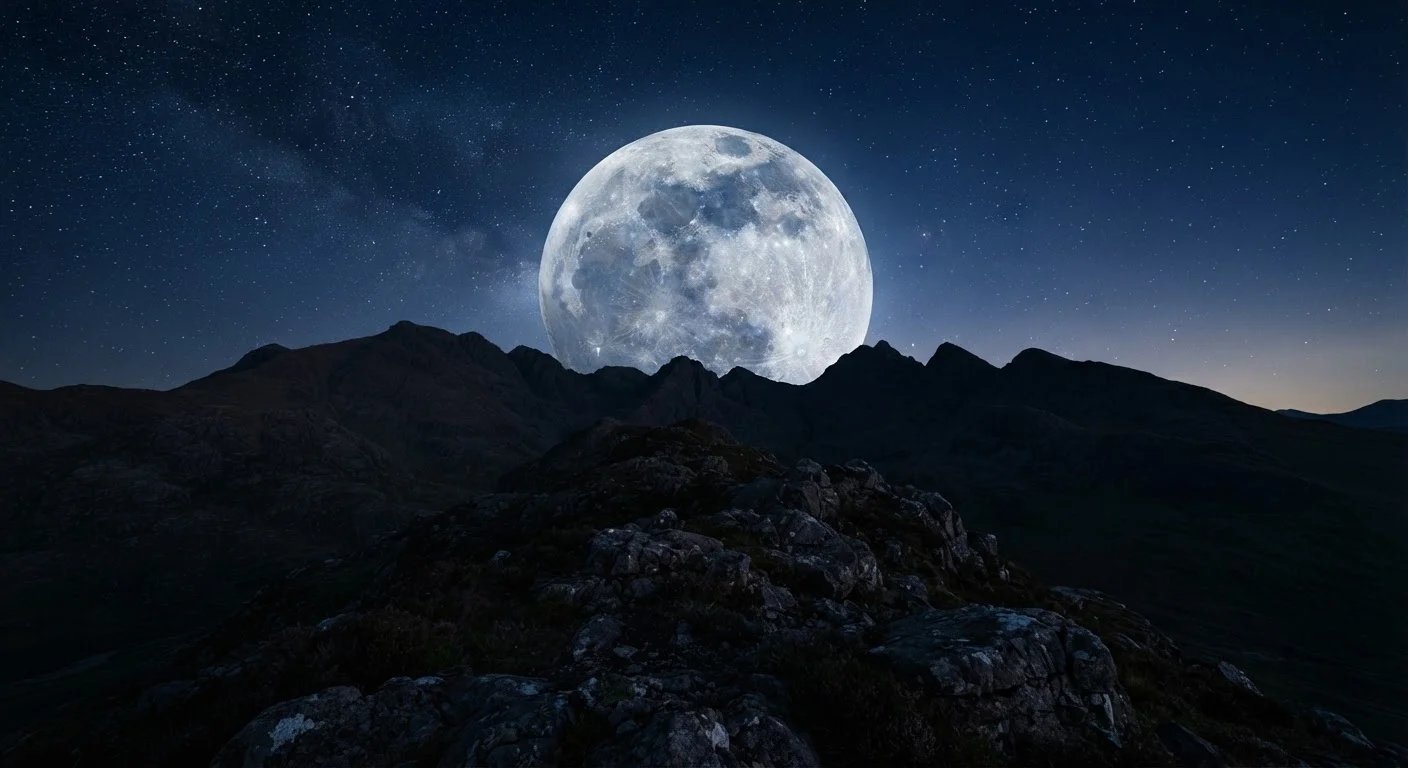
The confusion stems from the fact that the moon is tidally locked to Earth - meaning the same hemisphere always faces us. That far side is never visible from Earth's surface, which led to it being popularly called the 'dark side.' But 'dark' in this context means unseen, not unlit. As the moon orbits the sun along with Earth, sunlight reaches the far hemisphere just as regularly as the near side. NASA's lunar missions and satellite imagery have mapped the far side thoroughly - it is rocky, cratered, and well-lit roughly half the time.
Myth
A full moon disrupts sleep and causes strange behavior.
Fact
Large, well-controlled studies have found little to no consistent effect of lunar phase on human sleep or behavior.
The belief that full moons affect sleep - or cause erratic behavior - is one of the most durable pieces of lunar folklore. Early small studies reported weak correlations, which generated significant media attention. However, analyses drawing on thousands of nights of sleep data from multiple countries have found the effect to be negligible or absent when confounding factors (like artificial light or seasonal variation) are properly controlled.
Researchers suggest that confirmation bias plays a role: people notice and remember restless nights that happen to coincide with a full moon and forget the many others. Brighter outdoor light during a full moon may have had a modest effect on sleep in pre-electric environments, but modern indoor lighting largely eliminates that variable.
Myth
The moon is a perfect sphere.
Fact
The moon is slightly flattened and has a far side that sits measurably higher in elevation on average than the near side.
Like Earth itself, the moon is not a perfect ball. Its shape is technically a triaxial ellipsoid - slightly squashed at the poles and subtly elongated along the axis pointing toward Earth due to gravitational forces over billions of years. Additionally, the lunar far side has a thicker crust and higher average elevation than the near side, an asymmetry scientists are still working to fully explain. Lunar topography data from missions such as NASA's Lunar Reconnaissance Orbiter has mapped these variations in remarkable detail.
Myth
The moon produces its own light.
Fact
Moonlight is entirely reflected sunlight; the moon generates no light whatsoever on its own.
The moon has no internal energy source capable of producing visible light. What we see as 'moonlight' is sunlight bouncing off the lunar surface - and the moon is actually not a very efficient reflector. Its albedo (reflectivity) is only about 12%, meaning it reflects roughly one-eighth of the sunlight that strikes it. That is comparable to worn asphalt. It appears bright in our sky primarily because space is dark and our eyes adapt well to low light - not because the moon is a particularly good mirror.
Myth
The moon is moving away from Earth and will eventually escape entirely.
Fact
The moon is gradually moving away, but it will never escape Earth's gravity under current conditions.
Laser ranging experiments - made possible by reflectors left on the lunar surface during the Apollo missions - confirm that the moon is receding from Earth at roughly 3.8 centimeters per year. This is caused by tidal interactions transferring rotational energy from Earth to the moon's orbit. However, this drift will not continue indefinitely in a straight line toward escape. Over billions of years, the process is expected to slow and eventually reach an equilibrium, long before the sun expands into a red giant and fundamentally changes the solar system's dynamics.
What the Moon Actually Does - and Doesn't - Affect
Some lunar influences are entirely real and scientifically precise. The gravitational pull of the moon - combined with that of the sun - drives Earth's ocean tides, a phenomenon modeled to extraordinary accuracy by modern physics. The moon also stabilizes Earth's axial tilt over geological timescales, a fact that has likely played a role in maintaining the relatively stable climate conditions life depends on.
What the science does not support is a cascade of biological effects on humans beyond light exposure. Reviews of emergency room data, crime statistics, birth records, and surgical outcomes have repeatedly failed to find meaningful correlations with lunar phase. The intuitive appeal of lunar influence on human behavior is understandable - we are, after all, largely water - but tidal forces on the scale of the human body are immeasurably small compared with everyday gravitational effects like standing near a building.
3.8 cm
Annual distance the moon recedes from Earth
Measured via laser ranging experiments using Apollo-era retroreflectors, confirmed by NASA and international lunar science programs.
~12%
Moon's surface reflectivity (albedo)
According to NASA planetary data, the lunar surface reflects only about 12% of incoming sunlight - similar to worn pavement.
Understanding which claims about the moon are real and which are folklore is the kind of scientific literacy that pays dividends across many topics. Just as researchers have had to carefully separate signal from noise in areas like the gut microbiome, lunar science requires setting cultural intuition aside and following the data.