
How an Incandescent Bulb Actually Makes Light
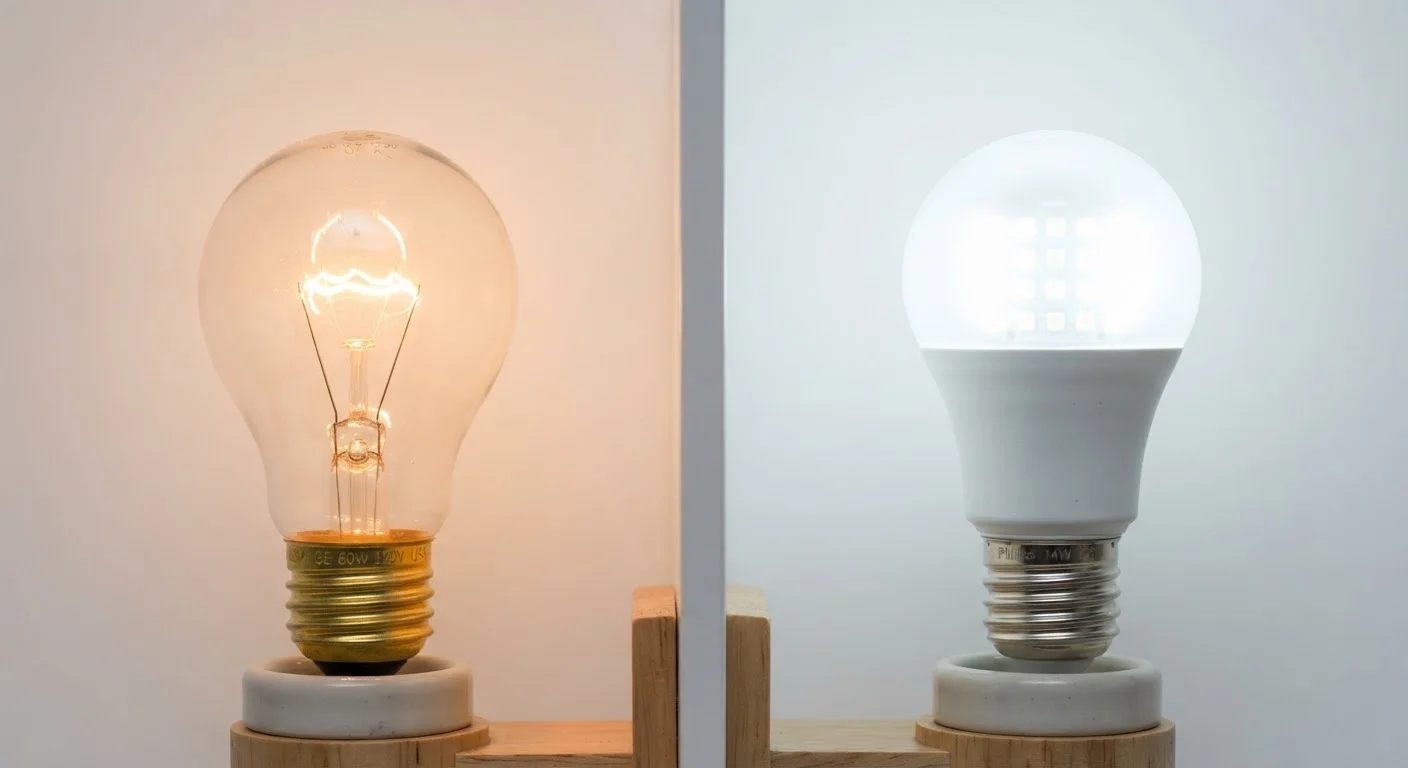
An incandescent bulb operates on a deceptively simple principle: run electricity through a thin tungsten wire until it gets so hot it glows. That process is called incandescence - light produced as a byproduct of thermal energy. The filament reaches temperatures around 2,700 Kelvin (roughly 4,400°F), which causes it to emit electromagnetic radiation across a broad spectrum.
Here's the critical problem. Only a narrow slice of that broad spectrum falls within the visible light range the human eye can detect. The rest - the overwhelming majority - is emitted as infrared radiation, which we perceive as heat. Physicists describe this behavior using blackbody radiation curves: the hotter an object, the more light it emits, but the distribution is always spread across wavelengths, and for tungsten at these temperatures, most energy lands outside visible frequencies.
The result is that a standard 60-watt incandescent bulb converts only about 5-10% of the electrical energy it consumes into visible light. The rest - 90% or more - radiates away as infrared heat. Touch a lit incandescent and this becomes immediately obvious.
How LEDs Generate Light - A Different Process Entirely
An LED (light-emitting diode) doesn't heat anything to make light. Instead, it exploits a quantum mechanical process called electroluminescence. When electrical current passes through a semiconductor material - typically a compound like gallium nitride - electrons are pushed into a higher energy state. When they drop back down to their ground state, they release that excess energy as photons, the fundamental particles of light.
The crucial advantage is precision. Engineers can tune the semiconductor's composition to control exactly which wavelengths of photons are released. White LED bulbs typically combine a blue LED with a phosphor coating that converts some of that blue light into broader wavelengths, producing the full-spectrum appearance of white light. The process is targeted, not scattershot.
| Criterion | Incandescent Bulb | LED Bulb |
|---|---|---|
| Light-producing mechanism | Thermal radiation (heated filament) | Electroluminescence (semiconductor) |
| Typical wattage for 800 lumens | 60 watts | 8-10 watts |
| Energy converted to visible light | ~5-10% | ~40-50% |
| Typical lifespan | ~1,000 hours | 15,000+ hours |
| Operating temperature | Very hot to the touch | Slightly warm or cool |
| Spectrum control | Broad, fixed by filament temperature | Tunable via semiconductor composition |
Because electrons are directly converting electrical energy into photons rather than generating vast amounts of waste heat first, LEDs are dramatically more efficient. A modern LED bulb converts roughly 40-50% of consumed electricity into visible light - a tenfold improvement over incandescent technology.
The Numbers That Make the Difference
Efficiency in lighting is measured in lumens per watt - how much visible light output you get for each watt of electricity consumed. A standard 60-watt incandescent produces around 800 lumens, yielding approximately 13-15 lumens per watt. A comparable LED bulb produces the same 800 lumens using just 8-10 watts, delivering 80-100 lumens per watt.
~90%
Energy wasted as heat by incandescent bulbs
According to the U.S. Department of Energy, roughly 90% of an incandescent bulb's energy is released as heat rather than visible light.
75%
Less energy LEDs use vs. incandescents
The U.S. Department of Energy estimates LED bulbs use at least 75% less energy than traditional incandescent lighting.
15x
Longer LED lifespan vs. incandescent
LED bulbs commonly last 15,000 hours or more, compared to the roughly 1,000-hour average life of a standard incandescent bulb.
That gap compounds over time. Because LEDs generate so little waste heat, their semiconductor components degrade far more slowly than a tungsten filament being constantly stressed by extreme temperatures. This is why LED rated lifespans regularly exceed 15,000 hours while incandescent bulbs typically last around 1,000 hours - a fifteenfold difference driven directly by the underlying physics.
The heat difference also has a secondary effect: incandescent bulbs contribute meaningfully to the heat load of a room, which can increase air-conditioning demands in warm climates. LEDs, running cool, don't carry that hidden cost.
Why This Physics Lesson Matters for Everyday Life
Understanding the mechanism behind LED efficiency isn't just academic. It explains why switching to LEDs reduces electricity bills, why they last so much longer, and why the transition away from incandescent technology has been embraced globally. The U.S. Department of Energy has estimated that widespread LED adoption could save hundreds of terawatt-hours of electricity annually across the country.
It also illustrates a broader principle in physics and engineering: the most efficient systems are those that convert energy directly into the desired output, with minimal intermediate steps producing waste. Incandescent bulbs take a detour through extreme heat to get to light. LEDs skip that detour almost entirely. The physics was always there - it just took decades of semiconductor research to harness it in a form small enough to screw into a lamp socket.
Next time you flip a light switch, you're witnessing applied quantum mechanics at work - electrons dropping energy levels and releasing photons on demand, billions of times per second.