The Slow Climb: Building Stored Energy
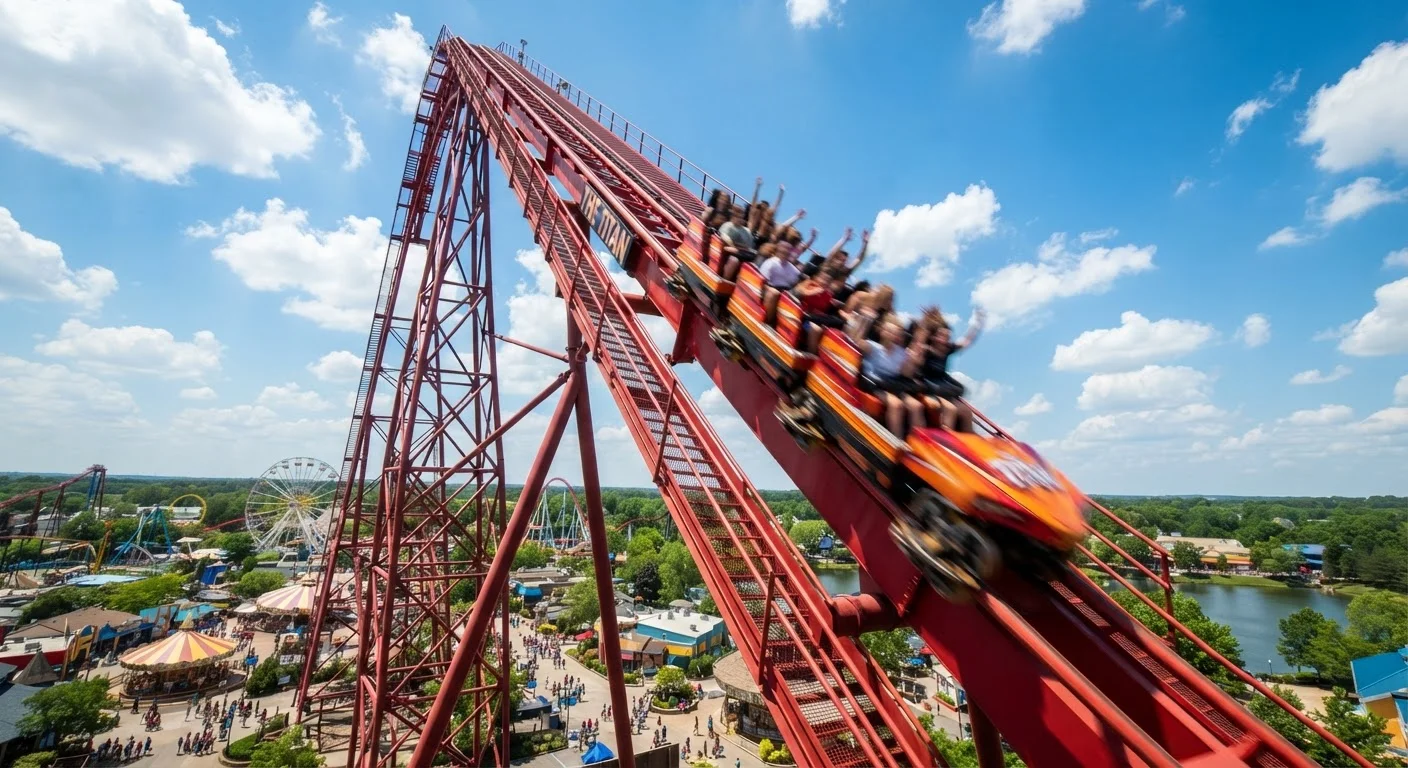
The moment a roller coaster car locks onto the lift chain and begins its grinding ascent, physics is already at work. Every foot of elevation gained represents real, measurable energy being stored in the system. This is gravitational potential energy - energy held in reserve simply because of the car's position above the ground.
The formula is straightforward: potential energy equals mass times the force of gravity times height (PE = mgh). A heavier train climbing a taller hill stores proportionally more energy. That's why the anticipation riders feel on the slow climb isn't just psychological - the system is genuinely accumulating the fuel for everything that follows.
The motor driving the lift chain is doing real work, converting electrical energy into gravitational potential energy. Nothing dramatic happens during the climb, but the energy budget is being loaded up for the payoff ahead.
The First Drop: Potential Becomes Speed
When the car crests the top of the first hill and the chain releases it, the conversion begins. Gravity pulls the car downward, and as height decreases, potential energy drops. But that energy doesn't disappear - it transforms into kinetic energy, the energy of motion (KE = ½mv²).
This is the core principle at work: conservation of energy. In a frictionless, idealized system, the total energy remains constant. Whatever potential energy is lost as the car descends is gained back as speed. At the very bottom of the drop, potential energy is at its minimum and kinetic energy - and speed - is at its maximum.
420 ft
Height of the world's tallest roller coaster drop
Kingda Ka in New Jersey features a 418-foot drop, storing an enormous amount of gravitational potential energy before release.
128 mph
Top speed reached by Formula Rossa coaster
Formula Rossa at Ferrari World Abu Dhabi reaches 128 mph using a hydraulic launch system, converting stored hydraulic energy directly into kinetic energy.
½mv²
Formula for kinetic energy
This equation shows that kinetic energy increases with the square of velocity - doubling speed quadruples kinetic energy, which is why top speeds feel so dramatic.
Riders experience this conversion physically. The stomach-dropping sensation at the start of the descent happens because the car accelerates faster than the body expects, briefly reducing the normal force the seat exerts on the rider.
Why Real Coasters Can't Beat Physics
Real roller coasters operate in the real world, where friction and air resistance are unavoidable. Every time the wheels roll along the track, some kinetic energy converts into heat. Every hill, curve, and loop extracts a small toll from the energy budget. This is why the first hill on any traditional coaster is always the tallest - it's the only point where a full energy reserve exists.
Engineers design each subsequent element - a lower hill, a tighter loop - to be achievable with the energy remaining after those losses. If a second hill were as tall as the first, the car would slow to a stop before reaching the top. The descending profile of a roller coaster's hills isn't a stylistic choice; it's a physical necessity.
Launched coasters sidestep this constraint by injecting energy mid-ride using magnetic or hydraulic systems, which is why some modern coasters can send trains over multiple tall elements or even run the course in reverse.
Loops, Valleys, and the Feel of Acceleration
The energy exchange doesn't stop after the first drop. Every valley and crest repeats the same conversion cycle on a smaller scale. In a valley, the car moves fastest (maximum kinetic energy); at the crest of a smaller hill, some of that kinetic energy converts back into potential energy and speed drops slightly.
Loops introduce another dimension: centripetal acceleration. To navigate a circular loop, the car must travel fast enough that gravity and the track's normal force together provide the inward acceleration needed to keep it on a circular path. At the top of a loop, riders moving fast enough feel reduced weight - often described as a sensation of floating - because the net downward force is largely accounted for by the circular motion itself.
All of these sensations - the surge of speed, the press into the seat at the bottom of a dip, the lightness at a crest - are direct, bodily experiences of the energy transformations that physicists describe with equations. A roller coaster is, in this sense, one of the most effective physics demonstrations ever built.