The Physics of Charge Transfer
Every material is made of atoms, and atoms contain electrons - tiny, negatively charged particles orbiting the nucleus. In most objects, positive and negative charges balance each other perfectly, so the object is electrically neutral. Static electricity happens when that balance gets disrupted.
The culprit is a process called the triboelectric effect: when two different materials contact each other and then separate, electrons from one material jump to the other. One surface ends up with a surplus of electrons (negatively charged) and the other has a deficit (positively charged). The further apart two materials sit on the triboelectric series - a ranking of materials by their tendency to gain or lose electrons - the greater the charge transfer.
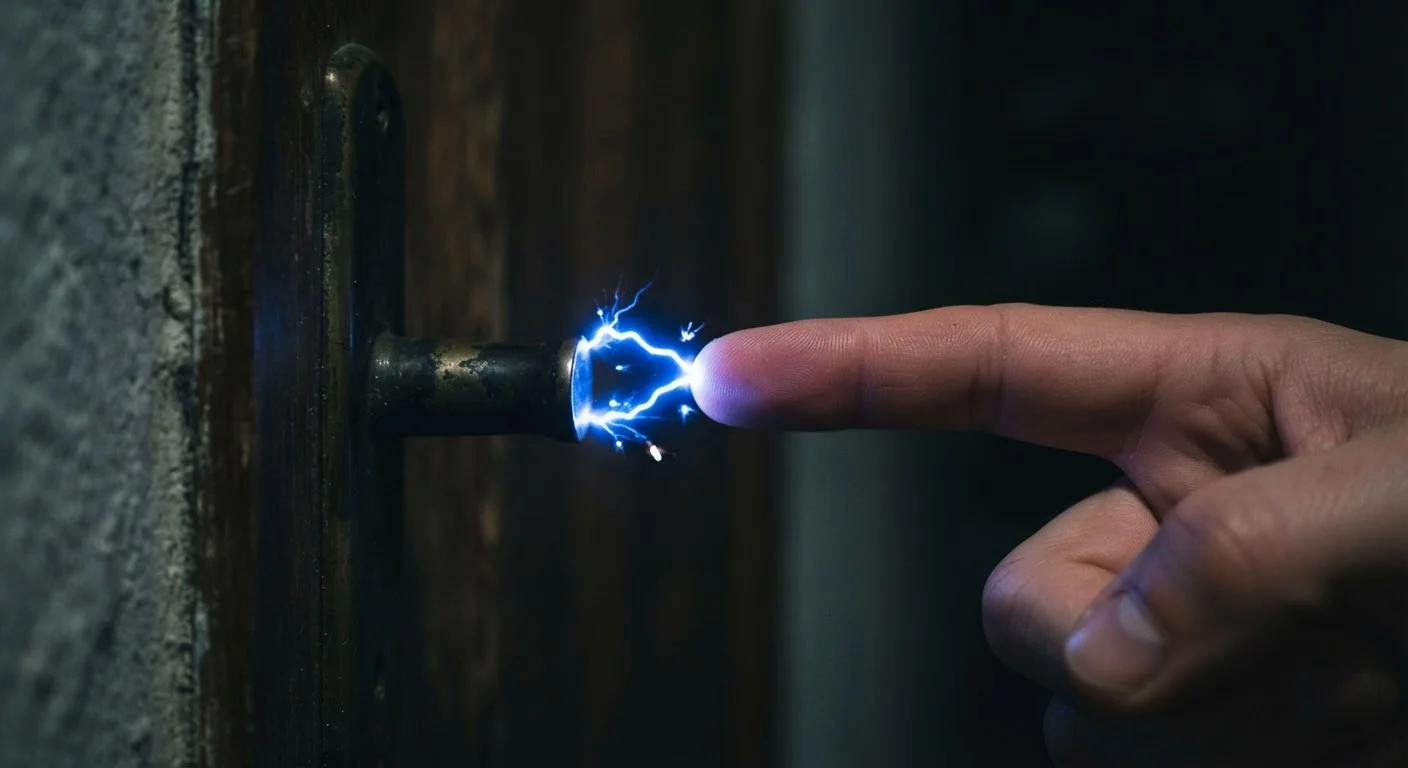
Shuffling across a carpet in socks is a textbook example. Your body accumulates thousands of volts of charge. Touch a grounded metal surface, and the charge equalizes instantly. That equalization is the shock.
The Triboelectric Series Explained
Materials can be ranked from those that strongly give up electrons (like human skin and glass) to those that strongly accept them (like Teflon and polyester). When two materials from opposite ends of this ranking touch and separate, the charge transfer is greatest. Knowing where common materials fall on this scale helps explain why some fabric combinations are far more prone to static than others.
Why Winter Air Makes It So Much Worse
Here is where seasonal weather enters the picture. Water molecules in humid air are polar - they have a slight charge distribution - and they make air a moderately decent conductor. When the air around you contains plenty of moisture, excess electrons bleed off surfaces continuously and harmlessly into the surrounding air before they have a chance to accumulate.
In winter, two things strip moisture from the air. First, cold air holds far less water vapor than warm air - a basic property of atmospheric physics. Second, indoor heating systems warm that already-dry air without adding any moisture back, pushing relative humidity in many homes below 20% in the coldest months. The result: charge has nowhere to escape. It keeps building on your clothing, skin, and furniture until something conductive finally gives it a path out.
10,000-25,000 V
Voltage in a typical winter static shock
Despite the high voltage, the current is so small (measured in microamperes) and duration so brief that it poses no meaningful health risk to healthy individuals.
Below 20%
Typical indoor winter relative humidity
According to the American Society of Heating, Refrigerating and Air-Conditioning Engineers (ASHRAE), relative humidity in heated buildings commonly drops to this range during cold months, eliminating the air's ability to dissipate charge.
100 V
Minimum discharge to damage semiconductor components
The U.S. military standard MIL-STD-1686 classifies components by ESD sensitivity - many modern chips can be damaged by discharges far too small for humans to perceive.
Summer humidity rarely allows this kind of buildup. The charge bleeds away as fast as it forms, and you never feel a thing.
Carpets, Synthetics, and the Perfect Storm
Modern homes are well-designed static generators. Wall-to-wall carpeting - especially nylon carpet - pairs with rubber-soled shoes to create significant charge on every step. Synthetic fabrics like polyester and fleece rank high on the triboelectric series, meaning they exchange electrons aggressively with skin and other materials. Even pulling a fleece blanket off a polyester couch can generate a visible spark in a dark room.
The combination - dry heated air, synthetic textiles, and insulating rubber footwear - creates conditions where charge builds rapidly and has no route to escape. Walk to the light switch, reach out, and physics does the rest.
Practical Ways to Reduce Winter Shocks
Understanding the mechanism points directly to solutions. Because humidity is the key variable, running a humidifier to maintain indoor relative humidity between 40-50% addresses the root cause rather than the symptom. Most people notice a dramatic reduction in static events at that humidity level.
Beyond humidity, a few behavioral adjustments help. Wearing natural-fiber clothing - cotton and linen sit in the middle of the triboelectric series and generate far less charge than synthetics. Choosing leather-soled footwear over rubber allows charge to dissipate through the floor rather than accumulating in your body. If you know you're charged, touching a non-conductive surface first - a wooden desk, a painted wall - lets you discharge more slowly and painlessly before reaching for metal.
For electronics, the risks go beyond discomfort. A discharge you can barely detect is still enough to destroy a microprocessor. Store-bought anti-static wrist straps ground you to your workspace and are the standard protection when handling circuit boards or computer components.