
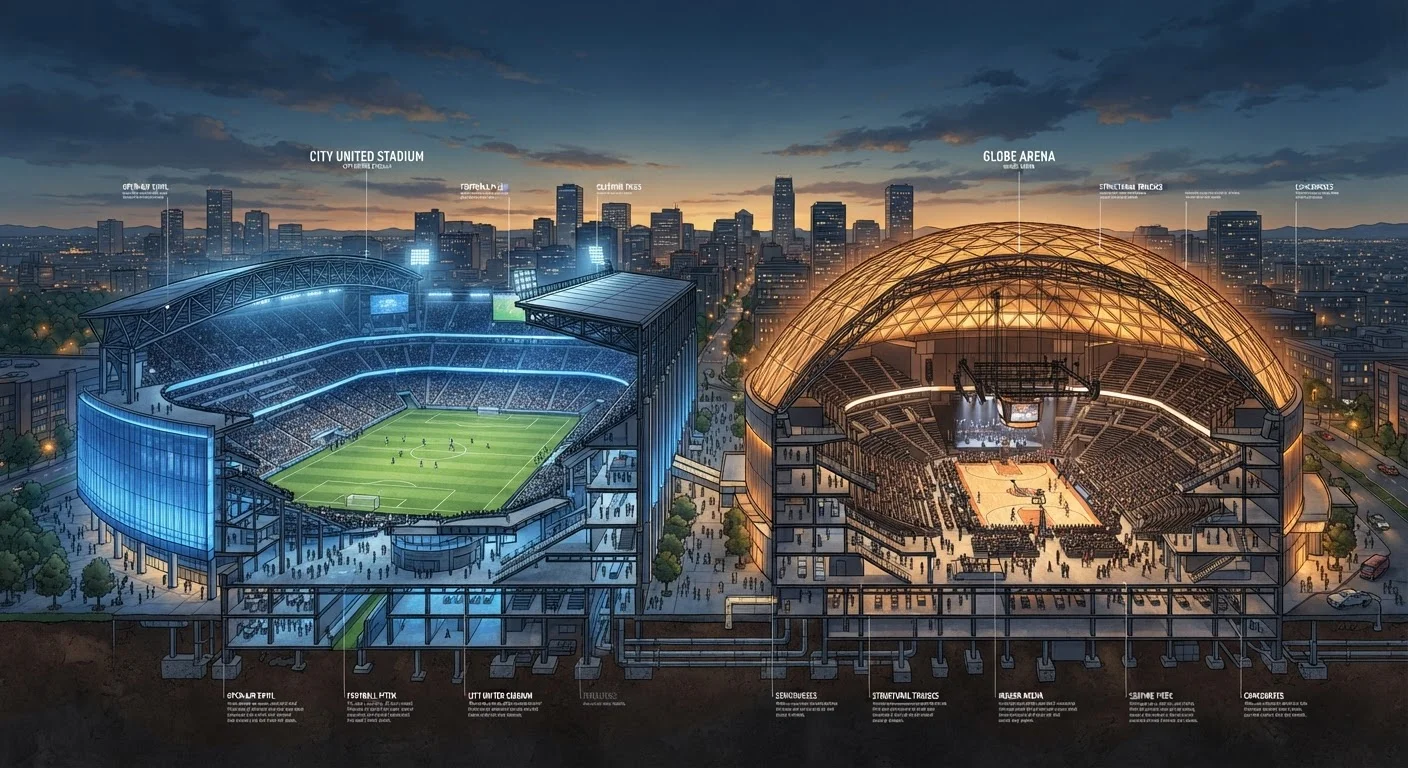
The Basic Physics: Sound Needs Somewhere to Go
Sound is mechanical energy - pressure waves rippling outward from a source in all directions. What happens to those waves after they leave the source depends almost entirely on the boundaries around them. In an open stadium, the sky is effectively a boundary that doesn't exist. Sound energy radiates upward and outward and simply keeps traveling until it dissipates. Physicists describe this as the inverse square law: every time you double the distance from a sound source, the intensity drops to one-quarter of its original level.
In a domed arena, those same waves hit walls, ceilings, and floors and bounce back. Each reflection carries energy back into the listening space, overlapping with the original sound and subsequent reflections. This phenomenon - reverberation - is the single biggest acoustic difference between the two venue types. A long reverberation time means sound lingers; a short one means it dies quickly. Open stadiums have extremely short reverberation times because there is no enclosing surface to sustain reflections.
| Criterion | Open Stadium | Domed Arena |
|---|---|---|
| Sound boundary | Open sky - no upper enclosure | Full or partial roof - enclosed |
| Reverberation time | Very short - sound escapes rapidly | Long - sound bounces and lingers |
| Primary acoustic challenge | Getting sound to reach distant fans | Controlling excessive reflections |
| Weather influence | High - wind, temperature, humidity matter | Minimal - climate-controlled interior |
| Perceived loudness | Drops sharply with distance | Sustained and amplified by reflections |
| Speech intelligibility | Generally clearer in most seats | Can be poor without acoustic treatment |
| Engineering focus | Canopies, distributed speakers | Absorptive baffles, asymmetric geometry |
Open Stadiums: Wind, Geometry, and the Vanishing Crowd Roar
Anyone who has sat in the upper deck of an open-air stadium knows the experience can be acoustically strange. The crowd below roars, yet the sound reaching your ears may feel thin, delayed, or inconsistent depending on where you sit. Several factors drive this.
Atmospheric effects play a major role outdoors. Temperature gradients - layers of warmer or cooler air at different altitudes - bend sound waves through a process called refraction. On a calm, cool evening, sound bends downward and can travel surprisingly far. On a hot afternoon with a strong crosswind, it scatters unpredictably. Wind itself carries sound waves faster in the direction it blows and slows them against it, creating asymmetric coverage across a stadium's seating bowl.
The geometry of the bowl matters too. Open stadiums often have large upper tiers designed to maximize sightlines, not acoustics. Overhanging canopies help by reflecting some sound back toward fans, but without a full enclosure, a significant fraction of acoustic energy still escapes skyward on every sound event. This is why a sold-out outdoor game can occasionally feel quieter than it looks on television.
Domed Arenas: Reverberation, Flutter Echo, and the Noise Problem
Step inside a domed arena and the acoustic environment shifts dramatically. Hard concrete, steel, and glass surfaces reflect sound with very little absorption. When tens of thousands of fans cheer simultaneously, those waves bounce around the interior in a dense, overlapping cascade. The result is a reverberation time - typically measured as RT60, the time for sound to decay by 60 decibels - that can stretch to several seconds in untreated venues.
This sustained energy is what gives domed arenas their reputation for deafening noise. Measurements at venues like CenturyLink Field (now Lumen Field) in Seattle - which features a partial roof - have recorded crowd noise exceeding 136 decibels during peak moments, rivaling the threshold of pain for human hearing. While not all domed arenas reach those extremes, the physics is consistent: containment multiplies perceived loudness far beyond what the raw crowd size alone would produce.
The downside is flutter echo - rapid, repetitive reflections between parallel hard surfaces that can make speech intelligibility nearly impossible. Public address systems in domed venues require careful acoustic engineering, including delay towers, directional speaker arrays, and sound-absorbing panels strategically placed to control excessive reverb without killing the crowd atmosphere that makes these venues exciting.
136 dB
Peak crowd noise recorded at a partially roofed NFL stadium
Measurements at Lumen Field in Seattle have documented crowd noise approaching or exceeding 136 decibels during peak moments - near the human pain threshold.
RT60
Standard measure of reverberation time in acoustic science
RT60 describes the time, in seconds, for a sound to decay by 60 decibels after the source stops - a key metric distinguishing open and enclosed venue acoustics.
~75%
Sound energy lost upward in typical open-air venues
Acoustic modeling studies estimate that a substantial majority of crowd sound energy in open stadiums escapes skyward rather than reaching other fans.
How Engineers Shape Sound in Both Venue Types
Acoustic engineers approach open and domed venues with fundamentally different toolkits. In open stadiums, the primary challenge is getting sound to fans rather than controlling too much of it. Canopies and overhanging roof structures act as partial reflectors, bouncing crowd and PA sound back into the bowl. Distributed speaker systems - placing smaller speakers closer to fans rather than relying on a few high-powered sources - reduce the inverse-square-law penalty and improve clarity across distant seating sections.
In domed arenas, the challenge reverses: engineers must tame the acoustic energy the enclosure naturally produces. Suspended acoustic baffles - large panels of absorptive material hung from the ceiling - reduce RT60 without compromising the visual spectacle. The geometry of the dome itself is carefully considered; a perfectly hemispherical dome creates a focusing effect, concentrating reflections at a central point on the floor. Modern domes are deliberately asymmetric or faceted to scatter sound more evenly.
Neither venue type achieves acoustic perfection, but that is arguably the point. The unpredictability of the open sky and the thunderous reverberation of a dome are part of what makes each experience viscerally distinct - and understanding the physics behind them makes the next game just a little more fascinating to attend.
Why TV Broadcasts Sound Different from Being There
Broadcast microphones placed at field level or in press boxes capture a narrow slice of a venue's full acoustic environment. They often miss the diffuse reverberation that makes a domed arena feel overwhelming in person, or the spatial openness of an outdoor stadium. Audio engineers apply post-processing to create a 'fuller' crowd sound for home viewers, which is why the same game can feel acoustically richer on screen than in certain seats inside the actual venue.